
Non-FictionInformativeEducational
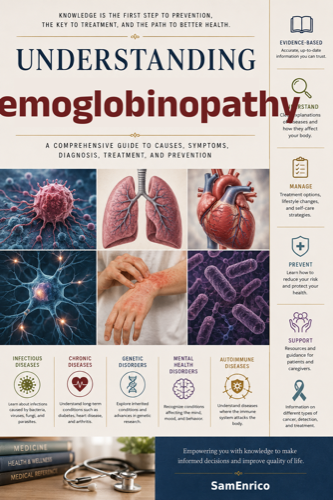
Understanding Hemoglobinopathy eBook
This disease publication, published by SamEnrico,
This disease publication, published by SamEnrico, covers Understanding Hemoglobinopathy
Formats
Free sample
Chapter 1: The Crimson Architect...--Hemoglobin is the most successful molecule you have never consciously met. Every second of every minute of every day, 25 trillion red blood cells in your circulation each carry approximately 270 million copies of this protein, and together they deliver oxygen from your lungs to every corner of your body with such flawless precision that you only notice the system when it breaks. When it breaks, the consequences are catastrophic. A single mutation in one gene out of twenty thousand can transform this elegant oxygen transporter into a molecular assassin, turning blood from a river of life into a river of sickled daggers or a trickle of empty, iron-starved husks. This chapter is about the architecture of that molecule—not as a dry biochemical diagram, but as a story of evolutionary compromise, developmental timing, and breathtaking vulnerability.
Understanding hemoglobinopathy begins with understanding hemoglobin itself, because every pain crisis in sickle cell disease, every transfusion-dependent night in thalassemia, and every gene therapy designed to cure these disorders traces back to the shape of one protein and the choreography of its four subunits.The structure of hemoglobin was solved in 1959 by Max Perutz, a feat that earned him the Nobel Prize and laid the foundation for molecular medicine. What Perutz saw under X-ray crystallography was a nearly spherical protein composed of four polypeptide chains, each cradling a flat heme group with a single iron atom at its center. That iron atom is the active site—the place where oxygen binds reversibly, ferried from the lungs to the tissues without ever breaking the chemical bonds that would create toxic free radicals. The four chains come in two flavors: two alpha-like chains and two beta-like chains. In adult hemoglobin, which comprises 98 percent of the hemoglobin in a healthy person over six months of age, the combination is alpha-2 and beta-2, written as α₂β₂.
This tetramer is not a rigid box but a breathing, cooperative machine. When oxygen binds to the first heme iron, it triggers a conformational shift that propagates through the protein, making it easier for oxygen to bind to the second, third, and fourth hemes. This cooperativity is why the oxygen-hemoglobin dissociation curve is sigmoidal rather than hyperbolic, and it is why a small drop in partial pressure of oxygen in the tissues causes a large release of oxygen exactly where it is needed. Without cooperativity, you would need three times as much hemoglobin to deliver the same amount of oxygen to your muscles during exercise. Evolution solved this problem not by making more hemoglobin, but by making smarter hemoglobin.The heme group itself is a marvel of coordination chemistry.
Protoporphyrin IX, a large ring-shaped organic molecule, chelates a single ferrous iron (Fe²⁺) at its center through four nitrogen atoms. The iron has six coordination sites: four are occupied by the porphyrin nitrogens, one is occupied by the proximal histidine of the globin chain (the eighth amino acid of the alpha chain, number 87 in the beta chain, known as F8 in the globin fold numbering), and the sixth site is reserved for molecular oxygen. That oxygen does not simply sit loosely; it forms a bent bond with the iron, stabilized by the distal histidine on the opposite side of the heme pocket. This arrangement ensures that oxygen binding is reversible. If the iron were to oxidize to the ferric state (Fe³⁺), it would form methemoglobin, which cannot bind oxygen and turns the blood a chocolate-brown color.
Normally, the red cell has enzymatic systems—cytochrome b5 reductase and NADH—to keep iron in the ferrous state. But when these systems fail, either genetically as in congenital methemoglobinemia (covered in Chapter 6) or oxidatively as in certain drug reactions, the patient presents with cyanosis unresponsive to supplemental oxygen because the problem is not oxygen availability but oxygen capture.The globin chains themselves are evolutionarily ancient. The ancestral globin gene duplicated and diverged hundreds of millions of years ago, producing the alpha and beta lineages that now reside on different chromosomes. The alpha globin gene cluster lives on the short arm of chromosome 16 (16p13.3), and in a twist of genetic generosity, it contains two nearly identical functional alpha globin genes—alpha-1 and alpha-2—arranged in tandem. Having two copies means that a single deletion still leaves one functional copy, which is why alpha thalassemia silent carrier states are so common and so benign.
The beta globin gene cluster lives on the short arm of chromosome 11 (11p15.4), and it contains only one functional beta globin gene. That asymmetry explains a fundamental clinical difference: alpha thalassemia severity scales with gene dosage from one deletion (silent carrier) to four deletions (hydrops fetalis, incompatible with life), while beta thalassemia severity scales with the type of mutation (β⁰ producing no beta globin, β⁺ producing reduced amounts) because there is no second copy to compensate.But the most remarkable feature of hemoglobin biology is not the adult molecule itself; it is the developmental progression that precedes it. The human fetus does not use adult hemoglobin. In the first weeks of embryonic life, the yolk sac produces hemoglobins Gower-1 (ζ₂ε₂), Gower-2 (α₂ε₂), and Portland (ζ₂γ₂). These embryonic hemoglobins have higher oxygen affinities than adult hemoglobin, which is appropriate for the low-oxygen environment of the early embryo.
By eight weeks of gestation, the site of erythropoiesis shifts to the fetal liver, and the switch to fetal hemoglobin (Hb F, α₂γ₂) occurs. Fetal hemoglobin has a higher oxygen affinity than adult hemoglobin because it binds 2,3-BPG less tightly. The gamma globin chain has a serine at position 143 instead of the histidine found in the beta chain, and that single amino acid difference reduces the positive charge that normally interacts with negatively charged 2,3-BPG. The result is that fetal hemoglobin pulls oxygen off maternal hemoglobin at the placenta, where maternal blood has already unloaded some oxygen, and delivers it to the fetal circulation. It is a beautiful example of molecular adaptation: the fetus creates a hemoglobin variant specifically designed to steal oxygen from its mother.The switch from fetal to adult hemoglobin begins shortly before birth and is largely complete by six months of age.
At term, cord blood contains approximately 60 to 80 percent Hb F and 20 to 40 percent Hb A. By six months, those numbers invert, with Hb F falling to less than 1 percent in most healthy individuals, though some people maintain low levels of Hb F throughout life due to genetic variation in the BCL11A gene. That residual Hb F turns out to be the single most important modifier of disease severity in sickle cell disease. Patients with sickle cell disease who maintain high Hb F levels have fewer pain crises, later onset of end-organ damage, and longer survival. The reason is simple: Hb F does not polymerize with Hb S.
It dilutes the concentration of sickle hemoglobin within the red cell and directly inhibits the fiber formation that causes sickling. This observation has driven decades of therapeutic development, from hydroxyurea (which induces Hb F pharmacologically, covered in Chapter 9) to CRISPR-based gene editing that disrupts the BCL11A enhancer to reactivate fetal hemoglobin production in adults (covered in Chapter 10).The oxygen-hemoglobin dissociation curve deserves extended attention because it is the functional output of everything described above. Plot oxygen saturation…
This is the end of the free sample. Get the eBook to keep going. Buy now
About this book
Details
- Author
- Whittaker Luis
- Publisher
- SamEnrico
- Language
- English
- Genre
- Non-Fiction, Informative, Educational
- Released
- 2026-05-07
- Pages (approx.)
- 150
- Available as
- eBook, Audiobook

Read better in the ZLOADR app
Your eBooks on your phone or tablet. Sign in with your SamEnrico account and start reading.
More by Whittaker Luis
 Self Esteem And Relationship AnxietyWhittaker Luis$11.99
 Purpose Challenge GuideWhittaker Luis$11.99
 Gamblers Anonymous Companion GuideWhittaker Luis$11.99
 The MBSR for Athletes GuideWhittaker Luis$11.99
 Whispers in the Empty Quarter: The Djinn of the Lost CaravanWhittaker Luis$11.99
 Paddling into the Unknown: The Forgotten Canoe Expeditions of Southeast AsiaWhittaker Luis$11.99
 Physics Chemistry Math JEE WorkbookWhittaker Luis$12.99
 Direct to Consumer Brand OutlookWhittaker Luis$12.99
 Measurement TechnicianWhittaker Luis$11.99
 How to Become a Seam SteamerWhittaker Luis$11.99
You may also like
 Hong Kong Handover 1997Dunn Johnnie$11.99
 Zumba For Postnatal Recovery CourseNeal Christian$11.99
 Zumba for BeginnersLadner Nikia$11.99
 YouTube Comment Mining GuideHumes Pandora$12.99
 Worry Box MeditationCarlin Rudy$11.99
 Workplace Stress MeditationNguyen Lynn$11.99
 Workplace Stress and Sleep RepairHawley Ivory$11.99
 Workplace Perfectionism CureDelaney Jeffry$11.99
 Workplace Injustice Anger GuideWallen Isabelle$11.99
 Work Addiction and Burnout LinkGreenwood Ester$11.99
 Women in Yoga and WellnessBeattie Galina$11.99
 Women in Stand Up ComedyChun Evangeline$11.99