
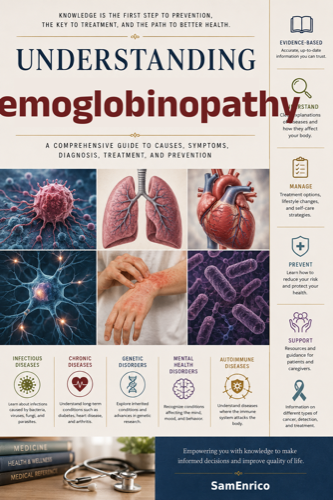
Non-FictionInformativeEducational
Understanding Hemoglobinopathy Audiobook
This disease publication, published by SamEnrico,
This disease publication, published by SamEnrico, covers Understanding Hemoglobinopathy
Formats
Free sample
Chapter 1: The Crimson Architect...--Hemoglobin is the most successful molecule you have never consciously met. Every second of every minute of every day, 25 trillion red blood cells in your circulation each carry approximately 270 million copies of this protein, and together they deliver oxygen from your lungs to every corner of your body with such flawless precision that you only notice the system when it breaks. When it breaks, the consequences are catastrophic. A single mutation in one gene out of twenty thousand can transform this elegant oxygen transporter into a molecular assassin, turning blood from a river of life into a river of sickled daggers or a trickle of empty, iron-starved husks. This chapter is about the architecture of that molecule—not as a dry biochemical diagram, but as a story of evolutionary compromise, developmental timing, and breathtaking vulnerability.
Understanding hemoglobinopathy begins with understanding hemoglobin itself, because every pain crisis in sickle cell disease, every transfusion-dependent night in thalassemia, and every gene therapy designed to cure these disorders traces back to the shape of one protein and the choreography of its four subunits.The structure of hemoglobin was solved in 1959 by Max Perutz, a feat that earned him the Nobel Prize and laid the foundation for molecular medicine. What Perutz saw under X-ray crystallography was a nearly spherical protein composed of four polypeptide chains, each cradling a flat heme group with a single iron atom at its center. That iron atom is the active site—the place where oxygen binds reversibly, ferried from the lungs to the tissues without ever breaking the chemical bonds that would create toxic free radicals. The four chains come in two flavors: two alpha-like chains and two beta-like chains. In adult hemoglobin, which comprises 98 percent of the hemoglobin in a healthy person over six months of age, the combination is alpha-2 and beta-2, written as α₂β₂.
This tetramer is not a rigid box but a breathing, cooperative machine. When oxygen binds to the first heme iron, it triggers a conformational shift that propagates through the protein, making it easier for oxygen to bind to the second, third, and fourth hemes. This cooperativity is why the oxygen-hemoglobin dissociation curve is sigmoidal rather than hyperbolic, and it is why a small drop in partial pressure of oxygen in the tissues causes a large release of oxygen exactly where it is needed. Without cooperativity, you would need three times…
This is the end of the free sample. Get the Audiobook to keep going. Buy now
About this book
Details
- Author
- Whittaker Luis
- Publisher
- SamEnrico
- Language
- English
- Genre
- Non-Fiction, Informative, Educational
- Released
- 2026-05-07
- Pages (approx.)
- 150
- Available as
- eBook, Audiobook

Listen in the VoxFlicks app
Audiobooks and audio dramas wherever you go. Sign in with your SamEnrico account and press play.
More by Whittaker Luis
 Self Esteem And Relationship AnxietyWhittaker Luis$11.99
 Purpose Challenge GuideWhittaker Luis$11.99
 Gamblers Anonymous Companion GuideWhittaker Luis$11.99
 The MBSR for Athletes GuideWhittaker Luis$11.99
 Whispers in the Empty Quarter: The Djinn of the Lost CaravanWhittaker Luis$11.99
 Paddling into the Unknown: The Forgotten Canoe Expeditions of Southeast AsiaWhittaker Luis$11.99
 Physics Chemistry Math JEE WorkbookWhittaker Luis$12.99
 Direct to Consumer Brand OutlookWhittaker Luis$12.99
 Measurement TechnicianWhittaker Luis$11.99
 How to Become a Seam SteamerWhittaker Luis$11.99
You may also like
 Hong Kong Handover 1997Dunn Johnnie$11.99
 Zumba For Postnatal Recovery CourseNeal Christian$11.99
 Zumba for BeginnersLadner Nikia$11.99
 YouTube Comment Mining GuideHumes Pandora$12.99
 Worry Box MeditationCarlin Rudy$11.99
 Workplace Stress MeditationNguyen Lynn$11.99
 Workplace Stress and Sleep RepairHawley Ivory$11.99
 Workplace Perfectionism CureDelaney Jeffry$11.99
 Workplace Injustice Anger GuideWallen Isabelle$11.99
 Work Addiction and Burnout LinkGreenwood Ester$11.99
 Women in Yoga and WellnessBeattie Galina$11.99
 Women in Stand Up ComedyChun Evangeline$11.99