
Non-FictionInformativeEducational
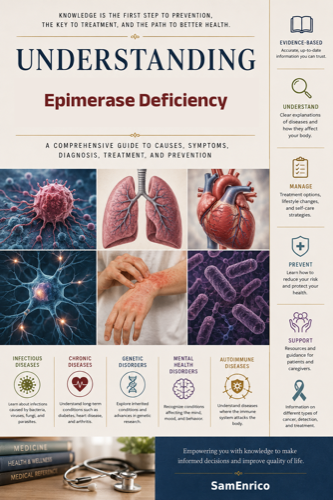
Understanding Epimerase Deficiency eBook
This disease publication, published by SamEnrico,
This disease publication, published by SamEnrico, covers Understanding Epimerase Deficiency
Formats
Free sample
Chapter 1: The Sugar Trap...--The most dangerous foods are often the ones we trust the most. A new parent does not fear the bottle of warm milk they offer their newborn. They fear car seats, choking hazards, and fevers in the night. They do not fear the very substance that has sustained mammalian life for two hundred million years. Yet for approximately one in every fifty thousand to one hundred thousand infants worldwide, that milk is a slow poison.
And for a smaller subset—those born with epimerase deficiency—the situation is even more insidious. Their bodies cannot process the simple sugar galactose, one of the two building blocks of lactose. But unlike patients with the more common classic galactosemia, they also cannot survive on a diet completely free of that same sugar. They are trapped. Give them milk, and they become desperately ill.
Give them no galactose at all, and a different kind of crisis emerges—one that clinicians often fail to recognize because it looks nothing like the classic disease.This is the sugar trap. Understanding its mechanism requires a journey into the microscopic machinery of human metabolism, a world of enzymes and substrates where one broken gear can bring an entire factory to a halt. But unlike a mechanical factory, the human body is adaptable. It has redundancies, workarounds, and surprising sources of resilience. In epimerase deficiency, those workarounds are both the key to survival and the source of the disorder’s most confusing feature: its astonishing variability from one patient to the next.The Leloir Pathway: Nature’s Galactose Recycling Plant To understand epimerase deficiency, you must first understand how healthy cells handle galactose.
Unlike glucose—the body’s primary fuel, which can enter the energy-production pathway directly—galactose requires a conversion process. This process is called the Leloir pathway, named after the Argentine biochemist Luis Leloir, who pieced it together in the 1950s and 1960s. Leloir’s work was so fundamental that he received the Nobel Prize in Chemistry in 1970. Yet despite its elegance, the pathway he discovered is surprisingly fragile. It depends on three enzymes working in precise sequence, and a defect in any one of them produces a different form of galactosemia.The first enzyme in the pathway is galactokinase, abbreviated GALK.
When galactose enters a cell—usually a liver cell, since the liver is the body’s primary metabolic clearinghouse—GALK attaches a phosphate group to it. This chemical tag creates galactose-1-phosphate, a molecule that cannot easily escape back into the bloodstream. The cell has effectively captured the galactose and committed it to processing. Deficiency of GALK causes a mild form of galactosemia (Type II), characterized primarily by cataracts. It is rarely life-threatening because the downstream parts of the pathway remain functional.The second enzyme is galactose-1-phosphate uridylyltransferase, abbreviated GALT.
This enzyme performs a molecular swap meet. It takes the galactose-1-phosphate produced by GALK and exchanges its phosphate group for a much larger and more complex structure called a uridine diphosphate (UDP) group. The donor of the UDP group is a molecule called UDP-glucose, which releases its UDP to become plain glucose-1-phosphate. The product is UDP-galactose. GALT deficiency causes classic galactosemia (Type I), the most common and most severe form.
Without functional GALT, galactose-1-phosphate accumulates to toxic levels, damaging the liver, kidneys, and brain. This is the form that most physicians learn about in medical school: the infant who feeds poorly, becomes jaundiced, develops E. coli sepsis, and dies if not immediately switched to a soy-based formula.The third enzyme is UDP-galactose-4-epimerase, abbreviated GALE. This is the enzyme at the center of this book. GALE performs a seemingly simple chemical operation: it converts UDP-galactose back into UDP-glucose.
This completes the cycle. UDP-glucose can again donate its UDP group to another molecule of galactose-1-phosphate, and the process repeats. If GALE is deficient, UDP-galactose accumulates, and UDP-glucose becomes depleted. The cycle stalls. But unlike GALK and GALT deficiency, where the problem is purely one of toxic accumulation, GALE deficiency creates a second problem: the cell runs out of UDP-glucose for other essential functions.This dual problem is the key to understanding everything that follows.
UDP-glucose and UDP-galactose are not merely intermediates in galactose metabolism. They are the raw materials for a process called glycosylation—the attachment of sugar chains to proteins and fats. These sugar chains, known as glycans, are essential for countless biological functions. They help proteins fold correctly. They determine where proteins go within the cell.
They serve as recognition markers for the immune system. They form the protective coating on the surface of every cell in the body. Without adequate UDP-glucose and UDP-galactose, glycosylation falters. Proteins that should be coated with sugar chains are left bare. Cells lose their ability to communicate with one another.
The immune system misidentifies its own tissues. And in the developing brain, where glycosylation is particularly active, the consequences can be profound and permanent.The Two Poison Problem Every inborn error of metabolism presents a paradox: the body is simultaneously starved of something it needs and poisoned by something it cannot eliminate. In classic galactosemia, the poison is galactose-1-phosphate, and the deficiency is of glucose-1-phosphate (which the body can obtain from other sources, like glucose itself). Removing galactose from the diet solves both problems. In epimerase deficiency, removing galactose solves the toxicity problem—galactose-1-phosphate levels fall rapidly—but it worsens the deficiency problem.
Without dietary galactose, the production of UDP-galactose from UDP-glucose (the GALE reaction) slows dramatically. The cell must now rely on other pathways to maintain UDP-galactose pools, and those pathways are insufficient.This creates a Goldilocks problem. Too much galactose, and the patient suffers from galactose-1-phosphate toxicity. Too little galactose, and the patient suffers from UDP-galactose deficiency and impaired glycosylation. Just the right amount of galactose—not too much, not too little—keeps both problems in check.
But what is the right amount? It varies from patient to patient, depending on their residual GALE activity. A patient with the peripheral form of the disease (where GALE is deficient only in red blood cells) can handle a normal diet without difficulty. A patient with the generalized form (where GALE is deficient in all cells) requires strict dietary restriction of lactose but must still consume trace amounts of galactose from fruits, vegetables, or soy formula. A patient with the intermediate form (where GALE activity is reduced but not absent in most cells) falls somewhere in between.This variability has been recognized for decades, but it was not until 2006 that a landmark study by Kimberly Openo and her colleagues provided the framework for understanding it.
Openo’s team measured GALE activity not just in red blood cells but in multiple tissue types from the same patients: red blood cells, white blood cells (lymphocytes), and skin cells (fibroblasts). They found that the degree of deficiency varied dramatically across tissues. Some patients had severe deficiency in red blood cells but normal activity in fibroblasts—these were the patients with the benign peripheral form. Others had severe deficiency in all cell types—the generalized form. But there was a third group: patients with deficiency in red blood cells and reduced activity in…
This is the end of the free sample. Get the eBook to keep going. Buy now
About this book
Details
- Author
- Mcdaniel Andrea
- Publisher
- SamEnrico
- Language
- English
- Genre
- Non-Fiction, Informative, Educational
- Released
- 2026-05-11
- Pages (approx.)
- 158
- Available as
- eBook, Audiobook

Read better in the ZLOADR app
Your eBooks on your phone or tablet. Sign in with your SamEnrico account and start reading.
More by Mcdaniel Andrea
 Email Segmentation Strategy GuideMcdaniel Andrea$11.99
 B Vitamin Complex HandbookMcdaniel Andrea$11.99
 Number Rhyme Peg System GuideMcdaniel Andrea$11.99
 Self Hypnosis For Dental Anxiety WorkbookMcdaniel Andrea$11.99
 Remote Knowledge Transfer GuideMcdaniel Andrea$11.99
 Whispers in the Wind: The Forgotten Accuser of SalemMcdaniel Andrea$11.99
 Harvard Extension vs LSE Recommendation LettersMcdaniel Andrea$12.99
 House Sitting Community GroupMcdaniel Andrea$12.99
 LacrosseMcdaniel Andrea$11.99
 Ultimate Handbook Guide to San Jose : (United States) Travel GuideMcdaniel Andrea$11.99
You may also like
 Hong Kong Handover 1997Dunn Johnnie$11.99
 Zumba For Postnatal Recovery CourseNeal Christian$11.99
 Zumba for BeginnersLadner Nikia$11.99
 YouTube Comment Mining GuideHumes Pandora$12.99
 Worry Box MeditationCarlin Rudy$11.99
 Workplace Stress MeditationNguyen Lynn$11.99
 Workplace Stress and Sleep RepairHawley Ivory$11.99
 Workplace Perfectionism CureDelaney Jeffry$11.99
 Workplace Injustice Anger GuideWallen Isabelle$11.99
 Work Addiction and Burnout LinkGreenwood Ester$11.99
 Women in Yoga and WellnessBeattie Galina$11.99
 Women in Stand Up ComedyChun Evangeline$11.99