
Non-FictionInformativeEducational
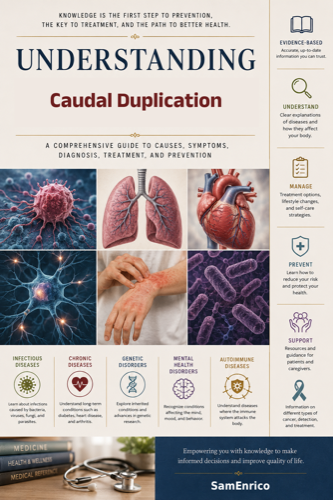
Understanding Caudal Duplication eBook
This disease publication, published by SamEnrico,
This disease publication, published by SamEnrico, covers Understanding Caudal Duplication
Formats
Free sample
Chapter 1: The Stranger Inside...--–- Every parent remembers the exact moment their world tilted. For some, it came during the quiet hum of a 20-week ultrasound, when the technician's cheerful small talk evaporated into silence. For others, it arrived with the first cry in a delivery room, as the obstetrician's practiced hands hesitated. And for a rare few—those whose duplications remained hidden for decades—it came in an emergency room or a fertility clinic, delivered by a radiologist pointing to a screen and saying, "Have you always known you had two of those?"This book is for all of them. For the mother who cannot stop replaying that ultrasound in her mind.
For the father who has memorized more medical terminology in six months than he learned in twelve years of school. For the adult who just discovered, at age forty-seven, that her body has kept a secret from her since before she was born. And for the surgeons, nurses, therapists, and friends who walk alongside them.This is a book about Caudal Duplication Syndrome—a condition so rare that most doctors will never encounter a single case in their entire careers. But more than that, it is a book about what happens when the elegant blueprint of human development takes an unexpected turn, producing bodies that are not less than typical, but more. More organs.
More structures. More questions. And, as the families in these pages will attest, often more love, more resilience, and more profound insight into what it means to be human.Before we go any further, let me tell you what this book is not. It is not a dry medical textbook filled with jargon that requires a degree to decode. It is not a collection of terrifying worst-case scenarios designed to keep you awake at night.
And it is not a prescriptive manual that claims there is only one right way to navigate this journey.What this book is, instead, is a companion. It is the friend who sits beside you in the hospital waiting room, translating the complex into the understandable. It is the voice that says, "You are not alone," and means it, because the pages that follow are filled with the stories of people who have walked this path before you. It is the practical guide that helps you ask the right questions, build the right team, and make the right decisions for your unique situation—because if there is one thing everyone with Caudal Duplication Syndrome shares, it is that no two cases are exactly alike.The Spectrum of Surprise: What Caudal Duplication Actually Means Let us begin with the most basic question: What is Caudal Duplication Syndrome?The word "caudal" comes from the Latin cauda, meaning tail. In embryology, it refers to the lower end of the developing human—the region that will become the pelvis, the lower spine, the bladder, the rectum, and the reproductive organs.
"Duplication" means exactly what it sounds like: instead of forming a single structure, the body forms two. Or, in some cases, two of almost everything.Caudal Duplication Syndrome, then, is a rare congenital condition in which the structures derived from the embryonic caudal region are partially or completely duplicated. A child with CDS might be born with two colons instead of one. Two bladders. Two uteri.
Two vaginas. Two penises. A spinal cord that splits into two separate cords. Or any combination of these duplications, in any degree of completeness.But here is where it gets complicated—and where most books get it wrong. CDS is not a single, uniform condition.
It is a spectrum disorder, meaning that the presentation ranges from so subtle that it is never noticed, to so complex that it requires dozens of surgeries over a lifetime.Consider the mild end of the spectrum. There are documented cases of adults who lived their entire lives with a duplicated appendix, discovered only during an unrelated surgery for appendicitis. "You had two?" the surgeon said afterward, and the patient shrugged, because they had never known anything different. There are women who discover they have two uteruses only when they become pregnant—or, in some remarkable cases, when they become pregnant in both uteruses at the same time. There are men who learn in middle age that they have two urethras, a finding that explains a lifetime of minor urinary quirks but nothing more.At the more complex end of the spectrum, the duplications are impossible to ignore.
A child might be born with two complete colons, each opening into a separate anus, or with a single anus that is imperforate—meaning it does not open at all, a surgical emergency. The bladder might be duplicated, each with its own ureters draining from the kidneys, making normal toilet training impossible without surgical intervention. The spinal cord might be split, leading to progressive neurologic loss if not surgically addressed. The external genitalia might be duplicated, presenting parents and surgeons with profound decisions about reconstruction, function, and quality of life.And then there is everything in between. A child with a duplicated colon but a single bladder.
A child with a duplicated bladder but a single uterus. A child with a tethered cord but no other duplications. The permutations are almost endless, which is why any book that claims to have all the answers is selling you a lie. What this book offers instead is a framework—a way of thinking about CDS that honors its complexity while providing practical, actionable guidance.A Brief History: How Doctors Learned to See Duplication The first recorded cases of what we now call Caudal Duplication Syndrome appeared in the medical literature in the mid-nineteenth century. These early reports were often titled something like "Case of a Female Child with Two Vaginas and Two Uteri" or "Description of an Infant with Complete Duplication of the Lower Colon." They were curiosities, published in medical journals alongside reports of two-headed calves and conjoined twins.
No one understood why these duplications happened. No one knew how common they were. And no one had any idea how to treat them.Through the twentieth century, as surgical techniques improved and imaging technologies advanced, doctors began to recognize that these duplications were not random anomalies but followed recognizable patterns. In the 1960s and 1970s, researchers noticed that certain duplications tended to occur together—colonic and bladder duplications, for example, or uterine and vaginal duplications. This clustering suggested a common underlying cause, something that went wrong during a specific window of embryonic development.The modern classification system for CDS emerged in the 1990s and early 2000s, thanks largely to the work of pediatric surgeons and radiologists who pooled their cases across institutions.
Because no single hospital sees enough CDS patients to draw meaningful conclusions, these collaborative efforts were essential. They established that CDS is distinct from Caudal Regression Syndrome (where structures fail to form rather than duplicate) and from conjoined twinning (where two separate individuals remain attached). They also established that CDS is truly rare: fewer than one in every 100,000 live births.Today, the medical community understands CDS as a primary developmental field defect—a mouthful of jargon that simply means something went wrong…
This is the end of the free sample. Get the eBook to keep going. Buy now
About this book
Details
- Author
- Fairley Ileen
- Publisher
- SamEnrico
- Language
- English
- Genre
- Non-Fiction, Informative, Educational
- Released
- 2026-05-11
- Pages (approx.)
- 157
- Available as
- eBook, Audiobook

Read better in the ZLOADR app
Your eBooks on your phone or tablet. Sign in with your SamEnrico account and start reading.
More by Fairley Ileen
 LBO Industrial Sector GuideFairley Ileen$11.99
 Bariatric Surgery Facebook Community GuideFairley Ileen$11.99
 Multiplayer Game Toxicity Addiction CourseFairley Ileen$11.99
 Debt Covenants DatabaseFairley Ileen$11.99
 FODMAP Certified Products GuideFairley Ileen$11.99
 The Last Transmission: How a Pirate Broadcast Outlasted the Cold WarFairley Ileen$11.99
 The Last Stand of the Zambezi: Livingstone’s Miracle SurvivalFairley Ileen$11.99
 Clinical Operations LeadFairley Ileen$11.99
 How to Become a Mobile-home-lot Utility WorkerFairley Ileen$11.99
 Proposal Word Count ReductionFairley Ileen$12.99
 AI Financial Commentary GenerationFairley Ileen$12.99
You may also like
 Hong Kong Handover 1997Dunn Johnnie$11.99
 Zumba For Postnatal Recovery CourseNeal Christian$11.99
 Zumba for BeginnersLadner Nikia$11.99
 YouTube Comment Mining GuideHumes Pandora$12.99
 Worry Box MeditationCarlin Rudy$11.99
 Workplace Stress MeditationNguyen Lynn$11.99
 Workplace Stress and Sleep RepairHawley Ivory$11.99
 Workplace Perfectionism CureDelaney Jeffry$11.99
 Workplace Injustice Anger GuideWallen Isabelle$11.99
 Work Addiction and Burnout LinkGreenwood Ester$11.99
 Women in Yoga and WellnessBeattie Galina$11.99
 Women in Stand Up ComedyChun Evangeline$11.99