
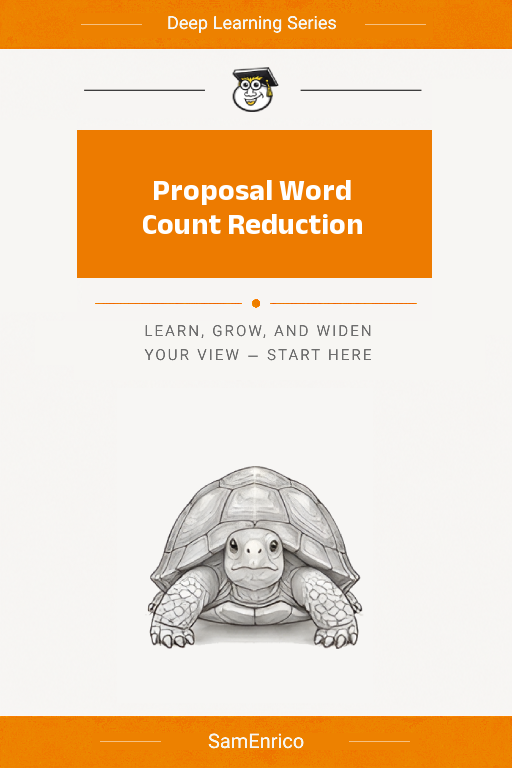
Proposal Word Count Reduction
Cut word count from research proposals without los
Cut word count from research proposals without losing meaning using tight editing and redundancy elimination.
Formats
About this book
Free sample
Chapter 1: The Ten-Thousand Dollar Word--–- The first time Maria lost a grant, she blamed the reviewers. The second time, she blamed the weather on submission day. The third time, she printed the 47-page rejection, walked to her office door, and very calmly taped it to the frame. Then she sat down and read every word of her own proposal for the first time as if she were a stranger.What she found made her want to tape the proposal to the door instead.Page after page of perfectly respectable, meticulously cited, entirely forgettable prose. Sentences that took scenic detours through clauses they did not need.
Paragraphs that said the same thing three times because saying it once felt too abrupt. A literature review that cited thirty-seven papers to prove a point that any first-year graduate student would have accepted without citation. Her specific aims—the heart of the proposal—buried on page four, after three pages of throat-clearing about the history of the field.Maria had spent six weeks writing that proposal. She had polished every sentence, checked every citation, aligned every margin. She had done everything her advisors taught her.
And she had lost, by her calculation, roughly $450,000 in direct costs.The winning proposal, she later learned from a program officer, was two pages shorter. Not better science. Not a more famous PI. Just shorter. Cleaner.
Easier to read at 9:47 PM on a Tuesday when the reviewer had already read eleven other proposals and had a headache.That is what this chapter is about. Not grammar. Not style. Not the passive voice. Those come later.
This chapter is about a single, uncomfortable, liberating truth: your proposal is almost certainly 30 to 40 percent longer than it needs to be, and that extra length is not harmless padding. It is actively hurting your chances of funding.The Fatal Assumption Let us name the enemy.Most academics write proposals under what this book will call the Fatal Assumption. The Fatal Assumption sounds reasonable, even generous. It sounds like this: Reviewers need me to explain everything thoroughly. They do not know my field…
This is the end of the free sample. Get the eBook to keep going. Buy now
Contents
- Chapter 1
- Chapter 2
- Chapter 3
- Chapter 4
- Chapter 5
- Chapter 6
- Chapter 7
- Chapter 8
- Chapter 9
- Chapter 10
- Chapter 11
- Chapter 12
Details
- Author
- Fairley Ileen
- Publisher
- SamEnrico
- Language
- English
- Genre
- Non-Fiction, Student's Shortcut, Editing Guide, Concision
- Released
- 2026-06-01
- Pages (approx.)
- 151
- Available as
- eBook, Audiobook

Read better in the ZLOADR app
Your eBooks on your phone or tablet. Sign in with your SamEnrico account and start reading.
More by Fairley Ileen
 LBO Industrial Sector GuideFairley Ileen$11.99
 Bariatric Surgery Facebook Community GuideFairley Ileen$11.99
 Multiplayer Game Toxicity Addiction CourseFairley Ileen$11.99
 Debt Covenants DatabaseFairley Ileen$11.99
 FODMAP Certified Products GuideFairley Ileen$11.99
 The Last Transmission: How a Pirate Broadcast Outlasted the Cold WarFairley Ileen$11.99
 The Last Stand of the Zambezi: Livingstone’s Miracle SurvivalFairley Ileen$11.99
 Clinical Operations LeadFairley Ileen$11.99
 How to Become a Mobile-home-lot Utility WorkerFairley Ileen$11.99
 AI Financial Commentary GenerationFairley Ileen$12.99
 Understanding Caudal DuplicationFairley Ileen$17.99