
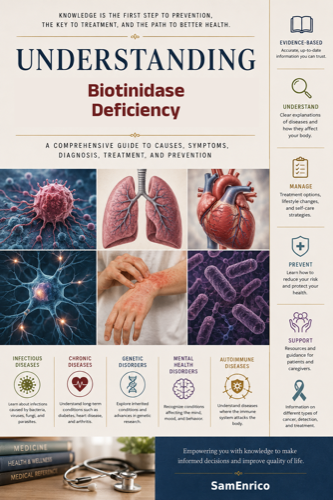
Non-FictionInformativeEducational
Understanding Biotinidase Deficiency
This disease publication, published by SamEnrico,
by Sapp Houston
This disease publication, published by SamEnrico, covers Understanding Biotinidase Deficiency
Formats
About this book
Free sample
Chapter 1: The Recycling Plant--– In a healthy newborn, trillions of microscopic machines hum along inside every cell, performing the millions of chemical reactions that keep a human being alive. These machines—called enzymes—break down food, build new tissues, generate energy, and dispose of waste. Most of them work silently, reliably, without ever demanding our attention. But one of these machines has a peculiar vulnerability. It depends entirely on a tiny, unassuming vitamin that most people have never heard of.
And when that vitamin runs out, the machines start to fail—not all at once, but one by one, like dominoes falling in slow motion.The story of biotinidase deficiency begins not with disease, but with a marvel of metabolic engineering. To understand what goes wrong, you first need to understand what goes right in the body of every healthy child. This chapter builds that foundation from the ground up, using no prior knowledge of biochemistry. By the end, you will understand not only the science behind this rare condition, but also why it has been called “the best-kept secret in newborn medicine”—a disease that is devastating when missed, yet almost trivially easy to treat when caught in time.The Vitamin You’ve Never Heard Of Biotin—also known as Vitamin B7 or, in older literature, Vitamin H (from the German Haar und Haut, meaning hair and skin)—is a water-soluble vitamin that belongs to the B-complex family. Unlike some vitamins that the human body can synthesize in small amounts (Vitamin D from sunlight, Vitamin K from gut bacteria), biotin cannot be made by human cells at all.
Every molecule of biotin your body ever uses must come from food.Fortunately, biotin is widely distributed in the foods people commonly eat. Egg yolks are among the richest sources, followed by liver, salmon, avocados, sweet potatoes, nuts, seeds, and certain vegetables like cauliflower and mushrooms. A typical Western diet provides between 35 and 70 micrograms of biotin per day—more than enough to meet the estimated adequate intake of 30 micrograms per day for adults and 5 to 20 micrograms per day…
This is the end of the free sample. Get the eBook to keep going. Buy now
Contents
- Chapter 1
- Chapter 2
- Chapter 3
- Chapter 4
- Chapter 5
- Chapter 6
- Chapter 7
- Chapter 8
- Chapter 9
- Chapter 10
- Chapter 11
- Chapter 12
Details
- Author
- Sapp Houston
- Publisher
- SamEnrico
- Language
- English
- Genre
- Non-Fiction, Informative, Educational
- Released
- 2026-05-18
- Pages (approx.)
- 156
- Available as
- eBook, Audiobook

Read better in the ZLOADR app
Your eBooks on your phone or tablet. Sign in with your SamEnrico account and start reading.
More by Sapp Houston
 Personal Ing For Success Target AudienceSapp Houston$11.99
 The Talent Migration Data HandbookSapp Houston$11.99
 Intuitive Eating For Bariatric Surgery GuideSapp Houston$11.99
 Opioid Rotation ProtocolSapp Houston$11.99
 The Food Pantry ChefSapp Houston$11.99
 The Arctic Exodus: The Great Snow Goose Migration MysterySapp Houston$11.99
 The Affair That Shook the Crown: Prince Andrew and the Epstein ScandalSapp Houston$11.99
 Distributing Profits to Foreign OwnersSapp Houston$12.99
 Degree In Progress Bootcamp ChoiceSapp Houston$12.99
 Security Operations AnalystSapp Houston$11.99
 How to Start a Poultry Grit Business (Beginners Guide)Sapp Houston$11.99
You may also like
 Hong Kong Handover 1997Dunn Johnnie$11.99
 Zumba For Postnatal Recovery CourseNeal Christian$11.99
 Zumba for BeginnersLadner Nikia$11.99
 YouTube Comment Mining GuideHumes Pandora$12.99
 Worry Box MeditationCarlin Rudy$11.99
 Workplace Stress MeditationNguyen Lynn$11.99
 Workplace Stress and Sleep RepairHawley Ivory$11.99
 Workplace Perfectionism CureDelaney Jeffry$11.99
 Workplace Injustice Anger GuideWallen Isabelle$11.99
 Work Addiction and Burnout LinkGreenwood Ester$11.99
 Women in Yoga and WellnessBeattie Galina$11.99
 Women in Stand Up ComedyChun Evangeline$11.99