
Non-FictionForecast & OutlookData Analytics
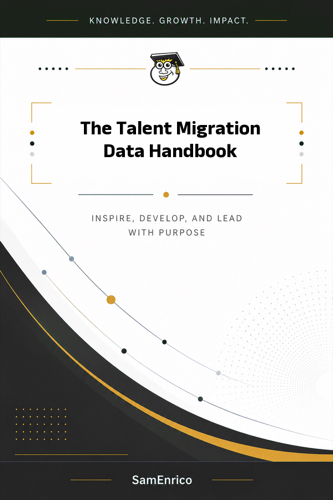
The Talent Migration Data Handbook
Use key metrics to forecast workforce movements fo
by Sapp Houston
Use key metrics to forecast workforce movements for planning.
Formats
About this book
Free sample
Chapter 1: The Silent Stampede--The email arrived at 11:47 on a Tuesday. Sarah Chen, Chief People Officer at a rapidly growing fintech company called Verge, opened it expecting the usual weekly operations update. Instead, she found a spreadsheet with forty-seven names. Forty-seven senior engineers, product managers, and data scientists—all remote employees based in the Austin, Texas area. All had submitted their resignations within a seventy-two-hour window.
No warning. No pattern. No precedent.By Friday afternoon, the number had grown to sixty-two.Verge lost nearly 40 percent of its remote engineering team in ninety days. The post-mortem analysis revealed something that kept Sarah awake for months afterward: a competitor had been quietly mapping Verge's attrition risks for nearly a year. They had built a model that predicted—with 83 percent accuracy—which Verge employees were most likely to leave, when they would leave, and what compensation package would pull them across.
While Sarah's team was conducting exit interviews and posting job requisitions, their competitor was already three moves ahead.This is not a story about bad leadership or toxic culture. Verge had competitive salaries, strong engagement scores, and a leadership team that genuinely cared. This is a story about a fundamental mismatch between how organizations have always planned for workforce changes and how talent actually moves in the modern economy. Verge was playing checkers. Their competitor was playing chess with real-time data.Welcome to the age of talent migration—where your best people are already packing, and you don't even know it yet.The Myth of the Static Workforce For most of corporate history, workforce planning followed a simple, intuitive model that we will call the "stock and flow" approach.
Think of your organization as a reservoir of talent. Employees enter through the intake valve (hiring). They exit through the outflow pipe (attrition, retirement, termination). The goal of workforce planning is to keep the reservoir at the right level by adjusting the intake valve whenever the outflow pipe opens a little wider. This model worked reasonably well when careers were linear, jobs were local, and employees changed employers every seven to ten years.That world…
This is the end of the free sample. Get the eBook to keep going. Buy now
Contents
- Chapter 1
- Chapter 2
- Chapter 3
- Chapter 4
- Chapter 5
- Chapter 6
- Chapter 7
- Chapter 8
- Chapter 9
- Chapter 10
- Chapter 11
- Chapter 12
Details
- Author
- Sapp Houston
- Publisher
- SamEnrico
- Language
- English
- Genre
- Non-Fiction, Forecast & Outlook, Data Analytics
- Released
- 2026-06-10
- Pages (approx.)
- 160
- Available as
- eBook, Audiobook

Read better in the ZLOADR app
Your eBooks on your phone or tablet. Sign in with your SamEnrico account and start reading.
More by Sapp Houston
 Personal Ing For Success Target AudienceSapp Houston$11.99
 Intuitive Eating For Bariatric Surgery GuideSapp Houston$11.99
 Opioid Rotation ProtocolSapp Houston$11.99
 The Food Pantry ChefSapp Houston$11.99
 The Arctic Exodus: The Great Snow Goose Migration MysterySapp Houston$11.99
 The Affair That Shook the Crown: Prince Andrew and the Epstein ScandalSapp Houston$11.99
 Distributing Profits to Foreign OwnersSapp Houston$12.99
 Degree In Progress Bootcamp ChoiceSapp Houston$12.99
 Understanding Biotinidase DeficiencySapp Houston$17.99
 Security Operations AnalystSapp Houston$11.99
 How to Start a Poultry Grit Business (Beginners Guide)Sapp Houston$11.99
You may also like
 Hong Kong Handover 1997Dunn Johnnie$11.99
 Zumba For Postnatal Recovery CourseNeal Christian$11.99
 Zumba for BeginnersLadner Nikia$11.99
 YouTube Comment Mining GuideHumes Pandora$12.99
 Worry Box MeditationCarlin Rudy$11.99
 Workplace Stress MeditationNguyen Lynn$11.99
 Workplace Stress and Sleep RepairHawley Ivory$11.99
 Workplace Perfectionism CureDelaney Jeffry$11.99
 Workplace Injustice Anger GuideWallen Isabelle$11.99
 Work Addiction and Burnout LinkGreenwood Ester$11.99
 Women in Yoga and WellnessBeattie Galina$11.99
 Women in Stand Up ComedyChun Evangeline$11.99