
Non-FictionInformativeEducational
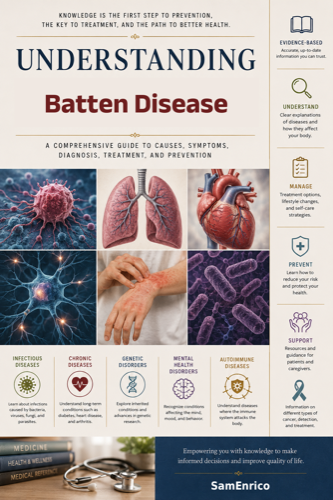
Understanding Batten Disease eBook
This disease publication, published by SamEnrico,
This disease publication, published by SamEnrico, covers Understanding Batten Disease
Formats
Free sample
Chapter 1: When Cells Cannot Clean...–- Inside every cell of the human body, a microscopic world of astonishing complexity operates with seamless precision. Mitochondria generate energy. Ribosomes assemble proteins. The nucleus stores genetic blueprints. And scattered throughout the cellular landscape, like thousands of tiny sanitation workers on an endless shift, are the lysosomes.
These membrane-bound compartments, numbering in the hundreds per cell, perform one of the most critical functions in all of biology: they break down waste. Every day, each of your trillions of cells produces cellular garbage—worn-out proteins, used-up organelles, foreign invaders that have been neutralized. The lysosomes digest this waste into raw materials that the cell can reuse. Without this recycling system, cells would choke on their own debris, swell with unprocessed garbage, and eventually die.This is precisely what happens in Batten disease. The lysosomes fail.
The waste accumulates. And the cells that suffer most are the ones we can least afford to lose: the neurons of the brain and the photoreceptors of the retina. The result is a relentless, irreversible neurodegenerative disorder that robs children of their sight, their mobility, their cognitive abilities, their very selves.Understanding Batten disease begins with understanding the lysosome. This chapter will take you on a journey into the cellular world—a world of enzymes, membranes, and molecular machines—to explain how a single genetic mutation can trigger a cascade of destruction. We will explore what lysosomes do, how they fail in Batten disease, what that failure looks like under a microscope, and how this cellular disaster translates into the clinical syndrome of progressive neurodegeneration.
By the end of this chapter, you will have a clear, foundational understanding of the science behind one of the most devastating neurological disorders affecting children worldwide.The Lysosome: Nature's Most Efficient Recycling Center The lysosome was discovered in 1955 by Belgian biochemist Christian de Duve, a discovery that would earn him the Nobel Prize in Physiology or Medicine nearly two decades later. Using a newly developed technique called cell fractionation, de Duve and his team spun broken-open cells in an ultracentrifuge, separating cellular components by their size and density. They noticed a mysterious fraction containing enzymes that could digest nearly any biological molecule—proteins, fats, carbohydrates, nucleic acids. But these enzymes were dangerous. If released into the cell, they would destroy it from within.
De Duve deduced that these enzymes must be enclosed within a protective membrane, sealed away until needed. He named these compartments "lysosomes," from the Greek words lysis (loosening, dissolving) and soma (body).Today, we know that every human cell contains between fifty and several hundred lysosomes, depending on the cell type. A lysosome is a spherical vesicle, approximately 0.1 to 1.2 micrometers in diameter—so small that hundreds could fit across the width of a human hair. Its interior is a hostile environment, maintained at a p H of approximately 4.5 to 5.0, about one hundred times more acidic than the neutral p H of the surrounding cytoplasm (7.2). This acidity is generated by proton pumps—protein machines embedded in the lysosomal membrane that actively pump hydrogen ions into the interior.Why such acidity?
The lysosome's digestive enzymes, known as acid hydrolases, require an acidic environment to function. These enzymes have evolved to work optimally at low p H, ensuring that if a lysosome ruptures and spills its contents into the cytoplasm (where the p H is neutral), the enzymes will be inactive and will not digest the cell from within. This is a brilliant design feature—a fail-safe built into the system.There are more than sixty different acid hydrolases, each specialized to break down a specific type of biological molecule:Proteases digest proteins into amino acids Lipases digest fats (lipids) into fatty acids and glycerol Nucleases digest DNA and RNA into nucleotides Glycosidases digest complex sugars (carbohydrates) into simple sugars Phosphatases remove phosphate groups from various molecules When a cell needs to dispose of waste, it delivers the material to a lysosome in one of three ways. Autophagy (literally "self-eating") is the process by which a cell surrounds its own damaged organelles or protein aggregates with a double membrane, forming an autophagosome that fuses with a lysosome for degradation. Endocytosis is the process by which a cell engulfs material from its external environment, bringing it into vesicles that mature into lysosomes.
And phagocytosis is the process by which specialized cells (such as immune cells) engulf large particles like bacteria or cellular debris.Once the waste is inside the lysosome, the acid hydrolases go to work, breaking down complex molecules into their building blocks. These building blocks—amino acids, fatty acids, sugars, nucleotides—are then transported back into the cytoplasm, where the cell can use them to build new proteins, membranes, and other structures. In this way, the lysosome is not merely a garbage disposal. It is a recycling center, breaking down the old to make way for the new.This recycling function is particularly important in neurons. Unlike skin cells or liver cells, which divide and replace themselves throughout life, most neurons are post-mitotic—they are born during development and never divide again.
A neuron that dies cannot be replaced. To survive for decades, neurons must maintain themselves meticulously, repairing damage and clearing waste continuously. They are more dependent on lysosomal function than almost any other cell type in the body.The Failure of Recycling: When Lysosomes Stop Working In Batten disease, the lysosomal recycling system fails catastrophically. The failure begins not in the lysosome itself but in the genes that encode its components. A child with Batten disease inherits mutations in one of fourteen different genes—CLN1 through CLN14—each of which provides instructions for building a protein essential for lysosomal function.
Some of these genes encode the acid hydrolase enzymes directly (CLN1, CLN2, CLN10, CLN13). Others encode proteins involved in lysosomal transport, membrane function, or the regulation of lysosomal p H.Regardless of which gene is affected, the result is the same: waste products accumulate within the lysosomes because the cellular machinery that should break them down is missing or defective. These waste products are known as lipopigments—complex molecules composed of fats (lipids) and proteins that have been incompletely digested. They are also called ceroid lipofuscin, a term that reflects their appearance under a microscope (ceroid meaning waxy, lipofuscin meaning fat pigment).The accumulation of lipopigments is not a rapid process. It occurs gradually over months to years, which is why children with Batten disease typically develop normally for a period of time before symptoms emerge.
The lysosomes fill up like garbage bins that are never emptied. As they swell with indigestible material, they enlarge, distorting the shape of the cell and interfering with its normal functions. Eventually, the affected cell swells, its internal signaling pathways become disrupted, and it undergoes programmed cell death—a process known as apoptosis.Why are neurons so vulnerable? Several factors contribute. First, neurons are long-lived and non-dividing, so they cannot dilute away accumulated waste through cell division.
Second, neurons have extremely high metabolic demands and produce large amounts of cellular waste that must be cleared. Third, neurons have limited capacity for lysosomal biogenesis—they cannot produce new lysosomes as quickly as other cell types. Fourth, neurons…
This is the end of the free sample. Get the eBook to keep going. Buy now
About this book
Details
- Author
- Rash Shawanna
- Publisher
- SamEnrico
- Language
- English
- Genre
- Non-Fiction, Informative, Educational
- Released
- 2026-05-08
- Pages (approx.)
- 133
- Available as
- eBook, Audiobook

Read better in the ZLOADR app
Your eBooks on your phone or tablet. Sign in with your SamEnrico account and start reading.
More by Rash Shawanna
 Microbiome Autoimmune GuideRash Shawanna$11.99
 Public Transit Alternative GuideRash Shawanna$11.99
 Dental Health Quit ManualRash Shawanna$11.99
 The Parent Death Financial GuideRash Shawanna$11.99
 Cleopatra Language and Multilingual RuleRash Shawanna$11.99
 Freedom’s Unfinished Symphony: The Battle for the 1964 Civil Rights ActRash Shawanna$11.99
 The Sky Pioneers: Mapping the Lost Lands of the Fertile CrescentRash Shawanna$11.99
 Gen X Alcohol Delivery SpendingRash Shawanna$12.99
 10 Ways to Use Chives (Recipe Book)Rash Shawanna$11.99
 Insurance SpecialistRash Shawanna$11.99
You may also like
 Hong Kong Handover 1997Dunn Johnnie$11.99
 Zumba For Postnatal Recovery CourseNeal Christian$11.99
 Zumba for BeginnersLadner Nikia$11.99
 YouTube Comment Mining GuideHumes Pandora$12.99
 Worry Box MeditationCarlin Rudy$11.99
 Workplace Stress MeditationNguyen Lynn$11.99
 Workplace Stress and Sleep RepairHawley Ivory$11.99
 Workplace Perfectionism CureDelaney Jeffry$11.99
 Workplace Injustice Anger GuideWallen Isabelle$11.99
 Work Addiction and Burnout LinkGreenwood Ester$11.99
 Women in Yoga and WellnessBeattie Galina$11.99
 Women in Stand Up ComedyChun Evangeline$11.99