
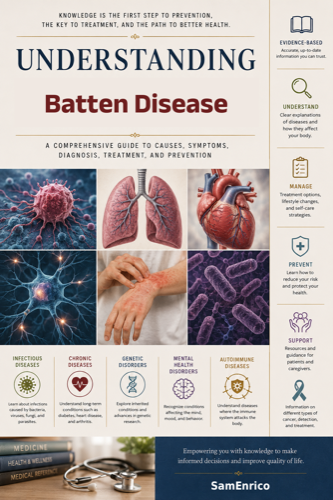
Non-FictionInformativeEducational
Understanding Batten Disease Audiobook
This disease publication, published by SamEnrico,
This disease publication, published by SamEnrico, covers Understanding Batten Disease
Formats
Free sample
Chapter 1: When Cells Cannot Clean...–- Inside every cell of the human body, a microscopic world of astonishing complexity operates with seamless precision. Mitochondria generate energy. Ribosomes assemble proteins. The nucleus stores genetic blueprints. And scattered throughout the cellular landscape, like thousands of tiny sanitation workers on an endless shift, are the lysosomes.
These membrane-bound compartments, numbering in the hundreds per cell, perform one of the most critical functions in all of biology: they break down waste. Every day, each of your trillions of cells produces cellular garbage—worn-out proteins, used-up organelles, foreign invaders that have been neutralized. The lysosomes digest this waste into raw materials that the cell can reuse. Without this recycling system, cells would choke on their own debris, swell with unprocessed garbage, and eventually die.This is precisely what happens in Batten disease. The lysosomes fail.
The waste accumulates. And the cells that suffer most are the ones we can least afford to lose: the neurons of the brain and the photoreceptors of the retina. The result is a relentless, irreversible neurodegenerative disorder that robs children of their sight, their mobility, their cognitive abilities, their very selves.Understanding Batten disease begins with understanding the lysosome. This chapter will take you on a journey into the cellular world—a world of enzymes, membranes, and molecular machines—to explain how a single genetic mutation can trigger a cascade of destruction. We will explore what lysosomes do, how they fail in Batten disease, what that failure looks like under a microscope, and how this cellular disaster translates into the clinical syndrome of progressive neurodegeneration.
By the end of this chapter, you will have a clear, foundational understanding of the science behind one of the most devastating neurological disorders affecting children worldwide.The Lysosome: Nature's Most Efficient Recycling Center The lysosome was discovered in 1955 by Belgian biochemist Christian de Duve, a discovery that would earn him the Nobel Prize in Physiology or Medicine nearly two decades later. Using a newly developed technique called cell fractionation, de Duve and his team spun broken-open cells in an ultracentrifuge, separating cellular components by their size and density. They noticed a mysterious fraction containing enzymes that could digest nearly any biological molecule—proteins, fats, carbohydrates, nucleic acids. But these enzymes were dangerous. If released into the cell, they would destroy it from within.
De Duve deduced that these enzymes must be enclosed within a protective membrane, sealed away until needed. He named these…
This is the end of the free sample. Get the Audiobook to keep going. Buy now
About this book
Details
- Author
- Rash Shawanna
- Publisher
- SamEnrico
- Language
- English
- Genre
- Non-Fiction, Informative, Educational
- Released
- 2026-05-08
- Pages (approx.)
- 133
- Available as
- eBook, Audiobook

Listen in the VoxFlicks app
Audiobooks and audio dramas wherever you go. Sign in with your SamEnrico account and press play.
More by Rash Shawanna
 Microbiome Autoimmune GuideRash Shawanna$11.99
 Public Transit Alternative GuideRash Shawanna$11.99
 Dental Health Quit ManualRash Shawanna$11.99
 The Parent Death Financial GuideRash Shawanna$11.99
 Cleopatra Language and Multilingual RuleRash Shawanna$11.99
 Freedom’s Unfinished Symphony: The Battle for the 1964 Civil Rights ActRash Shawanna$11.99
 The Sky Pioneers: Mapping the Lost Lands of the Fertile CrescentRash Shawanna$11.99
 Gen X Alcohol Delivery SpendingRash Shawanna$12.99
 10 Ways to Use Chives (Recipe Book)Rash Shawanna$11.99
 Insurance SpecialistRash Shawanna$11.99
You may also like
 Hong Kong Handover 1997Dunn Johnnie$11.99
 Zumba For Postnatal Recovery CourseNeal Christian$11.99
 Zumba for BeginnersLadner Nikia$11.99
 YouTube Comment Mining GuideHumes Pandora$12.99
 Worry Box MeditationCarlin Rudy$11.99
 Workplace Stress MeditationNguyen Lynn$11.99
 Workplace Stress and Sleep RepairHawley Ivory$11.99
 Workplace Perfectionism CureDelaney Jeffry$11.99
 Workplace Injustice Anger GuideWallen Isabelle$11.99
 Work Addiction and Burnout LinkGreenwood Ester$11.99
 Women in Yoga and WellnessBeattie Galina$11.99
 Women in Stand Up ComedyChun Evangeline$11.99