
Non-FictionBusiness BriefPersonal Safety
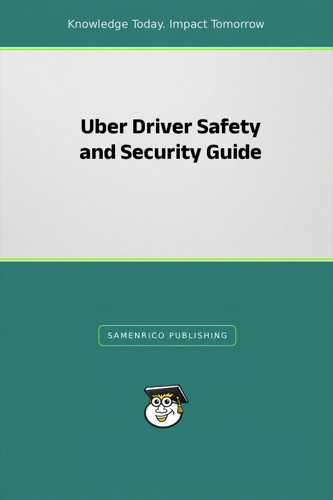
Uber Driver Safety and Security Guide eBook
Teaches dash cam use, late night strategies, and p
Teaches dash cam use, late night strategies, and passenger risk assessment.
Formats
Free sample
Chapter 1: The Witness Within...--–- The first time Marcus checked his rearview mirror and realized he was completely alone with a stranger’s accusation, he had no dashboard camera, no interior audio, and no prayer of proving he hadn’t done what she claimed. Three weeks later, Uber deactivated him for “sexual misconduct,” a process that took exactly one passenger report, zero evidence, and forty-eight hours to destroy a four-year driving record with 9,800 five-star ratings. Marcus never drove again. Not because he was guilty—he wasn’t—but because he had no way to prove his innocence. The woman who filed the report later admitted to a friend in a text message that she “needed a free ride home and Uber always sides with the passenger.” That text message never reached Uber’s safety team.
Marcus’s career ended not with a crash or a crime, but with a silence. A silence his camera could have broken.This book exists to ensure that silence never happens to you.Every day, rideshare drivers across North America face a fundamental asymmetry of evidence. Passengers can accuse you of anything—theft, assault, discrimination, harassment, drunk driving—and Uber’s system, by design, tends to believe them first. The company processes millions of trips daily; their safety algorithms prioritize passenger retention over driver defense. This is not a conspiracy.
It is a mathematical reality. When a passenger reports a problem, Uber’s automated systems flag your account. When you report a problem, you are one voice against a corporate infrastructure built to minimize liability. The only way to balance this asymmetry is to create your own evidence. That evidence begins with one device: the dash cam.But not just any dash cam.
A single forward-facing lens that watches the road through your windshield misses ninety percent of what matters in rideshare driving. You don’t need to prove what happened outside the car. You need to prove what happened inside it. The road is rarely the source of false accusations. The back seat is.
And that is why this chapter will transform how you think about in-vehicle recording—not as a passive security measure, but as the single most important professional tool you will ever own.The Myth of the Single Lens Most drivers who install dash cams make a predictable and dangerous mistake. They buy a cheap forward-facing unit, stick it to the windshield behind the rearview mirror, and assume they are protected. They are not. A forward-facing camera captures exactly one thing: what is happening in front of your car. It does not capture the passenger who leans forward and claims you touched them.
It does not capture the drunk rider who vomits on your floor mats and later denies it. It does not capture the three passengers who crowd into your back seat and refuse to wear seatbelts, then report you for “dangerous driving” when you ask them to leave.The rideshare environment creates a unique evidentiary problem. Unlike a taxi, which operates under commercial vehicle regulations and often has visible cameras, rideshare vehicles are personal cars. Passengers enter them expecting privacy, which makes them more likely to behave badly and more likely to lie afterward. According to internal data leaked from a major rideshare company in 2022, approximately 34% of driver deactivations for “safety violations” were reversed when drivers provided video evidence.
That means two-thirds of deactivated drivers who had cameras were reinstated. But what about the drivers who had no cameras? Most never returned to the platform.Consider the physics of the accusation. A passenger who wants to file a false report needs only a plausible narrative and a smartphone. They do not need witnesses, physical evidence, or even consistency.
They need to type a few sentences into Uber’s help chat, and within hours, your account is flagged. Meanwhile, you are left with your memory—a notoriously unreliable thing, especially under stress—and a passenger rating that is about to plummet. The only reliable counterweight is continuous, high-quality, multi-angle video and audio recording.Three Channels, One Truth: Why Interior Visibility Is Non-Negotiable The correct setup for rideshare driving is a three-channel dash cam system. Here is what each channel captures and why you need all three:Front channel: Mounted on your windshield, facing forward. This captures the road, traffic conditions, weather, and any external events like accidents or pedestrians.
It also establishes the timeline of your trip by showing when you started driving, when you stopped, and whether you were following traffic laws. If a passenger claims you ran a red light or drove recklessly, the front channel provides an objective record of your driving behavior.Rear channel: Mounted on your back windshield or rear deck, facing backward. This captures vehicles behind you, which is essential for proving you were not at fault in a rear-end collision. It also captures passengers exiting the vehicle—useful if someone claims you dropped them off in an unsafe location or drove away before they fully exited.Cabin channel (interior): Mounted on your dashboard or rearview mirror stem, facing into the passenger compartment. This is the most important channel for rideshare safety.
The interior camera captures every passenger’s face, hands, body language, and behavior from the moment they enter until they exit. If a passenger accuses you of inappropriate touching, the interior camera shows where your hands were (on the steering wheel, on the gear shift, nowhere near the passenger). If a passenger claims you were intoxicated, the interior camera shows your steady driving and clear eyes. If a passenger vomits, the interior camera captures the exact moment it happened, along with their state of sobriety.Some drivers ask: “Do I really need the rear channel? Can I get away with just front and interior?” The answer depends on your risk tolerance.
Rear channel footage has saved drivers from false “hit and run” accusations when a passenger claimed the driver backed into another car. It also provides redundancy: if your front camera fails, the rear camera may still capture critical context. For the additional fifty to one hundred dollars that a three-channel system costs over a two-channel system, the peace of mind is inexpensive.Night Vision: Seeing What the Dark Hides More than sixty percent of rideshare safety incidents occur between 9:00 PM and 3:00 AM. During those hours, your vehicle’s interior is dark. A camera without proper night vision will capture nothing but grainy shadows—useless as evidence.
When evaluating dash cams, look for IR (infrared) night vision specifically designed for interior use. Not all night vision is equal.Consumer-grade dash cams often advertise “night vision” that is actually just low-light sensitivity. These cameras rely on ambient light from streetlamps, headlights, or the moon. Inside a car at 2:00 AM on a residential street, there is no ambient light. The result is a dark, unusable video.
True interior IR night vision uses invisible infrared LEDs (light-emitting diodes) mounted around the camera lens. These LEDs illuminate the cabin with light that your eyes cannot see but the camera sensor can. The result is a clear, black-and-white video that shows passenger faces, hand movements, and behavior even in complete darkness.What to look for on the…
This is the end of the free sample. Get the eBook to keep going. Buy now
About this book
Details
- Author
- Lindsey Velma
- Publisher
- SamEnrico
- Language
- English
- Genre
- Non-Fiction, Business Brief, Personal Safety
- Released
- 2026-06-10
- Pages (approx.)
- 153
- Available as
- eBook, Audiobook

Read better in the ZLOADR app
Your eBooks on your phone or tablet. Sign in with your SamEnrico account and start reading.
More by Lindsey Velma
 Personal Board BuildingLindsey Velma$11.99
 Parental Therapy Access GuideLindsey Velma$11.99
 Hitchcock Suspense MasterclassLindsey Velma$11.99
 World of Warcraft Time Sink GuideLindsey Velma$11.99
 Blood and Rupees: The Financial War That Birthed Modern IndiaLindsey Velma$11.99
 Reliability SpecialistLindsey Velma$11.99
 Ultimate Handbook Guide to Xinmin : (China) Travel GuideLindsey Velma$11.99
 Project Management Cost ComparisonLindsey Velma$12.99
 Bioinformatics Data Skills GuideLindsey Velma$12.99
 Understanding Membranoproliferative Glomerulonephritis (Type Ii)Lindsey Velma$17.99
You may also like
 Hong Kong Handover 1997Dunn Johnnie$11.99
 Zumba For Postnatal Recovery CourseNeal Christian$11.99
 Zumba for BeginnersLadner Nikia$11.99
 YouTube Comment Mining GuideHumes Pandora$12.99
 Worry Box MeditationCarlin Rudy$11.99
 Workplace Stress MeditationNguyen Lynn$11.99
 Workplace Stress and Sleep RepairHawley Ivory$11.99
 Workplace Perfectionism CureDelaney Jeffry$11.99
 Workplace Injustice Anger GuideWallen Isabelle$11.99
 Work Addiction and Burnout LinkGreenwood Ester$11.99
 Women in Yoga and WellnessBeattie Galina$11.99
 Women in Stand Up ComedyChun Evangeline$11.99