
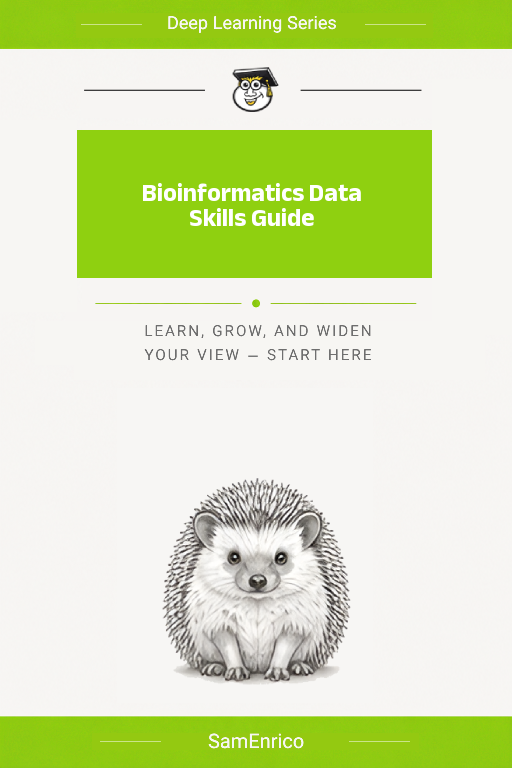
Non-FictionForecast & OutlookBioinformatics
Bioinformatics Data Skills Guide
Discover genomic data analysis, computational biol
Discover genomic data analysis, computational biology, and proteomics software proficiency demand.
Formats
About this book
Free sample
Chapter 1: The Pipeline Mandate--You are staring at a terminal window. A cursor blinks. Somewhere on your hard drive, three versions of the same analysis exist: final_analysis.sh, final_analysis_REAL.sh, and final_analysis_REAL_FINAL_v2.sh. Your PI just asked for the figure from last month's lab meeting, the one with the volcano plot that took six hours to make, and you cannot remember which script produced it. The data has moved.
The software version has changed. You are not a sloppy scientist. You are a typical bioinformatician who was never taught how to build analyses that survive contact with reality.This chapter exists because that experience—the quiet panic of irreproducibility—is the single greatest obstacle to your career in genomics, computational biology, or proteomics. Not your understanding of p-values. Not your ability to memorize alignment algorithms.
The thing that separates a hireable bioinformatician from an unhireable one is the ability to build analyses that are reproducible, scalable, and auditable. This chapter diagnoses why most bioinformatics projects fail, introduces the core mindset that fixes them, and gives you a checklist you will use before every project you ever start.The Three Failures That Will Kill Your Career Let us name the enemies. In ten years of teaching bioinformatics across universities and biotech companies, I have watched hundreds of talented scientists fail for the same three reasons—not because they lacked intelligence, but because they were never taught how to structure computational work.Failure 1: The Invisible Pipeline You ran twelve steps to produce that figure. Some steps were in R. Some were in Python.
One step involved manually editing a text file because the output format was wrong. One step required running a tool that only works on the lab server because it needs a license. When your collaborator asks you to re-run the analysis on new data, you cannot. When a reviewer asks for a minor change, you cannot. When you get a new computer, you cannot.This is the invisible pipeline problem.
Your analysis exists as a sequence of actions in your memory, not as a reproducible artifact. The solution, which this…
This is the end of the free sample. Get the eBook to keep going. Buy now
Contents
- Chapter 1
- Chapter 2
- Chapter 3
- Chapter 4
- Chapter 5
- Chapter 6
- Chapter 7
- Chapter 8
- Chapter 9
- Chapter 10
- Chapter 11
- Chapter 12
Details
- Author
- Lindsey Velma
- Publisher
- SamEnrico
- Language
- English
- Genre
- Non-Fiction, Forecast & Outlook, Bioinformatics
- Released
- 2026-05-30
- Pages (approx.)
- 150
- Available as
- eBook, Audiobook

Read better in the ZLOADR app
Your eBooks on your phone or tablet. Sign in with your SamEnrico account and start reading.
More by Lindsey Velma
 Uber Driver Safety and Security GuideLindsey Velma$11.99
 Personal Board BuildingLindsey Velma$11.99
 Parental Therapy Access GuideLindsey Velma$11.99
 Hitchcock Suspense MasterclassLindsey Velma$11.99
 World of Warcraft Time Sink GuideLindsey Velma$11.99
 Blood and Rupees: The Financial War That Birthed Modern IndiaLindsey Velma$11.99
 Reliability SpecialistLindsey Velma$11.99
 Ultimate Handbook Guide to Xinmin : (China) Travel GuideLindsey Velma$11.99
 Project Management Cost ComparisonLindsey Velma$12.99
 Understanding Membranoproliferative Glomerulonephritis (Type Ii)Lindsey Velma$17.99
You may also like
 Hong Kong Handover 1997Dunn Johnnie$11.99
 Zumba For Postnatal Recovery CourseNeal Christian$11.99
 Zumba for BeginnersLadner Nikia$11.99
 YouTube Comment Mining GuideHumes Pandora$12.99
 Worry Box MeditationCarlin Rudy$11.99
 Workplace Stress MeditationNguyen Lynn$11.99
 Workplace Stress and Sleep RepairHawley Ivory$11.99
 Workplace Perfectionism CureDelaney Jeffry$11.99
 Workplace Injustice Anger GuideWallen Isabelle$11.99
 Work Addiction and Burnout LinkGreenwood Ester$11.99
 Women in Yoga and WellnessBeattie Galina$11.99
 Women in Stand Up ComedyChun Evangeline$11.99