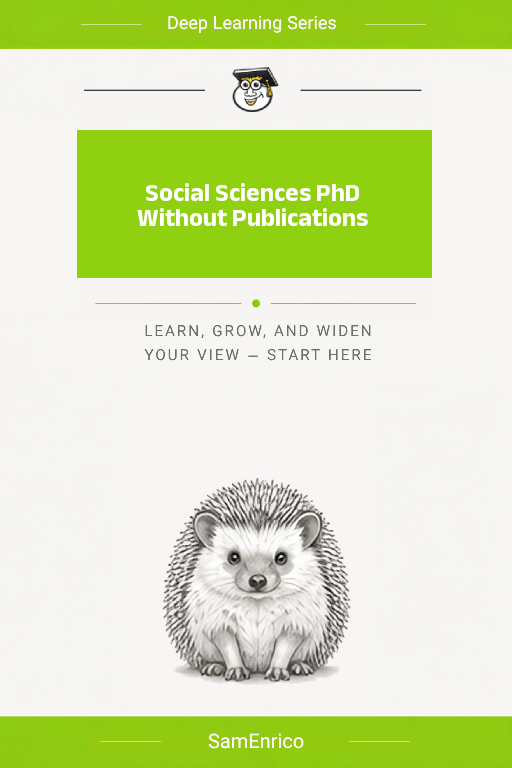
Social Sciences PhD Without Papers
Applies to social science doctoral programs that p
by Prince Zack
Applies to social science doctoral programs that prioritize research design and methodological training over publications.
Formats
About this book
Free sample
Chapter 1: The Publication Trap--You are not failing. You are in the wrong game.Every time you stare at your blank CV, every time you see a peer announce a new publication on Linked In, every time your advisor asks “Where are you submitting?” and you have no answer—you feel a quiet, creeping shame. You tell yourself that you should have written more during coursework. You should have turned that seminar paper into a submission. You should have said yes when your labmate offered co-authorship on a project you barely believed in.But here is what no one tells you: The game you are trying to win is rigged.The “publish or perish” model that dominates academic imagination is not ancient tradition.
It is not a timeless measure of scholarly worth. It was not handed down from Max Weber or Émile Durkheim. The modern obsession with counting peer-reviewed publications emerged in the early 1980s, when university ranking systems—first U.S. News & World Report, then QS, then the Academic Ranking of World Universities—began using publication counts as a proxy for institutional prestige. What followed was a classic Goodhart’s Law disaster: the measure became the goal.
Universities started hiring and promoting based on publication metrics. Journals proliferated. Advisors began demanding that students produce papers not because papers made better scholars, but because papers made the program look productive.And you, the doctoral student, were caught in the machinery.The Invention You Were Never Told About Before approximately 1982, social science Ph Ds looked very different. A review of dissertation requirements from the 1960s and 1970s at leading institutions—Harvard Sociology, Berkeley Political Science, University of Chicago Anthropology—reveals a striking pattern: zero mention of publication requirements. Doctoral students were expected to complete coursework, pass comprehensive exams, and produce a dissertation.
That was it. Publications were a happy byproduct of excellent research, not a prerequisite for graduation or a line item on an annual review form.What changed? Three interlocking forces.First, university ranking systems needed quantitative metrics. It is easy to count publications. It is hard to measure research quality.
So rankings counted. And departments that wanted to climb the rankings incentivized publication volume. A culture that had valued depth…
This is the end of the free sample. Get the eBook to keep going. Buy now
Contents
- Chapter 1
- Chapter 2
- Chapter 3
- Chapter 4
- Chapter 5
- Chapter 6
- Chapter 7
- Chapter 8
- Chapter 9
- Chapter 10
- Chapter 11
- Chapter 12
Details
- Author
- Prince Zack
- Publisher
- SamEnrico
- Language
- English
- Genre
- Non-Fiction, Student's Shortcut, Social Sciences
- Released
- 2026-06-01
- Pages (approx.)
- 139
- Available as
- eBook, Audiobook

Read better in the ZLOADR app
Your eBooks on your phone or tablet. Sign in with your SamEnrico account and start reading.
More by Prince Zack
 The Climate Tech UX Design CareerPrince Zack$11.99
 Emotional Regulation For LovePrince Zack$11.99
 Dreams And Fall Trauma GuidePrince Zack$11.99
 The Graduate Student StressPrince Zack$11.99
 DBT For JournalistsPrince Zack$11.99
 The Baghdad Strangler: Iraq's Forgotten Serial Killer and the Birth of a Media SensationPrince Zack$11.99
 Understanding Talipes EquinovarusPrince Zack$17.99
 Kirchhoff's Principle Acoustic Resonance TechnicianPrince Zack$11.99
 Pop Up Design Lagos GuidePrince Zack$12.99
 How to Start a Pallet Truck Business (Beginners Guide)Prince Zack$11.99