
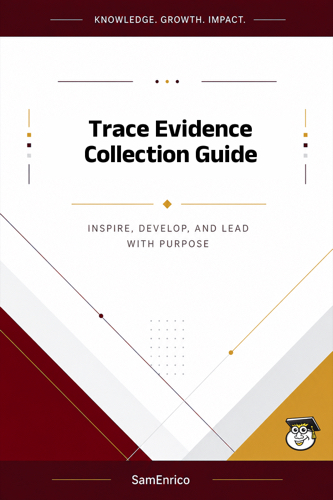
Non-FictionTrue CrimeEvidence Collection
Trace Evidence Collection Guide eBook
Properly gather hair, fiber, and glass from crime
Properly gather hair, fiber, and glass from crime scenes using this protocol.
Formats
Free sample
Chapter 1: The Unseen Witness...-- Every crime scene tells a story. The problem is that most of the story is invisible.On a humid July night in 1987, a twenty-three-year-old waitress named Angela Sampson left her shift at a truck stop off Interstate 5 in Washington State. She never arrived home. Her car was found three days later in a gravel turnout, doors locked, no blood, no weapon, no fingerprints that didn’t belong to her. The interior appeared clean—immaculately so, as if someone had vacuumed the seats and wiped down the dashboard.
The lead investigator, a veteran detective with twenty years on the force, stood beside the car and pronounced it a “clean scene.” No witnesses. No confession. No case.Angela’s murder went cold for eighteen months.Then a junior crime scene analyst named Rebecca Hodes was assigned to re-examine the evidence locker. Inside a cardboard box no larger than a shoebox, she found a single manila envelope that had been overlooked. Inside that envelope was a piece of clear adhesive tape, approximately two inches by two inches, mounted on an acetate sheet.
The tape had been lifted from the passenger seat of Angela’s car—a seat that had appeared clean to the naked eye. Under a comparison microscope at forty times magnification, Hodes saw something the original investigators had missed: eleven microscopic fibers, four of them blue, three beige, two gray, and two that appeared to be animal hair. None of those fibers matched Angela’s clothing. None matched her car’s upholstery. None matched anything in her apartment.Those eleven invisible threads would eventually lead to a serial killer named Roger Kibbe, the so-called I-5 Strangler, who had murdered at least seven women across Washington and California.
The fibers came from a blue work uniform and a beige carpet in Kibbe’s van. The animal hairs came from his dog. When Kibbe was finally arrested in 1987, he had already disposed of a victim’s body and cleaned his van twice. But he could not erase what he could not see.This is the central paradox of trace evidence: the most powerful witness to a crime is also the most easily overlooked. Hair, fiber, and glass fragments are smaller than a grain of sand, lighter than a breath of air, and more easily destroyed than a soap bubble.
Yet they can place a suspect in a room they claim never to have entered, link a weapon to a victim they claim never to have touched, and tie a vehicle to a crime scene miles away from where it was parked. They are, in the words of one forensic pioneer, “the silent witness that never forgets and never lies.”Before you learn how to collect these invisible witnesses, you must first understand why they matter. And to understand why they matter, you must understand the man who first recognized their power: Dr. Edmond Locard.The French Doctor Who Changed Crime Fighting Forever In 1910, the city of Lyon, France, appointed a young physician named Edmond Locard to serve as its first forensic laboratory director. The laboratory occupied two attic rooms above the city’s courthouse.
Locard had no budget, no staff, and no equipment beyond a few microscopes and Bunsen burners. What he did have was an obsessive curiosity about the microscopic world. He had read the Sherlock Holmes stories with fervor, and he believed that Conan Doyle’s fictional detective was not imagining clues—he was simply looking closely enough to see what others ignored.Locard’s great insight emerged from a simple observation: every human action involves physical contact, and every physical contact leaves a trace. When two objects touch, particles transfer from one to the other. You cannot shake hands without exchanging skin cells.
You cannot walk across a carpet without shedding fibers from your clothing. You cannot break a window without carrying away invisible fragments of glass on your sleeves and shoes. The perpetrator of a crime will always bring something to the scene and leave with something from it.This became known as Locard’s Exchange Principle, and it remains the single most important concept in forensic trace evidence analysis. It is not a law of physics in the sense of thermodynamics or gravity. It is an empirical observation about the nature of physical interaction, validated by more than a century of forensic casework.
The principle has three practical implications for crime scene investigators:First, absence of visible evidence is not evidence of absence. A scene that looks clean to the naked eye may contain hundreds of microscopic particles that require magnification, alternate light sources, or chemical enhancement to become visible. The cleanest car interior in the world still contains fibers from every person who has ever sat in it.Second, every transfer creates two crime scenes. The perpetrator leaves trace at the victim’s location (primary transfer), but also carries trace away from that location to their own environment (secondary transfer). A single hair found in a suspect’s car can be more probative than a fingerprint at the original crime scene.Third, trace evidence is a two-way link.
If you find a fiber from a suspect’s carpet on a victim’s clothing, you have not only placed the suspect at the crime scene—you have also placed the victim in the suspect’s environment. This bidirectional linkage is unique to trace evidence; DNA and fingerprints typically only travel one direction.Locard proved his principle in a 1912 case that made him famous. A young woman named Marie Latelle was found dead in her apartment in Lyon. The suspect, a counterfeit coin maker named Émile Gourbin, claimed he had been playing cards with friends all night. Locard examined Gourbin’s fingernails and found, trapped under the nail of his right ring finger, a trace of pink dust.
Under a microscope, the dust revealed itself to be cosmetic face powder. Locard obtained a sample of Marie Latelle’s face powder from her dressing table. The chemical composition was identical—a rare formulation containing bismuth, zinc oxide, and a specific shade of iron oxide pigment. Confronted with this microscopic evidence, Gourbin confessed. He had strangled Marie, then spent an hour scrubbing his hands.
But he could not scrub what was lodged under his fingernail.That case, more than a century ago, established the template for every trace evidence investigation that would follow. The principles are unchanged. Only the technology has evolved.Why Hair, Fiber, and Glass Are the Holy Trinity of Trace Evidence Not all trace evidence is created equal. Blood spatter, gunshot residue, paint chips, soil, pollen, and explosive residue all have their place in forensic science. But for the working crime scene investigator who arrives at a scene without knowing what they will find, three categories of evidence stand out as the most frequently encountered, the most easily preserved, and the most probative when properly collected: hair, fiber, and glass.Each category offers unique advantages, and each requires specialized collection protocols that will be detailed throughout this book.
But first, you must understand what makes each type valuable.Hair: The Biological Record Human hair is remarkable not because it contains nuclear DNA—although the root…
This is the end of the free sample. Get the eBook to keep going. Buy now
About this book
Details
- Author
- Steward Dwana
- Publisher
- SamEnrico
- Language
- English
- Genre
- Non-Fiction, True Crime, Evidence Collection
- Released
- 2026-06-08
- Pages (approx.)
- 158
- Available as
- eBook, Audiobook

Read better in the ZLOADR app
Your eBooks on your phone or tablet. Sign in with your SamEnrico account and start reading.
More by Steward Dwana
 Mindful Healthcare Professional GuideSteward Dwana$11.99
 Calf Strain Recovery ProtocolSteward Dwana$11.99
 UK CMA Merger BlocksSteward Dwana$11.99
 Metta For Evening Wind DownSteward Dwana$11.99
 Mentoring New ManagersSteward Dwana$11.99
 Good Father, Bad AngerSteward Dwana$11.99
 Assertiveness For FreelancersSteward Dwana$11.99
 A B Testing BiasesSteward Dwana$11.99
 The Clockwork Dreamer: How a 19th-Century Engineer Built the First Practical Steam-Powered CarSteward Dwana$11.99
 The Codebreaker of Southeast Asia: Hoang Tuan's Mathematical RevolutionSteward Dwana$11.99
 The Last Charge of the Qing: The Fall of the Boxer Rebellion (1900)Steward Dwana$11.99
 How to Start a Marine Insurance Survey Business (Beginners Guide)Steward Dwana$11.99
You may also like
 Hong Kong Handover 1997Dunn Johnnie$11.99
 Zumba For Postnatal Recovery CourseNeal Christian$11.99
 Zumba for BeginnersLadner Nikia$11.99
 YouTube Comment Mining GuideHumes Pandora$12.99
 Worry Box MeditationCarlin Rudy$11.99
 Workplace Stress MeditationNguyen Lynn$11.99
 Workplace Stress and Sleep RepairHawley Ivory$11.99
 Workplace Perfectionism CureDelaney Jeffry$11.99
 Workplace Injustice Anger GuideWallen Isabelle$11.99
 Work Addiction and Burnout LinkGreenwood Ester$11.99
 Women in Yoga and WellnessBeattie Galina$11.99
 Women in Stand Up ComedyChun Evangeline$11.99