
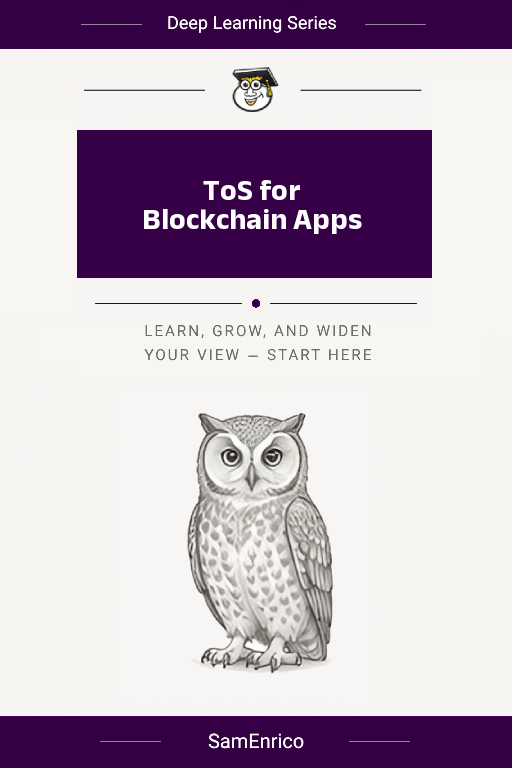
Non-FictionFirst 30 DaysWeb3 Terms
ToS for Blockchain Apps eBook
Draft Terms of Service for Web3, crypto, and block
Draft Terms of Service for Web3, crypto, and blockchain applications including smart contracts.
Formats
Free sample
Chapter 1: The Server Mirage...--–- The first lie a lawyer tells when drafting Terms of Service for a blockchain app is that the old rules still apply. It is an understandable lie—comforting, even. For decades, software contracts followed a predictable script: you hosted code on a server you controlled, users clicked “I agree,” and if something went wrong, you pointed to a governing law clause tied to the zip code of that server. The server was your leash on chaos. It gave you jurisdiction, termination power, and the illusion of control.
Blockchain tears that leash in half.This chapter is not about blockchain technology. You can find thousands of explainers on hashes, consensus mechanisms, and gas fees elsewhere. This chapter is about something far more uncomfortable for lawyers and founders alike: the quiet collapse of every assumption that made traditional Terms of Service work. By the time you finish reading, you will understand why your carefully crafted Saa S agreement is worse than useless on a blockchain—it is actively dangerous, because it promises things the technology cannot deliver and hides risks the technology amplifies.The Three Pillars of Traditional Saa S To SBefore we can understand why blockchain breaks contracts, we must understand what made traditional software contracts work. For the past twenty-five years, nearly every Terms of Service agreement for hosted software rested on three implicit pillars.The first pillar is centralized control.
When you ran a Saa S business, you owned the servers. You could restart them, patch them, shut them down, or delete data. Your To S reflected this reality: “We reserve the right to terminate your account,” “We may modify these terms at any time,” “We will provide notice via email to the address you provided.” Every clause assumed that you, the service provider, held the master key to the kingdom. You could reach into the database and change anything. This wasn’t theoretical—it was operational.The second pillar is jurisdictional anchoring.
Your servers sat somewhere. Maybe Virginia, maybe Ireland, maybe Singapore. That physical location gave courts something to grab onto. When a user sued, the question “where did the conduct occur?” had an answer: the server location, the corporate headquarters, the bank account receiving payments. Even if you had users in 150 countries, you could plausibly argue that your “principal place of business” was a specific address.
Governing law clauses weren’t magical, but they were plausible.The third pillar is revocability of access. In a Saa S agreement, “termination” means something real. You flip a switch in your database, and the user’s account becomes inaccessible. Their API keys stop working. Their data is archived or deleted.
The user’s remedy for a dispute—stop using the service—is symmetric with your remedy for a dispute—cut off access. This symmetry is so fundamental that most lawyers never even think about it. It is simply how software works.Blockchain destroys all three pillars simultaneously. Not one at a time. All three.The Death of Server Location Jurisdiction Let us start with jurisdiction, because it is the most seductive trap.
When I review draft To S for blockchain projects, I still see governing law clauses like this: “This agreement shall be governed by and construed in accordance with the laws of the State of New York, without regard to its conflict of laws principles.” The lawyer who wrote that clause probably felt proud. They used the standard language. They cited New York’s well-developed commercial law. They even remembered the conflict of laws carve-out. It is a beautiful piece of traditional drafting.It is also completely unenforceable in the way they imagine.Consider what happens when a user in Singapore interacts with a smart contract deployed on Ethereum.
Where are the “servers”? There are no servers in the traditional sense. The Ethereum network consists of thousands of independent nodes operated by strangers in dozens of countries. A node in Germany validates the transaction. A node in Japan stores the state.
A node in Brazil propagates the block. No single jurisdiction hosts “the” server because there is no single server.Now ask: which court has personal jurisdiction over the smart contract itself? The answer is none, because a smart contract is not a legal person. It cannot be sued. So the lawyer who drafted that New York governing law clause must look for someone else to sue—the developers, the DAO, the foundation.
But those entities may have no connection to New York whatsoever. The developers might live in Berlin. The DAO might be an unincorporated association with no physical headquarters. The foundation might be registered in the Cayman Islands.The governing law clause is not worthless. Let me be precise, because this distinction will save you from a common inconsistency that plagues blockchain legal writing.
A governing law clause serves two purposes. First, it tells a court which state’s substantive law to apply if the court accepts jurisdiction. Second, it signals the parties’ intent, which can influence a court’s decision to accept jurisdiction in the first place. But the clause does not create jurisdiction where none exists. If no court has personal jurisdiction over the defendant, the governing law clause is a message in a bottle thrown into an empty ocean.This is why I call this chapter “The Server Mirage.” The server was never just a technical artifact.
It was a legal anchor. It gave you a story to tell a judge: “Your Honor, our servers are in Virginia, our headquarters are in Virginia, and the user agreed to Virginia law.” Blockchain takes away that story. You can still write a governing law clause. You can still file a lawsuit. But you cannot assume the clause will work the way it did in Saa S.The User as Node Operator (Not a Customer)The second pillar—centralized control—collapses when we examine who the user really is in a blockchain application.
In Saa S, the user is a customer. They consume a service you provide. The relationship is asymmetrical: you have power, they have access. Your To S reflects this asymmetry with provisions about termination, suspension, and modification.In blockchain, the user is often also a node operator, a validator, or at minimum a participant in a peer-to-peer network. Even if the user never runs their own node—many use Infura or Alchemy as node-as-a-service providers—their wallet still signs transactions that are broadcast to and validated by the distributed network.
The user is not merely consuming a service; they are participating in a protocol.This distinction matters for liability. In Saa S, if a transaction fails because of a server error, you might be liable for downtime under your SLA. In blockchain, if a transaction fails because network congestion drives gas prices above the user’s bid, who is responsible? The user set the gas price. The user signed the transaction.
The network of independent validators chose not to include it. Your To S cannot simply say “we are not responsible for network delays” without also acknowledging that the user is a co-participant, not a passive consumer.The more radical implication is that you cannot “terminate” a user in…
This is the end of the free sample. Get the eBook to keep going. Buy now
About this book
Details
- Author
- Duff Cathrine
- Publisher
- SamEnrico
- Language
- English
- Genre
- Non-Fiction, First 30 Days, Web3 Terms
- Released
- 2026-06-01
- Pages (approx.)
- 134
- Available as
- eBook, Audiobook

Read better in the ZLOADR app
Your eBooks on your phone or tablet. Sign in with your SamEnrico account and start reading.
More by Duff Cathrine
 Shift Work Shift Trading GuideDuff Cathrine$11.99
 The Flaky Contact HandlerDuff Cathrine$11.99
 Self Esteem After Prison HandbookDuff Cathrine$11.99
 Cesium In Alternative Cancer CareDuff Cathrine$11.99
 Self Esteem Interracial RelationshipDuff Cathrine$11.99
 Silk & Shadows: The Secret Life of a Victorian CouturierDuff Cathrine$11.99
 The Last Message of the Karluk: A Ghost Ship’s Final BroadcastDuff Cathrine$11.99
 Understanding Exfoliative DermatitisDuff Cathrine$17.99
 NIST Framework SpecialistDuff Cathrine$11.99
 Executive Summary Formula That WorksDuff Cathrine$12.99
 How to Become a Molder-machine TenderDuff Cathrine$11.99
You may also like
 Hong Kong Handover 1997Dunn Johnnie$11.99
 Zumba For Postnatal Recovery CourseNeal Christian$11.99
 Zumba for BeginnersLadner Nikia$11.99
 YouTube Comment Mining GuideHumes Pandora$12.99
 Worry Box MeditationCarlin Rudy$11.99
 Workplace Stress MeditationNguyen Lynn$11.99
 Workplace Stress and Sleep RepairHawley Ivory$11.99
 Workplace Perfectionism CureDelaney Jeffry$11.99
 Workplace Injustice Anger GuideWallen Isabelle$11.99
 Work Addiction and Burnout LinkGreenwood Ester$11.99
 Women in Yoga and WellnessBeattie Galina$11.99
 Women in Stand Up ComedyChun Evangeline$11.99