

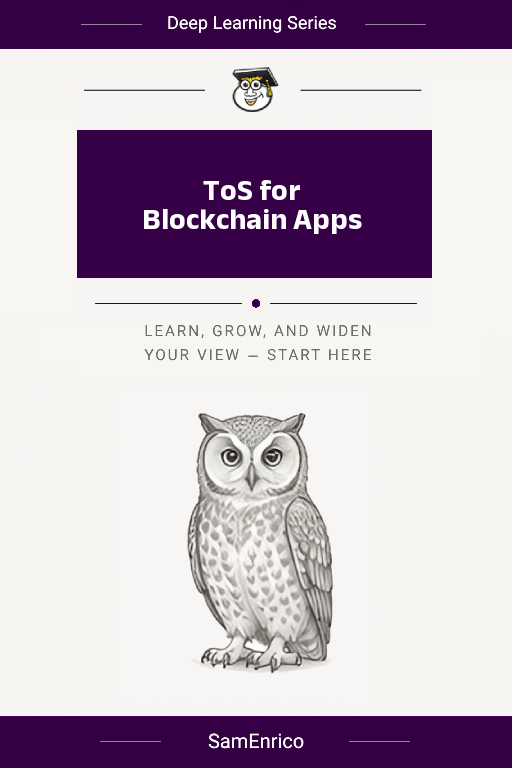
Non-FictionFirst 30 DaysWeb3 Terms
ToS for Blockchain Apps Audiobook
Draft Terms of Service for Web3, crypto, and block
Draft Terms of Service for Web3, crypto, and blockchain applications including smart contracts.
Formats
Free sample
Chapter 1: The Server Mirage...--–- The first lie a lawyer tells when drafting Terms of Service for a blockchain app is that the old rules still apply. It is an understandable lie—comforting, even. For decades, software contracts followed a predictable script: you hosted code on a server you controlled, users clicked “I agree,” and if something went wrong, you pointed to a governing law clause tied to the zip code of that server. The server was your leash on chaos. It gave you jurisdiction, termination power, and the illusion of control.
Blockchain tears that leash in half.This chapter is not about blockchain technology. You can find thousands of explainers on hashes, consensus mechanisms, and gas fees elsewhere. This chapter is about something far more uncomfortable for lawyers and founders alike: the quiet collapse of every assumption that made traditional Terms of Service work. By the time you finish reading, you will understand why your carefully crafted Saa S agreement is worse than useless on a blockchain—it is actively dangerous, because it promises things the technology cannot deliver and hides risks the technology amplifies.The Three Pillars of Traditional Saa S To SBefore we can understand why blockchain breaks contracts, we must understand what made traditional software contracts work. For the past twenty-five years, nearly every Terms of Service agreement for hosted software rested on three implicit pillars.The first pillar is centralized control.
When you ran a Saa S business, you owned the servers. You could restart them, patch them, shut them down, or delete data. Your To S reflected this reality: “We reserve the right to terminate your account,” “We may modify these terms at any time,” “We will provide notice via email to the address you provided.” Every clause assumed that you, the service provider, held the master key to the kingdom. You could reach into the database and change anything. This wasn’t theoretical—it was operational.The second pillar is jurisdictional anchoring.
Your servers sat somewhere. Maybe Virginia, maybe Ireland, maybe Singapore. That physical location gave courts something to grab onto. When a user sued, the question “where did the conduct occur?” had an answer: the server location, the corporate headquarters, the bank account receiving payments. Even if you had users in 150 countries, you could plausibly argue that your “principal place of business” was a specific address.
Governing law clauses weren’t magical, but they were plausible.The third pillar is revocability of access. In a Saa S agreement…
This is the end of the free sample. Get the Audiobook to keep going. Buy now
About this book
Details
- Author
- Duff Cathrine
- Publisher
- SamEnrico
- Language
- English
- Genre
- Non-Fiction, First 30 Days, Web3 Terms
- Released
- 2026-06-01
- Pages (approx.)
- 134
- Available as
- eBook, Audiobook

Listen in the VoxFlicks app
Audiobooks and audio dramas wherever you go. Sign in with your SamEnrico account and press play.
More by Duff Cathrine
 Shift Work Shift Trading GuideDuff Cathrine$11.99
 The Flaky Contact HandlerDuff Cathrine$11.99
 Self Esteem After Prison HandbookDuff Cathrine$11.99
 Cesium In Alternative Cancer CareDuff Cathrine$11.99
 Self Esteem Interracial RelationshipDuff Cathrine$11.99
 Silk & Shadows: The Secret Life of a Victorian CouturierDuff Cathrine$11.99
 The Last Message of the Karluk: A Ghost Ship’s Final BroadcastDuff Cathrine$11.99
 Understanding Exfoliative DermatitisDuff Cathrine$17.99
 NIST Framework SpecialistDuff Cathrine$11.99
 Executive Summary Formula That WorksDuff Cathrine$12.99
 How to Become a Molder-machine TenderDuff Cathrine$11.99
You may also like
 Hong Kong Handover 1997Dunn Johnnie$11.99
 Zumba For Postnatal Recovery CourseNeal Christian$11.99
 Zumba for BeginnersLadner Nikia$11.99
 YouTube Comment Mining GuideHumes Pandora$12.99
 Worry Box MeditationCarlin Rudy$11.99
 Workplace Stress MeditationNguyen Lynn$11.99
 Workplace Stress and Sleep RepairHawley Ivory$11.99
 Workplace Perfectionism CureDelaney Jeffry$11.99
 Workplace Injustice Anger GuideWallen Isabelle$11.99
 Work Addiction and Burnout LinkGreenwood Ester$11.99
 Women in Yoga and WellnessBeattie Galina$11.99
 Women in Stand Up ComedyChun Evangeline$11.99