
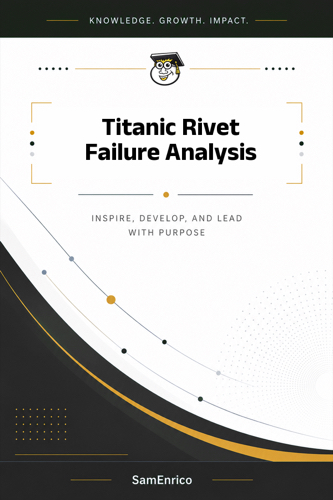
Titanic Rivet Failure Analysis Audiobook
Investigate the brittle wrought iron rivets that p
by Sam Reyna
Investigate the brittle wrought iron rivets that popped under iceberg impact.
Formats
Free sample
Chapter 1: The 90-Second Mystery...--–- The night of April 14, 1912, was unnaturally calm. For five days, the RMS Titanic had cut through the North Atlantic with a confidence that bordered on arrogance. She was the largest moving object ever built by human hands—882 feet long, 92 feet wide, and 46,328 tons of riveted steel. The men who designed her called her "practically unsinkable." The newspapers called her a triumph of Edwardian engineering. But at 11:40 PM ship's time, a lookout named Frederick Fleet raised his telephone to the bridge and spoke six words that would echo through history: "Iceberg, right ahead."The next ninety seconds would decide the fate of 2,224 people.The Grinding Truth What happened in those ninety seconds has been debated for over a century.
Witnesses below deck described a sensation that defied their expectations of catastrophe. Not a crash. Not an explosion. Not the violent shudder of a head-on collision. Instead, survivors consistently reported a low, grinding shudder—a sensation akin to dragging a massive metal spoon across corrugated concrete.
First-class passenger Jack Thayer, who survived by clinging to an overturned lifeboat, wrote in his memoir: "There was no shock. It was just a slight vibration that lasted about thirty seconds." Second Officer Charles Lightoller, the senior surviving officer from the bridge, testified before the British Wreck Commission: "I felt a slight jar, nothing more."This sensory evidence—the lack of a catastrophic crash—is the first forensic clue. If the iceberg had sliced open a three-hundred-foot gash, as popular lore once claimed, the impact would have been violent enough to throw passengers from their beds. Yet most slept through it. Edith Russell, a fashion buyer traveling in first class, recalled: "I felt a gentle bump, like a train stopping at a station.
I went back to sleep."Gentle bumps do not sink unsinkable ships. Something else happened in those ninety seconds, something that engineers would not understand for another eighty-six years.The Myth of the Three-Hundred-Foot Gash For decades after the disaster, the public accepted a simple explanation: the iceberg had sliced open the Titanic's hull like a can opener, creating a massive gash that allowed water to pour into five or six compartments simultaneously. This "Gash Theory" was reinforced by dramatic illustrations in newspapers, by the 1958 film A Night to Remember, and most famously by James Cameron's 1997 blockbuster, which depicted a jagged wound tearing open the starboard side…
This is the end of the free sample. Get the Audiobook to keep going. Buy now
About this book
Details
- Author
- Sam Reyna
- Publisher
- SamEnrico
- Language
- English
- Genre
- Non-Fiction, History, Metallurgy
- Released
- 2026-06-06
- Pages (approx.)
- 129
- Available as
- eBook, Audiobook

Listen in the VoxFlicks app
Audiobooks and audio dramas wherever you go. Sign in with your SamEnrico account and press play.
More by Sam Reyna
 The Anger and Jealousy GuideSam Reyna$11.99
 Self Talk for Money MindsetSam Reyna$11.99
 Conversation Starters for Voting LinesSam Reyna$11.99
 Postpartum Body Image GuideSam Reyna$11.99
 The Loss Acceptance WorkbookSam Reyna$11.99
 Leaving A Religious CommunitySam Reyna$11.99
 Shy Bladder SyndromeSam Reyna$11.99
 The Boardroom of the Gods: When Myths Made DealsSam Reyna$11.99
 Excalibur's Whisper: The Forgotten Knight of the Round TableSam Reyna$11.99
 How to Produce Hockey Stick ShaftsSam Reyna$11.99
 Mastering The Art of World War II CombativesSam Reyna$11.99
 Pet Bereavement AdvisorSam Reyna$12.99
You may also like
 Hong Kong Handover 1997Dunn Johnnie$11.99
 Zumba For Postnatal Recovery CourseNeal Christian$11.99
 Zumba for BeginnersLadner Nikia$11.99
 YouTube Comment Mining GuideHumes Pandora$12.99
 Worry Box MeditationCarlin Rudy$11.99
 Workplace Stress MeditationNguyen Lynn$11.99
 Workplace Stress and Sleep RepairHawley Ivory$11.99
 Workplace Perfectionism CureDelaney Jeffry$11.99
 Workplace Injustice Anger GuideWallen Isabelle$11.99
 Work Addiction and Burnout LinkGreenwood Ester$11.99
 Women in Yoga and WellnessBeattie Galina$11.99
 Women in Stand Up ComedyChun Evangeline$11.99