
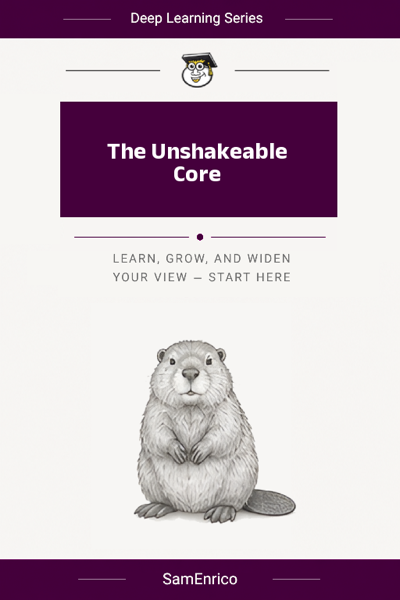
Non-FictionInformativeEducational
The Unshakeable Core eBook
A Coursebook on The Unshakeable Core
A Coursebook on The Unshakeable Core
Formats
Free sample
Chapter 1: The Asymmetric Bet...--The first time I watched someone lose everything, he was smiling.It was 2008. I was sitting in a coffee shop in downtown Austin, watching a man in a tailored suit calmly sip his latte while his Black Berry buzzed incessantly on the table. I didn't know him then, but I would come to know his story. His name was Marcus. He was forty-three years old, a managing director at a regional investment firm, and he had just lost 1.4 million dollars in a single week.
His retirement account? Down sixty-two percent. His personal stock portfolio? Wiped out almost entirely because he had been over-concentrated in financial sector stocks. His real estate investments?
Underwater. And yet, here he was, drinking coffee like it was any other Tuesday.I asked him, eventually, how he could be so calm.He looked at me over the rim of his cup and said something I have never forgotten: "I knew the bear was coming. I just didn't know when. So I prepared for the crash, not the recovery. Most people prepare to win.
I prepared not to lose."Marcus was not rich because he was lucky. He was unshakeable because he understood something that most self-help books never teach: stability is not about maximizing upside. It is about minimizing catastrophic downside. In the years that followed, I watched that same principle play out again and again—not just in finance, but in marriages, careers, mental health, and even spiritual lives. The people who broke were not the ones who took risks.
The people who broke were the ones who took symmetric risks: bets where they could lose as much as they could gain. The people who survived—who thrived—were the ones who mastered the art of the asymmetric bet.This chapter is about becoming one of those people.The Great Misunderstanding of Risk Most people believe that safety comes from avoiding risk entirely. They take the salaried job with the 401(k) match, the predictable mortgage, the safe friendship circle, the routine that never varies. They believe that if they can just make the risk go away, they will finally feel stable.This is a lie.Safety does not come from the absence of risk. Safety comes from the structure of risk.
A world without risk is a world without growth, without reward, without meaning. The problem is not that you take risks. The problem is that most people take risks that are mathematically designed to ruin them over time.Let me explain with a simple investment concept that will serve as the backbone for everything else in this book.The Asymmetric Risk Matrix Imagine two bets.Bet A: You risk one dollar to make three dollars. The downside is small and capped. The upside is large and uncapped.
If you lose, you are down a dollar. If you win, you are up three dollars. Over a series of these bets, even if you lose half the time, you end up wealthy.Bet B: You risk three dollars to make one dollar. The downside is large. The upside is small.
If you lose, you are down three dollars. If you win, you are up one dollar. Over time, even if you win most of the time, one bad loss wipes you out.Most people are living Bet B. They just do not know it.Trading your time for a salary is often a negative asymmetric transaction. The upside?
A capped paycheck that grows linearly, if at all. The downside? Burnout, layoffs, corporate politics, health deterioration from stress, and the opportunity cost of every hour you could have spent building something that belongs to you. You risk decades of your life for a retirement account that might or might not survive the next market crash.Starting a side business, learning a high-leverage skill, or building a portfolio of small assets is often a positive asymmetric transaction. The downside?
A few lost weekends, some social embarrassment, a small amount of money you might never see again. The upside? Financial freedom, creative fulfillment, ownership, and the kind of stability that no employer can take from you.The unshakeable person does not avoid risk. They restructure their life so that every significant risk they take is asymmetric—small downside, large upside.The Three Levers of Asymmetric Living If you want to reorient your life around asymmetric bets, you need to understand the three levers that generate asymmetry. These are not theoretical concepts.
They are practical tools that have built fortunes, rescued careers, and transformed ordinary people into unshakeable operators.Lever One: Skill Stacking Here is a truth that most career advice avoids: being the best in the world at a single, narrow thing is a terrible strategy for stability. Why? Because when that narrow thing becomes obsolete, you become obsolete with it. The typist who mastered 140 words per minute was unemployable by 1995. The SEO expert who only knew Google's 2010 algorithm was irrelevant by 2012.The asymmetric move is not to be the best at one thing.
It is to be very good at two or three things that almost no one combines.Consider the concept of skill stacking, popularized by Scott Adams, the creator of Dilbert. Adams was not the world's best artist. He was not the world's funniest writer. He was not the world's most insightful observer of corporate culture. But he was the only person who combined average drawing skills, above-average business humor, and deep experience working in a cubicle.
That combination created a monopoly.Your own skill stack might look different. Perhaps you are a decent coder with excellent sales skills. That combination is rare. Perhaps you are a good writer with deep knowledge of supply chain logistics. That combination is valuable.
Perhaps you are a competent accountant who understands behavioral psychology. That combination is almost nonexistent.The asymmetry comes from the combination. Each skill you add increases your value exponentially, not linearly. A person with one skill at 80% proficiency is replaceable. A person with three skills at 60% proficiency each is irreplaceable, because the Venn diagram overlap of those three skills contains almost no one else.The exercise: Write down your top three skills.
Now write down three more skills that you could develop to 60% proficiency within six months. Which combination of three (from the six total) creates the rarest overlap? That is your asymmetric stack.Lever Two: Ownership, Not Wages This lever is so important that I am going to state it bluntly: wages are a trap.When you trade your time for money, you are selling a finite resource. You have at most forty years of peak earning potential. Every hour you sell is an hour you will never get back.
And the contract is fundamentally asymmetric—but in the wrong direction. Your employer caps your upside (a raise of ten or twenty percent if you are exceptional) while your downside is unlimited (layoff, burnout, health crisis, automation). You risk everything. They risk a severance package.Ownership changes the math.When you own equity in something—a business, real estate, intellectual property, a portfolio of assets—your downside is typically limited to the money and time you invested upfront. But your upside is uncapped.…
This is the end of the free sample. Get the eBook to keep going. Buy now
About this book
Details
- Author
- Nicholson Katlyn
- Publisher
- SamEnrico
- Language
- English
- Genre
- Non-Fiction, Informative, Educational
- Released
- 2026-06-03
- Pages (approx.)
- 146
- Available as
- eBook, Audiobook

Read better in the ZLOADR app
Your eBooks on your phone or tablet. Sign in with your SamEnrico account and start reading.
More by Nicholson Katlyn
 TM Breathing Myths Clarified WorkbookNicholson Katlyn$11.99
 Equifax's Consumer Restitution FundNicholson Katlyn$11.99
 DNA Vaccine Technology GuideNicholson Katlyn$11.99
 Negotiation Self Talk GuideNicholson Katlyn$11.99
 The Self Esteem and Partner Criticism GuideNicholson Katlyn$11.99
 The Celestial Navigators of Aksum: Africa’s Starlight EmpireNicholson Katlyn$11.99
 How to Start a Museums of Jewellery Business (Beginners Guide)Nicholson Katlyn$11.99
 Unilever SWOT Analysis GuideNicholson Katlyn$12.99
 AI Financial Data VersioningNicholson Katlyn$12.99
 Understanding Myalgia Eosinophilia Associated With TryptophanNicholson Katlyn$17.99
You may also like
 Hong Kong Handover 1997Dunn Johnnie$11.99
 Zumba For Postnatal Recovery CourseNeal Christian$11.99
 Zumba for BeginnersLadner Nikia$11.99
 YouTube Comment Mining GuideHumes Pandora$12.99
 Worry Box MeditationCarlin Rudy$11.99
 Workplace Stress MeditationNguyen Lynn$11.99
 Workplace Stress and Sleep RepairHawley Ivory$11.99
 Workplace Perfectionism CureDelaney Jeffry$11.99
 Workplace Injustice Anger GuideWallen Isabelle$11.99
 Work Addiction and Burnout LinkGreenwood Ester$11.99
 Women in Yoga and WellnessBeattie Galina$11.99
 Women in Stand Up ComedyChun Evangeline$11.99