
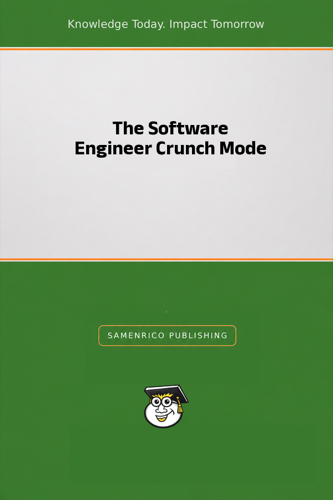
The Software Engineer Crunch Mode eBook
Handles release deadlines, on call rotation, and b
Handles release deadlines, on call rotation, and bug pressure.
Formats
Free sample
Chapter 1: The Hero's Funeral--You have been the hero. Or you have worked with one. Or you have managed one and wondered why they quit so suddenly, leaving behind a half-finished wiki page and a Slack status that simply says "Goodbye."The hero coder is the engineer who stays until midnight. Who answers the page at 2 AM on a Saturday. Who untangles the merge conflict that three other people looked at and walked away from.
Who carries the knowledge of the payment system in their head because "there wasn't time to document it." Who is praised in sprint retrospectives, nominated for "MVP of the Quarter," and quietly, invisibly, falling apart.This chapter is an autopsy. Not of a person, but of a myth. The myth that heroism is sustainable. The myth that one engineer working twice as hard is better than four engineers working calmly. The myth that crunch mode is a temporary necessity rather than a chronic disease.By the end of this chapter, you will understand why the hero always burns out.
You will see the three toxins that turn every deadline into a death march. And you will begin to suspect something radical: that the best engineering teams are not the ones with the most heroes. They are the ones that never needed heroes in the first place.The Day the Hero Quit Let me tell you about Sarah.Sarah was a senior backend engineer at a mid-sized fintech startup. She had been there for three years. She was the only person who understood the fraud detection pipeline, the only one who could debug the Kafka consumer that mysteriously died every fourth Tuesday, and the only one who remembered why a particular UUID field was stored as a string instead of a binary.Sarah worked an average of 55 hours per week.
During "release weeks," which happened every six weeks like clockwork, she worked 70. She never took all her vacation days. She answered pages during dinner, during her daughter's soccer games, and once, memorably, from the bathroom at a wedding.Her manager called her "indispensable." Her peers called her "amazing." Sarah called herself "tired."One Monday, after a particularly brutal release that involved three all-nighters and a production rollback at 4 AM, Sarah submitted her resignation. No two weeks' notice. No exit interview.
She simply sent an email to her manager and HR at 6 AM, attached her laptop to a shipping label, and never logged into the VPN again.The team collapsed. Not because Sarah was malicious, but because her heroism had been the structural support holding up a collapsing building. No one knew how the fraud pipeline worked. No one had access to the secrets stored in her local environment variables. No one had ever seen the postman collection for the payment webhooks.
The company spent the next four months scrambling, losing an estimated $1.2 million in fraud losses and engineering time.Here is what the postmortem did not say: Sarah was the problem.Here is what the postmortem should have said: The system was designed to require a hero. When the hero left, the system fell.The 10x Myth: Where It Comes From, Why It's Wrong The myth of the "10x engineer"—a programmer who is ten times more productive than the average—has been a staple of software folklore since the 1960s. The original research, conducted at IBM in 1968, did find wide variations in programmer productivity. But the study measured simple coding tasks: writing loops, sorting arrays, calculating factorials. It had nothing to say about modern software engineering: distributed systems, reliability engineering, security, observability, team coordination, code review, documentation, mentoring, or the thousand other activities that constitute real engineering work.The 10x myth persists because it is flattering to the people who believe themselves to be the heroes.
It is also convenient for managers who would rather hire one "genius" than build a functional team. And it is seductive to investors who want to believe that a single brilliant founder can out-code an entire engineering organization.But the data tells a different story. A metastudy of over 50 software development teams, published in Empirical Software Engineering in 2019, found that the most productive teams were not the ones with the highest "star power." They were the ones with the lowest variance in individual productivity—meaning that everyone contributed roughly equally, and no one was doing more than their share. The best predictor of team velocity was not individual brilliance but psychological safety: the degree to which team members felt safe asking for help, admitting mistakes, and saying "I don't know."The hero engineer, by contrast, creates an environment of low psychological safety. When one person can fix everything, others become afraid to touch the code.
When the hero works 60-hour weeks, others feel pressured to match that pace even if it destroys their own health. When the hero holds all the knowledge, the team becomes brittle, one departure away from catastrophe.Sarah's team did not need a hero. They needed a sustainable on-call rotation, a documented fraud pipeline, and a manager who said "no" to the feature that required three all-nighters. They got a hero instead. And when the hero left, they got nothing.The True Cost of Crunch: What the Research Says Let us examine the cognitive economics of overtime.
The assumption behind crunch mode is simple: more hours = more output. This assumption is catastrophically wrong for knowledge work.A landmark study published in The Lancet in 2015 tracked over 600,000 workers across Europe and found that working more than 55 hours per week was associated with a 33% increase in stroke risk and a 13% increase in coronary heart disease risk, even after controlling for other health factors. But the damage is not only physical. A controlled experiment conducted by the software engineering research group at Carnegie Mellon University gave 60 professional programmers the same coding task under two conditions: a 40-hour week and a 60-hour week. The results, published in 2018, showed that productivity (measured as features completed per hour) dropped by 50% after the second week of 60-hour work.
By the third week, the overtime group was producing fewer features than the 40-hour group and introducing three times as many bugs.The reason is not mysterious. Cognitive throughput—the brain's ability to process information, hold multiple variables in working memory, and make logical deductions—degrades linearly with fatigue. After 50 hours of work in a week, each additional hour produces less than half the value of the first hour. After 60 hours, the value of the marginal hour approaches zero and can become negative if the engineer introduces bugs that will take future hours to fix.This is the Burnout ROI, and it is unforgiving:Hours per week Effective output (indexed to 40h)Bug rate (relative)401.00x1.00x501.15x1.50x551.10x2.20x600.95x3.20x650.80x4.50x At 60 hours, you are producing less value than a 40-hour engineer and creating more than three times the future maintenance work. Crunch mode does not accelerate delivery.
It borrows time from the future at predatory interest rates, and the bill always comes due.The Three Toxins: A Feedback Loop of Failure The hero culture does not emerge from nowhere. It emerges from three specific pressures that, when combined, create a self-reinforcing…
This is the end of the free sample. Get the eBook to keep going. Buy now
About this book
Details
- Author
- Carrington Cassidy
- Publisher
- SamEnrico
- Language
- English
- Genre
- Non-Fiction, Self-Help, Tech
- Released
- 2026-06-09
- Pages (approx.)
- 139
- Available as
- eBook, Audiobook

Read better in the ZLOADR app
Your eBooks on your phone or tablet. Sign in with your SamEnrico account and start reading.
More by Carrington Cassidy
 Unsubscribe Marketing EmailsCarrington Cassidy$11.99
 Precipitated Withdrawal AvoidanceCarrington Cassidy$11.99
 Active Listening For AutismCarrington Cassidy$11.99
 The Stoic and the Sage: Marcus Aurelius and the Birth of Western ThoughtCarrington Cassidy$11.99
 Learn to Play the RackettCarrington Cassidy$11.99
 How to Start a Network Interface Cards Business (Beginners Guide)Carrington Cassidy$11.99
 Customer Support AdvocateCarrington Cassidy$11.99
 Working Capital Analysis with AICarrington Cassidy$12.99
You may also like
 Technology Anger TriggersJustus Hank$11.99
 Incognito Mode AccountabilityFaber Kayleen$11.99
 Work Addiction in Tech IndustryKroll Nu$11.99
 TM App and Timer GuideTownes Wei$11.99
 Outsourcing for Tech StartupsDevries Janette$11.99
 The Breath Counting App SupplementDonnell Lavelle$11.99
 Anger for Software EngineersRatcliff Claris$11.99
 Food Addiction Recovery for Software EngineersLusk Deirdre$11.99
 Remote Work VPN GuideBlaine Melisa$11.99
 Technology for Caregivers GuideOtis Norine$11.99Technology for Caregivers GuideOtis Norine$11.99
 Software Engineer Crunch TimeHerzog Stephany$11.99