
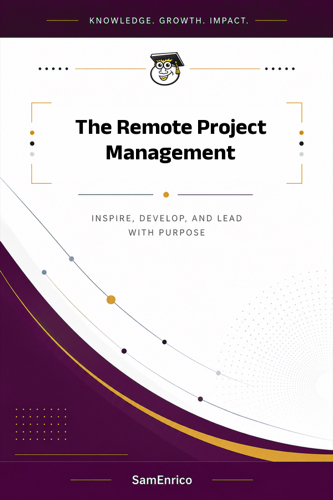
Non-FictionBusiness BriefProject
The Remote Project Management eBook
Track progress and coordinate tasks across distrib
Track progress and coordinate tasks across distributed teams.
Formats
Free sample
Chapter 1: The Watercooler Lie--Let me tell you something that every management book of the past fifty years has gotten wrong.They told you that effective leadership requires presence. That you need to walk the floor, read body language, overhear conversations, and catch people in the act of either doing great work or slacking off. They sold you on the myth of the watercooler—that spontaneous collision of human beings where creativity sparks, problems surface, and trust gets built through osmosis.It was a beautiful lie. And it only worked because we were all in the same building.Now the building is gone. The watercooler is a Slack channel that nobody checks.
The walkable floor is a Zoom grid of frozen faces and awkward silences. And the management playbook you inherited? It's not just outdated. It's actively destroying your team's productivity, your mental health, and your reputation as a leader.I know this because I've been that PM. The one refreshing Slack every thirty seconds, wondering why nobody responded to the urgent message you sent four hours ago.
The one scheduling back-to-back "quick check-ins" that somehow always run forty-five minutes. The one lying awake at 2 AM, staring at the ceiling, thinking: I have no idea what anyone on my team actually did today.The problem isn't you. The problem isn't your team. The problem is the operating system you're running.You're trying to manage a distributed team with a colocated mindset. You're measuring availability when you should be measuring responsiveness.
You're demanding presence when you should be demanding progress. You're running synchronous playbooks in an asynchronous world.This chapter is going to break that pattern. By the time you finish reading, you'll understand why traditional management fails in remote settings, what the fundamental shift from synchronous to asynchronous coordination actually looks like, and how to measure what really matters—not whether people are at their desks, but whether work is moving forward.Let's start with a story. It's a story about a project manager named Elena, a software engineer named Marcus, and the week that everything fell apart.The Monday That Broke Elena Elena managed a distributed team of twelve—developers in Poland, designers in Brazil, product managers in California, and quality assurance in the Philippines. She was good at her job.
She'd been a project manager for eight years, four of them in person and four hybrid. When her company went fully remote in 2020, she thought she had it figured out.She was wrong.It started on a Monday. Elena woke up at 6 AM Pacific Time, grabbed her phone, and opened Slack. She had forty-seven unread messages across twelve channels. She scrolled through them while brushing her teeth.
Most were from the weekend—casual chatter, memes, a few "hey, quick question" messages that weren't actually quick.She flagged the ones that seemed important and moved on.By 8 AM, she was in her first meeting of the day—a standup with the Polish developers. It was 5 PM for them. She could see the fatigue in their eyes. They rushed through their updates: "Did the thing. Working on the thing.
No blockers." She asked follow-up questions. They gave one-word answers. She ended the meeting twenty minutes later, no clearer than when she started.At 9 AM, she had a design review with the Brazilian team. Their internet was spotty. The Figma file kept freezing.
She spent half the meeting saying, "Can you hear me? Can you see my screen? Let me share again."At 10 AM, she had a one-on-one with her California product manager. He was supposed to have delivered requirements for a major feature by Friday. He hadn't.
When she asked why, he said, "I've been waiting on feedback from legal for two weeks." She asked if he'd escalated. He said, "I sent an email. I figured they'd get to it."At 11 AM, she had a client call. The client was angry. A deliverable that was supposed to be ready on Friday wasn't.
Elena had approved the timeline based on the team's estimates. She didn't know that the Polish developer assigned to the task had been out sick for three days. He hadn't told anyone. He'd just... stopped responding.By noon, Elena had been in four meetings, sent twenty-three Slack messages, and made exactly zero progress on her actual work.
She hadn't eaten. She hadn't moved from her chair. And she still had no idea whether her team was on track.The rest of the week went like this:Tuesday: More meetings. More Slack threads. A fire drill when the Brazilian designer realized she'd been working from the wrong version of a file for two weeks.
Nobody had told her the file had been updated.Wednesday: The Wednesday Black Hole. No momentum. No urgency. Just a grey sludge of "still working on it" status updates and "just following up" messages.Thursday: Panic. The Polish developer resurfaced.
He hadn't been sick. He'd been struggling with a technical dependency he couldn't solve. Instead of asking for help, he'd gone silent, hoping the problem would somehow resolve itself. It hadn't.Friday: Elena worked until 9 PM, firefighting. She pushed the client deliverable to Monday.
The client was furious. Her boss asked, "How did you not know this was going to happen?" She didn't have an answer.That weekend, Elena sat on her couch and wondered if she was cut out for remote project management. She'd done everything right—according to the old playbook. Daily standups. Weekly status reports.
Regular check-ins. Open-door policy. She'd been available. She'd been responsive. She'd been everywhere, all at once.And it hadn't mattered.Because she'd been measuring the wrong things.The Fallacy of Proximity Here's what Elena—and most project managers—didn't understand: colocated management works through a series of invisible information channels that simply don't exist in remote environments.When you manage in person, you absorb information without asking for it.
You overhear conversations. You see body language. You notice who looks tired, who looks stressed, who looks like they're about to snap. You walk past someone's desk and glance at their screen—not to spy, but to get a sense of what they're working on. You eat lunch with people and hear about problems before they become crises.These are not formal management techniques.
They're ambient awareness. And they require physical proximity.In a remote environment, ambient awareness drops to zero. You cannot overhear. You cannot observe. You cannot casually glance.
Every piece of information must be actively requested, deliberately shared, and explicitly documented.Most project managers respond to this loss by doubling down on synchronous communication. More meetings. More check-ins. More "just hopping on a quick call."This is the exact wrong response.When you increase synchronous communication in a remote environment, you don't increase awareness. You increase interruption, resentment, and burnout.
You force people into time zones that don't fit their lives. You replace deep work with shallow updates. And you create the illusion of progress—because meetings feel productive, even when they accomplish nothing.The research backs this up. A 2021 study by the National Bureau of Economic Research found that the shift to remote work increased the average number of meetings per employee by 13 percent but…
This is the end of the free sample. Get the eBook to keep going. Buy now
About this book
Details
- Author
- Madsen Vernell
- Publisher
- SamEnrico
- Language
- English
- Genre
- Non-Fiction, Business Brief, Project
- Released
- 2026-06-09
- Pages (approx.)
- 148
- Available as
- eBook, Audiobook

Read better in the ZLOADR app
Your eBooks on your phone or tablet. Sign in with your SamEnrico account and start reading.
More by Madsen Vernell
 Step Six Becoming ReadyMadsen Vernell$11.99
 Hair Loss After 60 GuideMadsen Vernell$11.99
 AED Error Messages GuideMadsen Vernell$11.99
 The Bear and the Eagle: Mikhail Gorbachev and the Soviet-Afghan WarMadsen Vernell$11.99
 How to Produce Blu-ray Disc Recordable MediaMadsen Vernell$11.99
 UK Business Credit IndustryMadsen Vernell$12.99
 Bismite MiningMadsen Vernell$11.99
 How to Start a Benniseed Oil Refining Business (Beginners Guide)Madsen Vernell$11.99
You may also like
 Hong Kong Handover 1997Dunn Johnnie$11.99
 Zumba For Postnatal Recovery CourseNeal Christian$11.99
 Zumba for BeginnersLadner Nikia$11.99
 YouTube Comment Mining GuideHumes Pandora$12.99
 Worry Box MeditationCarlin Rudy$11.99
 Workplace Stress MeditationNguyen Lynn$11.99
 Workplace Stress and Sleep RepairHawley Ivory$11.99
 Workplace Perfectionism CureDelaney Jeffry$11.99
 Workplace Injustice Anger GuideWallen Isabelle$11.99
 Work Addiction and Burnout LinkGreenwood Ester$11.99
 Women in Yoga and WellnessBeattie Galina$11.99
 Women in Stand Up ComedyChun Evangeline$11.99