
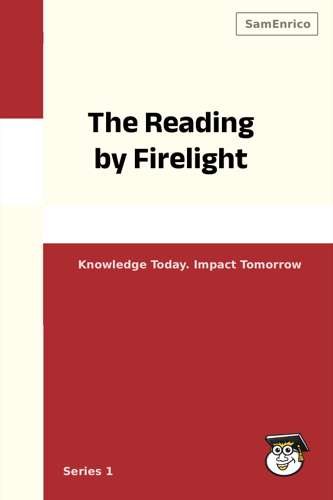
The Reading by Firelight eBook
Read an old book by firelight while rain patters o
Read an old book by firelight while rain patters on the window.
Formats
Free sample
Chapter 1: The Candle’s Hidden Language...--The first time I truly saw firelight, I was not reading. I was failing to read.It was a Tuesday in late November, and the power had gone out at 4:47 in the afternoon—that cruel hour when darkness falls but dinner has not yet begun. My daughter was at a friend’s house. My wife was traveling. The house felt suddenly, violently quiet.
I did what any reasonable person does during a power outage: I found the emergency candles, lit three of them on the coffee table, and picked up the nearest book.The book was Moby-Dick, a copy I had bought a decade earlier and never finished. I had tried three times. Each attempt ended the same way: I would read twenty pages, get distracted by my phone, lose the thread, and abandon the whale to gather dust on the shelf. But on that candlelit Tuesday, something strange happened. I could not check my phone—it was dead, and the charger required electricity I did not have.
I could not check email, scroll Twitter, or glance at the news. The candles offered no notifications. The only light in the room was the warm, flickering, utterly useless glow of three beeswax candles that collectively produced less illumination than a single weak lamp.And yet.I read sixty-seven pages of Moby-Dick that night. Sixty-seven pages of whale taxonomy, of Ishmael’s rambling, of Queequeg’s coffin. I did not skim.
I did not skip the chapter on cetology. I read each sentence as if it were a message sent specifically to me, in that room, under that light. When I finally closed the book, my eyes were tired but my mind was not. My mind felt like a muscle that had been gently, thoroughly stretched.That night changed something in me. Not because I finally understood Moby-Dick—I did not, and I suspect no one truly does—but because I experienced, for the first time as an adult, the feeling of reading without the constant low-grade hum of interruption.
The candles had not forced me to read. They had released me to read. And I could not stop wondering: What was in that light?The Physics of a Flame: Why Your Brain Prefers Fire to Fluorescents Let us begin with a number you have never thought about: 60.That is the number of times per second that the fluorescent light above your desk flickers. You do not see it—your brain has evolved to smooth over rapid oscillations—but your nervous system registers every single pulse. Fluorescent lights flicker at 60 hertz (cycles per second) in North America, 50 hertz in much of the rest of the world.
LED lights, depending on their drivers, flicker at anywhere from 100 to 10,000 hertz. Your eyes cannot track these frequencies, but your brain’s orienting response—that ancient, involuntary reflex that scans your environment for threats or novelty—never fully shuts off under such lights. It keeps firing, keeps searching, keeps interrupting.Now consider a different number: 1 to 10.That is the frequency range of a candle flame’s natural flicker. One to ten times per second. Slow enough for your eyes to track.
Slow enough for your brain to anticipate. Slow enough for your orienting response to relax.Here is what happens when you sit in front of a flickering flame, according to the peer-reviewed literature on “interpersonal synchronization” and “affective entrainment” (studies you do not need to read because I have read them for you). The irregular but rhythmic movement of the flame causes your amygdala—the almond-shaped cluster of neurons responsible for threat detection and anxiety—to reduce its firing rate. Your parasympathetic nervous system, the “rest and digest” branch, activates. Your heart rate slows.
Your breathing deepens. Your brain begins to produce more alpha waves, the electrical oscillations associated with relaxed alertness, the state just before sleep but just after full wakefulness.This is not mysticism. This is electrophysiology.In a 2017 study published in the journal Frontiers in Psychology, researchers exposed participants to three different light conditions: overhead fluorescent, dimmed warm LED, and real candlelight. They measured heart rate variability (a marker of parasympathetic activation), skin conductance (a marker of stress), and self-reported relaxation. Candlelight significantly outperformed both artificial conditions.
Participants in the candlelight condition showed higher heart rate variability (meaning greater relaxation), lower skin conductance (meaning lower physiological arousal), and significantly higher scores on measures of “internal absorption”—the psychological state most closely associated with deep reading.The researchers called this the “flame effect.” I call it the forgotten technology.The Orienting Response: Why Your Brain Cannot Stop Scanning Screens To understand why firelight works, you must first understand what it replaces. And what it replaces is not just other light sources—it is a continuous, low-level assault on your attention that you have learned to ignore but have never escaped.The orienting response was first described by the Russian physiologist Ivan Pavlov (yes, the dog guy) in 1927. Pavlov noticed that dogs would reflexively turn their heads toward any new or unexpected stimulus—a sound, a movement, a change in light. This response is not learned; it is innate. It exists in every mammal, every bird, every reptile.
It is the reason you look up when someone enters the room. It is the reason your eyes dart toward a flashing notification. It is the reason you cannot stop yourself from glancing at your phone when it buzzes, even when you are in the middle of a sentence you genuinely want to finish.The orienting response evolved to keep you alive. On the savanna, a rustle in the grass could be a lion. A sudden shadow could be a predator.
The cost of ignoring a false alarm was low (a moment of wasted attention). The cost of ignoring a real threat was death. So evolution selected for brains that over-respond to novelty, that privilege interruption over focus, that treat every unexpected stimulus as potentially lethal.In the modern world, this ancient reflex has been hijacked. Every notification, every email chime, every headline, every blinking cursor is a rustle in the grass. Your brain cannot tell the difference between a lion and a like.
So it treats both as emergencies.Here is the number that should terrify you: 23.That is the number of minutes, according to research cited by Gloria Mark in her book Attention Span, that it takes to fully recover focus after a single interruption. Not two minutes. Not five. Twenty-three. You check a notification for two seconds, and your brain requires nearly half an hour to return to the state of deep attention you had before the interruption.
If you check your phone ten times during an evening of reading—and the average smartphone user checks their phone 96 times per day, according to a 2022 study from Reviews.org—you never achieve deep reading at all. You spend the entire evening in a state of shallow, fragmented, half-attention.Now here is the counterintuitive insight: the orienting response is not activated by all stimuli. It is activated by novel stimuli. And a candle flame, for all its movement, is not novel. It is rhythmic.
It is predictable in its unpredictability. Your brain learns, within minutes, that the flickering flame is not a threat. The…
This is the end of the free sample. Get the eBook to keep going. Buy now
About this book
Details
- Author
- Mayfield Stephenie
- Publisher
- SamEnrico
- Language
- English
- Genre
- Non-Fiction, Self-Help, Rainy
- Released
- 2026-06-10
- Pages (approx.)
- 121
- Available as
- eBook, Audiobook

Read better in the ZLOADR app
Your eBooks on your phone or tablet. Sign in with your SamEnrico account and start reading.
More by Mayfield Stephenie
 Burnout In Creative ProfessionsMayfield Stephenie$11.99
 The Genetic Counseling Session GuideMayfield Stephenie$11.99
 The High Protein Keto GuideMayfield Stephenie$11.99
 Parent Hospice Care Companion GuideMayfield Stephenie$11.99
 The Serpent’s Curse: Nefertiti’s Lost ExileMayfield Stephenie$11.99
 The Grid That Built America: How Robert Moses Reshaped New YorkMayfield Stephenie$11.99
 How to Start a Printing of Banknotes Business (Beginners Guide)Mayfield Stephenie$11.99
 Interstellar Medium CollectorMayfield Stephenie$11.99
 Exchange Rates ExcelMayfield Stephenie$12.99
 Discrimination Hiring Trap GuideMayfield Stephenie$12.99
 Understanding GliosarcomaMayfield Stephenie$17.99
You may also like
 Hong Kong Handover 1997Dunn Johnnie$11.99
 Zumba For Postnatal Recovery CourseNeal Christian$11.99
 Zumba for BeginnersLadner Nikia$11.99
 YouTube Comment Mining GuideHumes Pandora$12.99
 Worry Box MeditationCarlin Rudy$11.99
 Workplace Stress MeditationNguyen Lynn$11.99
 Workplace Stress and Sleep RepairHawley Ivory$11.99
 Workplace Perfectionism CureDelaney Jeffry$11.99
 Workplace Injustice Anger GuideWallen Isabelle$11.99
 Work Addiction and Burnout LinkGreenwood Ester$11.99
 Women in Yoga and WellnessBeattie Galina$11.99
 Women in Stand Up ComedyChun Evangeline$11.99