
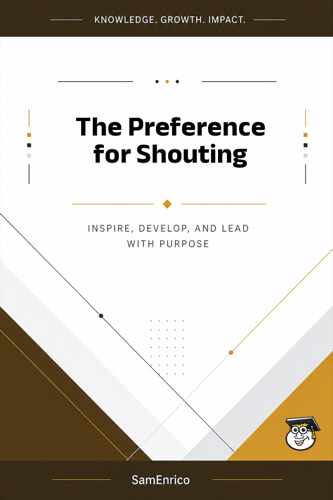
The Preference for Shouting
Why some parents choose yelling over connection, a
Why some parents choose yelling over connection, and how to stop.
Formats
About this book
Free sample
Chapter 1: The Yelling Hangover--When Sarah lost her temper with her four-year-old daughter for the third time before breakfast, she did what most parents do afterward. She stood in the kitchen, hands trembling, replaying the sound of her own voice. Why did I shout? She was just being four. I am a terrible mother.
I cannot control myself. What is wrong with me?Then she poured her coffee, avoided eye contact with her daughter for twenty minutes, and promised herself—sincerely, desperately—that she would never yell again. By dinner, she had yelled twice more.This is not a story about a bad parent. This is a story about the Yelling Hangover, and it is the story of millions of parents who wake up every morning intending to be calm, connected, and kind, only to find themselves shouting by mid-afternoon, then drowning in guilt by bedtime.The Yelling Hangover is the wave of shame, self-recrimination, and exhaustion that follows a shouting episode. It is called a hangover not because it involves alcohol, but because it shares the same three features: first, the impulsive act (the yell); second, the temporary relief (the tension release); and third, the crushing aftermath (the guilt, the avoidance, the renewed promise to change).
And like a hangover, the Yelling Hangover creates amnesia. In the moment of shouting, parents rarely think about the aftermath. They only feel the urgency of now. Then, when the hangover hits, they cannot believe they did it again.The central argument of this book is that yelling is not a character flaw. It is not evidence that you are a bad parent, a broken person, or someone who does not love their children enough.
Yelling is a learned response—a neurological pathway that has been reinforced over time until it became your brain's preferred shortcut for discharging stress. What starts as a neural default (inherited from your own childhood or forged in the crucible of sleep deprivation) becomes a learned preference because the brain craves the relief that yelling provides.This chapter is about understanding that mechanism. You cannot change a behavior you do not…
This is the end of the free sample. Get the eBook to keep going. Buy now
Contents
- Chapter 1
- Chapter 2
- Chapter 3
- Chapter 4
- Chapter 5
- Chapter 6
- Chapter 7
- Chapter 8
- Chapter 9
- Chapter 10
- Chapter 11
- Chapter 12
Details
- Author
- Mcbride Christina
- Publisher
- SamEnrico
- Language
- English
- Genre
- Non-Fiction, Parenting
- Released
- 2026-06-09
- Pages (approx.)
- 118
- Available as
- eBook, Audiobook

Read better in the ZLOADR app
Your eBooks on your phone or tablet. Sign in with your SamEnrico account and start reading.
More by Mcbride Christina
 Wholesaling Title Search BasicsMcbride Christina$11.99
 The MBSR for Fibromyalgia GuideMcbride Christina$11.99
 No Poach Agreement FinesMcbride Christina$11.99
 Refugee Childhood Self WorthMcbride Christina$11.99
 Metta For Difficult EmotionsMcbride Christina$11.99
 DNA from Hair Root AnalysisMcbride Christina$11.99
 Quadriceps Strain RehabilitationMcbride Christina$11.99
 Behavioral Change ManagementMcbride Christina$11.99
 The Silent Healer: Ancient India's Forgotten Brain SurgeonMcbride Christina$11.99
 Mirroring Madness: The Unseen Hand Behind the Copycat MurdersMcbride Christina$11.99
 Ananse's Golden Thread: The Spider’s Web of Love and DeceitMcbride Christina$11.99
 How to Start a Hobby in GamingMcbride Christina$11.99