
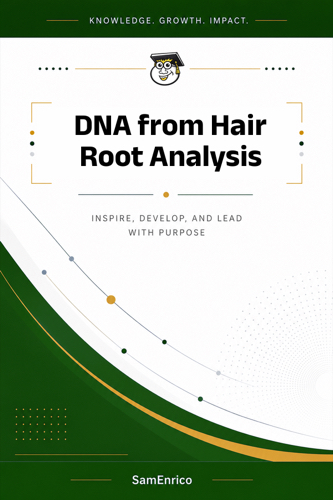
Non-FictionTrue CrimeDNA Analysis
DNA from Hair Root Analysis
Extract nuclear DNA from hair follicles for suspec
Extract nuclear DNA from hair follicles for suspect identification.
Formats
About this book
Free sample
Chapter 1: The Silent Witness...--The yellowed evidence envelope had been sitting in the same cold storage locker for thirty-four years. Inside, sealed in a small paper bindle, was a single strand of hair—forcibly pulled, still bearing a translucent bulb of tissue at its root. In 1987, when the envelope was first sealed, forensic scientists could look at that root under a microscope and say with confidence: This hair is human. It came from a person of European ancestry. It was pulled, not shed.
That was all. The root could not name its owner. It could not distinguish between the victim’s boyfriend and a stranger passing through town. It was a silent witness—present at the crime, burdened with evidentiary weight, but unable to speak.In 2021, a cold case detective requested that same hair root be re-examined. A forensic biologist placed the root in a digestion buffer, extracted the DNA, amplified it, and produced a full Short Tandem Repeat profile—twenty genetic markers that function as a biological fingerprint.
That profile was entered into CODIS, the FBI’s national DNA database. Within hours, it returned a match to a man who had been living three hundred miles away, serving a prison sentence for an unrelated offense. The root finally spoke. Its name was Donald G. Smith.This is the story of how forensic science transformed the humblest piece of biological evidence—a single hair root—from a near-useless curiosity into one of the most powerful identification tools available to law enforcement.
It is also a story of limitations, of false starts, and of the careful, painstaking work required to extract truth from microscopic traces.The Long Shadow of Microscopy Before the advent of DNA analysis, hair examination was almost exclusively the domain of microscopists. A trained forensic analyst could place a hair on a glass slide, mount it in a medium, and examine it under a comparison microscope at magnifications of 100x to 400x. They could measure the hair’s diameter, note the pattern of its cuticle scales (the overlapping outer layer), assess the distribution of pigment granules (melanin) in the cortex…
This is the end of the free sample. Get the eBook to keep going. Buy now
Contents
- Chapter 1
- Chapter 2
- Chapter 3
- Chapter 4
- Chapter 5
- Chapter 6
- Chapter 7
- Chapter 8
- Chapter 9
- Chapter 10
- Chapter 11
- Chapter 12
Details
- Author
- Mcbride Christina
- Publisher
- SamEnrico
- Language
- English
- Genre
- Non-Fiction, True Crime, DNA Analysis
- Released
- 2026-06-09
- Pages (approx.)
- 150
- Available as
- eBook, Audiobook

Read better in the ZLOADR app
Your eBooks on your phone or tablet. Sign in with your SamEnrico account and start reading.
More by Mcbride Christina
 Wholesaling Title Search BasicsMcbride Christina$11.99
 The MBSR for Fibromyalgia GuideMcbride Christina$11.99
 No Poach Agreement FinesMcbride Christina$11.99
 The Preference for ShoutingMcbride Christina$11.99
 Refugee Childhood Self WorthMcbride Christina$11.99
 Metta For Difficult EmotionsMcbride Christina$11.99
 Quadriceps Strain RehabilitationMcbride Christina$11.99
 Behavioral Change ManagementMcbride Christina$11.99
 The Silent Healer: Ancient India's Forgotten Brain SurgeonMcbride Christina$11.99
 Mirroring Madness: The Unseen Hand Behind the Copycat MurdersMcbride Christina$11.99
 Ananse's Golden Thread: The Spider’s Web of Love and DeceitMcbride Christina$11.99
 How to Start a Hobby in GamingMcbride Christina$11.99
You may also like
 Hong Kong Handover 1997Dunn Johnnie$11.99
 Zumba For Postnatal Recovery CourseNeal Christian$11.99
 Zumba for BeginnersLadner Nikia$11.99
 YouTube Comment Mining GuideHumes Pandora$12.99
 Worry Box MeditationCarlin Rudy$11.99
 Workplace Stress MeditationNguyen Lynn$11.99
 Workplace Stress and Sleep RepairHawley Ivory$11.99
 Workplace Perfectionism CureDelaney Jeffry$11.99
 Workplace Injustice Anger GuideWallen Isabelle$11.99
 Work Addiction and Burnout LinkGreenwood Ester$11.99
 Women in Yoga and WellnessBeattie Galina$11.99
 Women in Stand Up ComedyChun Evangeline$11.99