
Non-FictionSelf-HelpNeuroscience
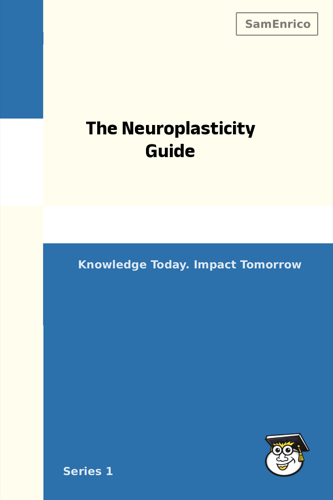
The Neuroplasticity Guide eBook
Understand how your brain changes with effort and
Understand how your brain changes with effort and practice.
Formats
Free sample
Chapter 1: The Unfixable Myth--–- On a cold morning in 1963, a twenty-one-year-old woman named Patricia walked into a neurologist’s office with a metal plate in her head, a seizure disorder that had consumed her childhood, and a question that doctors had answered with the same word for ten years: impossible. She wanted to learn to drive. The left hemisphere of her brain had been removed when she was five years old—a hemispherectomy to stop life-threatening seizures. Standard medical doctrine at the time stated that an adult brain was hardwired, fixed, and incapable of significant reorganization. Patricia had half a brain.
She should have been severely disabled, unable to walk properly, let alone operate a vehicle. The neurologist examined her. He ran tests. And then he watched in disbelief as Patricia walked normally, spoke fluently, and expressed frustration not at her limitations but at a system that kept telling her what she could not do. She did learn to drive.
She lived independently. And her case, documented in the medical literature, became a quiet time bomb ticking beneath the foundations of neuroscience. If a woman with half a brain could rewire herself to function as a whole, what else had the textbooks gotten wrong?This is the question that launched a revolution. And it is the question that this book will answer, not with abstract theory but with the practical, how-to science of changing your own brain.The Machine That Never Was For most of modern history, the brain was understood as a machine. Not a metaphorical machine, but a literal one: gears, wires, fixed circuits, replacement parts impossible.
The dominant model, known as localizationism, held that every mental function lived in a specific, unchanging brain region. Language lived in Broca’s area. Vision lived in the occipital lobe. Memory lived in the hippocampus. And once those regions were damaged or those circuits were set in childhood, they stayed that way forever.
This was not a fringe belief. It was the core assumption of neurology, psychiatry, and education for nearly a century.The consequences of this assumption were devastating in ways that are hard to overstate. If a child struggled with reading, the machine model said they had a “faulty circuit” that could not be repaired. If an adult suffered a stroke, rehabilitation was often minimal because the medical establishment believed the lost function was gone permanently. If you developed anxiety or depression, the model suggested your brain was simply “broken” in a way that could only be managed, not rewired.
And if you believed you were “not a math person” or “not creative” or “too old to learn an instrument,” the machine model validated that belief as biological destiny.This belief system had a name: the static brain hypothesis. And it was wrong.The static brain hypothesis was not born from malice or incompetence. It emerged from perfectly reasonable observations. When early neuroscientists damaged specific areas of animal brains, specific functions disappeared. Damage the motor cortex, and movement ceased.
Damage the visual cortex, and sight vanished. These experiments seemed to prove that the brain was a collection of dedicated, non-overlapping modules. What the early scientists could not see—because the technology did not yet exist—was what happened after the damage. They observed the deficit immediately after injury and assumed it was permanent. They did not watch for weeks or months as the brain, silently and without permission, began to reorganize itself around the wound.The first cracks in the static brain hypothesis appeared in the 1970s, but they were dismissed as anomalies.
A rat with damage to its somatosensory cortex would eventually regain sensation in its paw—but that was just a rat, critics said. A songbird that lost the brain region controlling its song would learn to sing again using other regions—but birds are not mammals. A stroke patient who could not speak would sometimes, years later, begin uttering words—but that was just spontaneous recovery, not true rewiring. The machine model was so deeply entrenched that evidence against it was explained away rather than examined.Then came the maps.The Mapmaker Who Changed Everything In the 1980s, a neuroscientist named Michael Merzenich did something that seemed simple but turned out to be revolutionary. He recorded, in exquisite detail, the brain maps of monkeys before and after learning a new skill.
He was not looking for plasticity. He was studying how the brain represented touch and movement. But what he found changed his career—and the field of neuroscience—overnight.Merzenich trained monkeys to perform a task that required them to touch a rotating disk with their fingertips. The task was difficult. It required precision and practice.
After weeks of training, Merzenich reopened the monkeys’ brains and looked at their cortical maps—the neural representations of each finger. The maps had changed. Dramatically. The brain regions dedicated to the fingertips that did the touching had expanded, pushing into neighboring territories. Fingers that were not used had shrunk.
The brain had not simply adjusted. It had physically, measurably reorganized itself in response to experience.Merzenich published his findings, and the static brain hypothesis began to crumble. But the old guard did not surrender easily. The criticism was immediate: monkeys are not humans. Fine motor training is not real-world learning.
Cortical map expansion might be temporary. Merzenich responded by doing the experiments again, this time with humans, using new brain imaging technologies like f MRI. The results were identical. When humans learn to play the piano, the brain region controlling the fingers expands. When violinists play, their cortical representation of the left hand (the hand that does the fingering) grows larger than the right.
When taxi drivers learn London’s labyrinthine streets, their hippocampus expands. When jugglers learn a three-ball cascade, their visual and motor cortices thicken. When stroke patients undergo intensive physical therapy, surviving brain regions take over the work of dead ones.The evidence was overwhelming. The brain is not a machine. It is a living, breathing, electrically active organ that reshapes itself in response to every thought, every action, every moment of attention.
This property is called neuroplasticity, from neuro (nerve) and plastos (molded or shaped). And it is the single most important fact about your brain that your doctor, your teacher, and your parents probably never told you.What Neuroplasticity Is—And What It Is Not Before we go any further, we need to be precise. Neuroplasticity has become a buzzword, slapped onto everything from brain-training apps to self-help seminars. In popular culture, it is often presented as a magical cure-all: just think positive thoughts and your brain will rewire itself. That is not what the science says.
Neuroplasticity is real, it is powerful, and it has genuine limits. Understanding both the power and the limits is the difference between using plasticity to change your life and being seduced by empty promises.Here is what neuroplasticity is: the lifelong ability of your brain to reorganize its structure and function in response to experience, learning, injury, or disease. This reorganization happens at multiple levels simultaneously—from the microscopic (individual synapses strengthening or weakening) to the macroscopic (entire cortical regions expanding or contracting). When you learn a…
This is the end of the free sample. Get the eBook to keep going. Buy now
About this book
Details
- Author
- Vasquez Darla
- Publisher
- SamEnrico
- Language
- English
- Genre
- Non-Fiction, Self-Help, Neuroscience
- Released
- 2026-06-07
- Pages (approx.)
- 153
- Available as
- eBook, Audiobook

Read better in the ZLOADR app
Your eBooks on your phone or tablet. Sign in with your SamEnrico account and start reading.
More by Vasquez Darla
 Postpartum Walking ProgramVasquez Darla$11.99
 Pink Noise Sleep GuideVasquez Darla$11.99
 Stress and Chronic Inflammation LinkVasquez Darla$11.99
 Job Loss Identity RecoveryVasquez Darla$11.99
 Hispanic Latina Breast Health GuideVasquez Darla$11.99
 Group Creativity for ConsultantsVasquez Darla$11.99
 The Dueling Stars: Love, Betrayal, and the First Latin American Olympic GymnastVasquez Darla$11.99
 Influence Techniques for PharmacistsVasquez Darla$11.99
 The Forgotten General: Paik Sun-Yup and the Birth of Modern KoreaVasquez Darla$11.99
 How to Produce Paintball Air TanksVasquez Darla$11.99
 A Collector's Handbook to the Triumph Spitfire MkivVasquez Darla$11.99
 Cradle to Cradle Export HandbookVasquez Darla$12.99
You may also like
 Hong Kong Handover 1997Dunn Johnnie$11.99
 Zumba For Postnatal Recovery CourseNeal Christian$11.99
 Zumba for BeginnersLadner Nikia$11.99
 YouTube Comment Mining GuideHumes Pandora$12.99
 Worry Box MeditationCarlin Rudy$11.99
 Workplace Stress MeditationNguyen Lynn$11.99
 Workplace Stress and Sleep RepairHawley Ivory$11.99
 Workplace Perfectionism CureDelaney Jeffry$11.99
 Workplace Injustice Anger GuideWallen Isabelle$11.99
 Work Addiction and Burnout LinkGreenwood Ester$11.99
 Women in Yoga and WellnessBeattie Galina$11.99
 Women in Stand Up ComedyChun Evangeline$11.99