
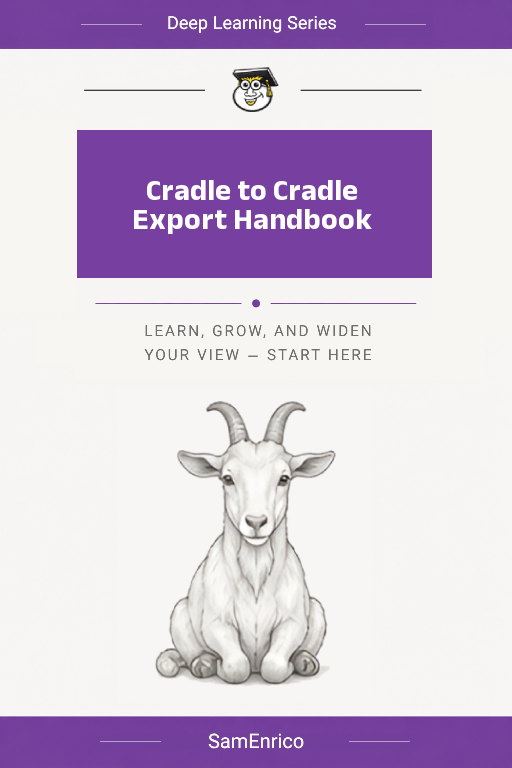
Non-FictionBusiness BriefCircular Economy
Cradle to Cradle Export Handbook
Achieve C2C certification for circular economy pro
Achieve C2C certification for circular economy product exports.
Formats
About this book
Free sample
Chapter 1: The Export Blindspot--Most exporters believe they know what their customers want. Price. Quality. Delivery speed. Maybe a recycled content label if the buyer is feeling progressive.
This assumption is about to cost them billions.The year 2027 will mark a turning point in global trade. On March 15 of that year, the European Union's Ecodesign for Sustainable Products Regulation (ESPR) will come into full effect, and with it, an estimated 340,000 products currently sold into the EU market will become non-compliant. Not because they are unsafe. Not because they violate labor laws. Not because they fail quality standards.
But because they are not circular.This is not a prediction. It is a regulatory reality that has already been published, debated, and finalized. And yet, in boardrooms across North America, Asia, and even Europe itself, export managers are still treating circularity as a marketing narrative rather than a compliance requirement. They are about to discover that their "less bad" eco-labels—recyclable claims, energy efficiency stickers, carbon offset promises—carry no weight at customs.This book exists because that discovery is avoidable. The Cradle to Cradle Certified standard is the passport that will get your products through the coming regulatory barrier.
But before we dive into the technical details of certification—the Bill of Materials deep dives, the toxicological assessments, the facility audits—we need to understand why this moment is different from every previous environmental initiative in export history.The Illusion of Eco-Efficiency For three decades, the dominant paradigm in sustainable business has been eco-efficiency. The logic is seductively simple: take the existing linear production model—extract, make, use, dispose—and make it less damaging. Use less energy. Create less waste. Emit less carbon.
Recycle a higher percentage of packaging.Mc Donough and Braungart, in their landmark book Cradle to Cradle: Remaking the Way We Make Things, called this approach "being less bad." And for a time, it was genuinely progress. Companies that reduced their energy intensity by 30 percent or cut water usage in half deserved credit. Eco-efficiency created genuine environmental improvements.But eco-efficiency has a fatal flaw when applied to export products. It…
This is the end of the free sample. Get the eBook to keep going. Buy now
Contents
- Chapter 1
- Chapter 2
- Chapter 3
- Chapter 4
- Chapter 5
- Chapter 6
- Chapter 7
- Chapter 8
- Chapter 9
- Chapter 10
- Chapter 11
- Chapter 12
Details
- Author
- Vasquez Darla
- Publisher
- SamEnrico
- Language
- English
- Genre
- Non-Fiction, Business Brief, Circular Economy
- Released
- 2026-06-01
- Pages (approx.)
- 135
- Available as
- eBook, Audiobook

Read better in the ZLOADR app
Your eBooks on your phone or tablet. Sign in with your SamEnrico account and start reading.
More by Vasquez Darla
 Postpartum Walking ProgramVasquez Darla$11.99
 Pink Noise Sleep GuideVasquez Darla$11.99
 Stress and Chronic Inflammation LinkVasquez Darla$11.99
 The Neuroplasticity GuideVasquez Darla$11.99
 Job Loss Identity RecoveryVasquez Darla$11.99
 Hispanic Latina Breast Health GuideVasquez Darla$11.99
 Group Creativity for ConsultantsVasquez Darla$11.99
 The Dueling Stars: Love, Betrayal, and the First Latin American Olympic GymnastVasquez Darla$11.99
 Influence Techniques for PharmacistsVasquez Darla$11.99
 The Forgotten General: Paik Sun-Yup and the Birth of Modern KoreaVasquez Darla$11.99
 How to Produce Paintball Air TanksVasquez Darla$11.99
 A Collector's Handbook to the Triumph Spitfire MkivVasquez Darla$11.99
You may also like
 Hong Kong Handover 1997Dunn Johnnie$11.99
 Zumba For Postnatal Recovery CourseNeal Christian$11.99
 Zumba for BeginnersLadner Nikia$11.99
 YouTube Comment Mining GuideHumes Pandora$12.99
 Worry Box MeditationCarlin Rudy$11.99
 Workplace Stress MeditationNguyen Lynn$11.99
 Workplace Stress and Sleep RepairHawley Ivory$11.99
 Workplace Perfectionism CureDelaney Jeffry$11.99
 Workplace Injustice Anger GuideWallen Isabelle$11.99
 Work Addiction and Burnout LinkGreenwood Ester$11.99
 Women in Yoga and WellnessBeattie Galina$11.99
 Women in Stand Up ComedyChun Evangeline$11.99