
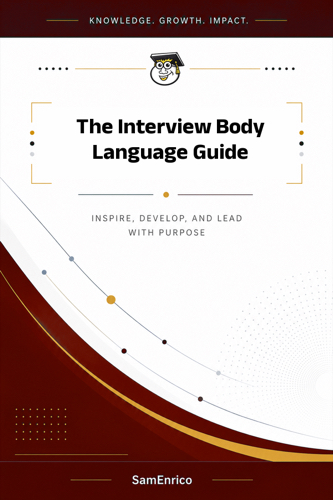
Non-FictionSelf-HelpCareer Skills
The Interview Body Language Guide eBook
Projects confidence and competence in job intervie
by Wilder Raven
Projects confidence and competence in job interviews.
Formats
Free sample
Chapter 1: The 93% Lie...--–- The first thing you need to know about the 7-38-55 rule is that it is not a rule. It is a finding, and a widely misunderstood one at that. But before we untangle the science, let me tell you about a candidate named Sarah. She walked into a corner office wearing a tailored navy suit, a perfect resume tucked inside her leather portfolio, and the quiet confidence of someone who had prepared for six weeks. She had memorized the company's quarterly earnings, rehearsed answers to forty-seven potential questions, and practiced her handshake until her roommate begged her to stop.
By every measurable standard, Sarah was the most qualified person in the room.She did not get the job.The hiring manager, a woman named Diane with twenty years of experience, later confessed to a colleague: "I just had a feeling. Something was off." When pressed for specifics, Diane struggled to articulate it. "She seemed... nervous? No, that's not right.
She seemed fine. But I didn't trust her. I can't explain it."Diane could not explain it because the information her brain was using never reached her conscious awareness. Her decision was made by a part of her mind that processes information faster than thought—a part that reads body language, tone, and micro-expressions before the verbal part of the brain has even finished forming the first syllable of "Tell me about yourself."This is the central paradox of job interviews. You believe you are being evaluated on your answers, your experience, and your qualifications.
In reality, the interviewer is often deciding based on something far more primitive. They are thin-slicing—making rapid, unconscious judgments based on narrow slices of behavioral data—and your body is the primary source of that data.Welcome to the first chapter of The Interview Body Language Guide. Everything you are about to read is designed to solve one problem: the gap between what you know you can do and what your body communicates in high-stakes moments. Let us begin by understanding the science, the stakes, and the single most important reframe you will carry through this entire book.The 93% Myth and the Truth Beneath It You have probably heard some version of the following statistic: in communication, words account for only 7% of the message, tone of voice accounts for 38%, and body language accounts for 55%. This is known as the 7-38-55 rule, derived from the work of psychologist Albert Mehrabian in the 1960s.Here is what Mehrabian actually discovered.
He conducted two studies on the communication of feelings and attitudes—specifically, how people judge whether someone likes or dislikes them. In the first study, he had actors say a single word ("maybe") with varying tones of voice while listeners guessed the intended emotion. In the second study, actors said a single word with different facial expressions. Mehrabian found that when words, tone, and facial expression conflicted (for example, saying "I'm fine" through gritted teeth), listeners trusted the non-verbal channels far more than the words.That is it. The 7-38-55 rule was never meant to apply to all communication.
It was never meant to apply to job interviews. It was a finding about emotional inconsistency in very narrow laboratory conditions.And yet, the statistic has proven useful—not because it is scientifically precise, but because it points toward a deeper truth. Interviewers do not weigh your words at 7% and your body at 55%. However, your body does influence their perception of your confidence, competence, and trustworthiness far more than most candidates realize. The exact percentage varies by context, industry, and individual interviewer, but the directional truth is undeniable: your non-verbal communication is not a minor accessory to your verbal answers.
It is a parallel conversation happening simultaneously, and that parallel conversation often determines the outcome.Consider this. A 2011 study published in the Journal of Applied Psychology found that interviewers' first impressions within the first 30 seconds of an interview predicted their final ratings of candidates, even after controlling for the content of the answers. Another study from researchers at Princeton found that people make judgments about trustworthiness, competence, and likeability after seeing a face for just 100 milliseconds—faster than a blink. Those initial judgments are remarkably resistant to change, even when contradicted by later information.This is not because interviewers are shallow or biased. It is because the human brain is an efficiency machine.
It evolved to make rapid survival decisions based on limited data. When you see a stranger approaching on a dark street, you do not wait for a twenty-minute conversation to decide whether they are a threat. Your brain assesses posture, gait, facial expression, and eye contact in a fraction of a second. That same ancient machinery is what operates in the interview room. Your interviewer is not judging you.
Their brain is doing what brains have done for a hundred thousand years: assessing safety, status, and intent.Thin-Slicing: The Science of Rapid Judgment In his book Blink, Malcolm Gladwell popularized the concept of "thin-slicing"—the ability of the unconscious mind to find patterns in narrow windows of experience. He described how a marriage counselor could predict with 95% accuracy whether a couple would divorce after watching just three minutes of their conversation. How a art historian instantly recognized a statue as a forgery even though months of scientific analysis had declared it authentic. How a firefighter knew to order his crew out of a burning building seconds before the floor collapsed, unable to explain why except to say, "Something felt wrong."Thin-slicing is not magic. It is pattern recognition based on thousands of past experiences.
Interviewers who have sat across from hundreds of candidates develop an intuitive sense for which non-verbal clusters correlate with successful hires. They cannot always articulate what they are seeing. But they feel it.Here is what they are seeing.They are seeing whether you hold eye contact or glance away when the question gets hard. They are seeing whether your smile reaches your eyes or stops at your mouth. They are seeing whether you settle into your chair as if you belong there or perch on the edge like a visitor waiting to be dismissed.
They are seeing whether your hands move to illustrate your points or fidget with anxiety. They are seeing whether your posture collapses when you finish speaking or holds steady.All of this happens in the first few seconds. And all of it happens before you have answered a single question.This is not fair. You have spent years building your skills, earning your credentials, and preparing your stories. It seems unjust that a hiring manager's gut feeling could override your carefully crafted answers.
But fairness is not the terrain we are playing on. We are playing on the terrain of human psychology. And human psychology is not fair—it is just predictable.The good news is that predictability cuts both ways. If interviewers' brains follow predictable patterns, you can learn to communicate in the language those brains understand. You do not have to change who you are.
You have to learn to align your non-verbal signals with your internal competence. When your body says what your resume already…
This is the end of the free sample. Get the eBook to keep going. Buy now
About this book
Details
- Author
- Wilder Raven
- Publisher
- SamEnrico
- Language
- English
- Genre
- Non-Fiction, Self-Help, Career Skills
- Released
- 2026-06-08
- Pages (approx.)
- 157
- Available as
- eBook, Audiobook

Read better in the ZLOADR app
Your eBooks on your phone or tablet. Sign in with your SamEnrico account and start reading.
More by Wilder Raven
 Cement Industry ESG BenchmarkWilder Raven$11.99
 Preeclampsia Loss Support HandbookWilder Raven$11.99
 The Norfolk Four DebacleWilder Raven$11.99
 Business Credit for EcommerceWilder Raven$12.99
 The Loving Kindness for CouplesWilder Raven$11.99
 The Unseen Canvas: How Banksy’s Ghostly Murals Changed the Art WorldWilder Raven$11.99
 Understanding Scarlet FeverWilder Raven$17.99
 Pipeline TechnicianWilder Raven$11.99
 Mentorship Meeting Preparation GuideWilder Raven$12.99Business Credit for EcommerceWilder Raven$12.99
 How to Become a Dry-wall SprayerWilder Raven$11.99
You may also like
 Hong Kong Handover 1997Dunn Johnnie$11.99
 Zumba For Postnatal Recovery CourseNeal Christian$11.99
 Zumba for BeginnersLadner Nikia$11.99
 YouTube Comment Mining GuideHumes Pandora$12.99
 Worry Box MeditationCarlin Rudy$11.99
 Workplace Stress MeditationNguyen Lynn$11.99
 Workplace Stress and Sleep RepairHawley Ivory$11.99
 Workplace Perfectionism CureDelaney Jeffry$11.99
 Workplace Injustice Anger GuideWallen Isabelle$11.99
 Work Addiction and Burnout LinkGreenwood Ester$11.99
 Women in Yoga and WellnessBeattie Galina$11.99
 Women in Stand Up ComedyChun Evangeline$11.99