
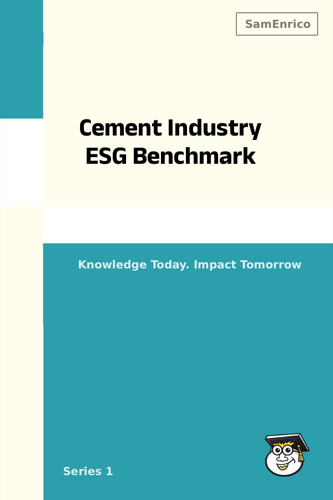
Non-FictionStrategic AtlasCement ESG
Cement Industry ESG Benchmark
Evaluate CO2 reduction pledges and alternative fue
by Wilder Raven
Evaluate CO2 reduction pledges and alternative fuel use among concrete firms.
Formats
About this book
Free sample
Chapter 1: The Gray Giant--Every time you walk into a building, drive over a bridge, or park in a garage, you are standing on a secret. The gray, unremarkable substance beneath your feet is the second most consumed material on Earth, trailing only water. We use thirty billion tons of it every year. That is enough to pave every street in America a thousand times over. And every single pound of it carries an invisible price tag: half its own weight in carbon dioxide, released before it ever hardens.The substance is concrete.
And the core ingredient that makes concrete possible—cement—is quietly cooking the planet.If the cement industry were a country, it would be the world’s third-largest emitter of greenhouse gases, behind only China and the United States. It outranks India, Russia, and every European nation. It dwarfs the aviation sector, which gets headlines for its contrails and carbon guilt. It overshadows shipping, which moves 90 percent of global trade. Cement alone accounts for roughly 8 percent of all human-caused CO₂ emissions.
That percentage has been climbing for decades, yet until recently, it has remained almost entirely invisible to the public, to policymakers, and even to many investors who pride themselves on climate-aware portfolios.This invisibility is not an accident. Cement is not glamorous. It does not leak methane like cattle, or burst into flames like oil, or belch smoke from dramatic smokestacks like coal plants. It is slow, industrial, and hidden behind facades of glass and steel. The emissions happen inside massive rotating kilns that look like sleeping dragons, often located in remote quarries far from population centers.
No one photographs a cement plant for a magazine cover. No activist chains themselves to a bag of Portland cement. And yet, without cement, modern civilization would collapse. No hospitals. No schools.
No dams. No wind turbine foundations. No electric vehicle charging stations. No subway tunnels. No sidewalks.We face an uncomfortable paradox: the material that builds the low-carbon future is itself a major source of carbon.
You cannot build a solar farm without concrete footings. You cannot erect a wind turbine without a massive concrete foundation.…
This is the end of the free sample. Get the eBook to keep going. Buy now
Contents
- Chapter 1
- Chapter 2
- Chapter 3
- Chapter 4
- Chapter 5
- Chapter 6
- Chapter 7
- Chapter 8
- Chapter 9
- Chapter 10
- Chapter 11
- Chapter 12
Details
- Author
- Wilder Raven
- Publisher
- SamEnrico
- Language
- English
- Genre
- Non-Fiction, Strategic Atlas, Cement ESG
- Released
- 2026-06-09
- Pages (approx.)
- 140
- Available as
- eBook, Audiobook

Read better in the ZLOADR app
Your eBooks on your phone or tablet. Sign in with your SamEnrico account and start reading.
More by Wilder Raven
 Preeclampsia Loss Support HandbookWilder Raven$11.99
 The Interview Body Language GuideWilder Raven$11.99
 The Norfolk Four DebacleWilder Raven$11.99
 Business Credit for EcommerceWilder Raven$12.99
 The Loving Kindness for CouplesWilder Raven$11.99
 The Unseen Canvas: How Banksy’s Ghostly Murals Changed the Art WorldWilder Raven$11.99
 Understanding Scarlet FeverWilder Raven$17.99
 Pipeline TechnicianWilder Raven$11.99
 Mentorship Meeting Preparation GuideWilder Raven$12.99Business Credit for EcommerceWilder Raven$12.99
 How to Become a Dry-wall SprayerWilder Raven$11.99
You may also like
 Hong Kong Handover 1997Dunn Johnnie$11.99
 Zumba For Postnatal Recovery CourseNeal Christian$11.99
 Zumba for BeginnersLadner Nikia$11.99
 YouTube Comment Mining GuideHumes Pandora$12.99
 Worry Box MeditationCarlin Rudy$11.99
 Workplace Stress MeditationNguyen Lynn$11.99
 Workplace Stress and Sleep RepairHawley Ivory$11.99
 Workplace Perfectionism CureDelaney Jeffry$11.99
 Workplace Injustice Anger GuideWallen Isabelle$11.99
 Work Addiction and Burnout LinkGreenwood Ester$11.99
 Women in Yoga and WellnessBeattie Galina$11.99
 Women in Stand Up ComedyChun Evangeline$11.99