
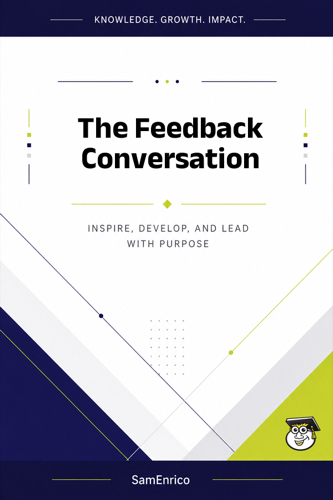
Non-FictionSelf-HelpFeedback Skills
The Feedback Conversation eBook
Give and receive constructive criticism without de
Give and receive constructive criticism without defensiveness or resentment.
Formats
Free sample
Chapter 1: The Neural Hijack--–- You are about to be attacked. Not by a predator in the wild, but by something that feels remarkably similar: a sentence that begins with “Can I give you some feedback?” In the space between those words leaving someone’s mouth and your brain processing their meaning, a biological ambush is already underway. Your heart rate increases. Blood rushes away from your prefrontal cortex—the seat of rational thought—and toward your limbs, preparing you to fight, flee, or freeze. Your hearing sharpens.
Your pupils dilate. Your digestive system slows down. All of this happens in less than two hundred milliseconds, which is roughly the time it takes to blink.This is not a sign of weakness, insecurity, or emotional instability. It is the legacy of five hundred million years of evolution.The human brain processes social rejection and criticism in the same neural regions—the anterior cingulate cortex and the insula—that process physical pain. In fact, brain imaging studies have shown that the experience of being criticized activates the same pain networks as being burned or cut.
Your brain literally cannot tell the difference between someone saying “Your work on that project was inadequate” and someone holding a hot iron to your skin. Both register as threats to survival. This is not a metaphor. This is neurology.For most of human history, being socially rejected meant death. Exile from the tribe meant no access to food, shelter, or protection from predators.
Your ancestors who felt the sting of criticism as a genuine threat were more likely to survive than those who shrugged it off. The result is that you are walking around with a brain exquisitely tuned to detect social danger—and to react defensively before you have even consciously registered what was said.This chapter is not about learning to stop that reaction. You cannot stop it any more than you can stop your heart from beating. Instead, this chapter is about learning to recognize the hijack as it happens, understand its three distinct forms, and install a small but powerful pause button between the trigger and your reaction. The goal is not to eliminate defensiveness—that would be like trying to eliminate your own shadow.
The goal is to catch it earlier, choose your response instead of being hijacked by it, and eventually learn to reset your brain’s threat-detection system so that feedback becomes information rather than assault.The Three Triggers: Why Your Brain Sounds the Alarm Not all defensiveness is created equal. The feedback that sends you into a spiral of argument, withdrawal, or shame can usually be traced back to one of three distinct triggers. Understanding which trigger is firing is the first step toward disarming it. These three categories come from the work of Douglas Stone and Sheila Heen, whose research at the Harvard Negotiation Project fundamentally changed our understanding of feedback dynamics. Each trigger corresponds to a different threat calculation in your brain, and each requires a different reset strategy.Truth Triggers: “That’s Not What Happened”The first type of trigger occurs when the feedback strikes you as factually wrong.
Your brain says: “That’s not what happened,” or “You have the facts wrong,” or “That’s not fair.” You feel a surge of indignation because the feedback violates your sense of accuracy. The trigger here is truth—or rather, the gap between what you believe to be true and what the other person is claiming. Your brain has entered what we might call accuracy protection mode.Truth triggers are particularly dangerous because they feel righteous. You are not being defensive; you are being correct. And correctness is virtuous, isn’t it?
This is the trap. When a truth trigger fires, every neuron is dedicated to gathering evidence, building counterarguments, and preparing your rebuttal. You stop listening because you are too busy assembling your case. The other person’s words become background noise to the trial you are conducting in your own head.Consider a common example. Your manager says, “You never respond to my emails on time.” You know for a fact that you responded to three of their last four emails within two hours.
The fourth email? It took you six days. But the word “never” is wrong, so your brain fixates on the inaccuracy. The signal—that your response times are inconsistent—gets lost in your righteous indignation about the word “never.” The feedback is poorly delivered, but the underlying pattern may still be worth examining. The truth trigger has just cost you a useful insight.The way out of a truth trigger is not to prove you are right.
The way out is to ask a specific clarifying question that moves from judgment to data. “You said ‘never,’ but I can think of several examples where I responded quickly. Can we look at the last four emails together and see the pattern?” This response does not abandon your accuracy; it invites a shared examination of the facts. And in that shared examination, both of you may learn something. Perhaps your manager only notices the late responses and forgets the quick ones.
Perhaps you have been late on high-stakes emails and on time for low-stakes ones. The truth trigger, once named, becomes a doorway to curiosity rather than a wall of defense.Relationship Triggers: “Who Are You to Say This?”The second type of trigger has nothing to do with the content of the feedback and everything to do with the person delivering it. Your brain asks: “Who are you to say this to me?” The trigger here is credibility, trust, or relationship history. If the person giving feedback has betrayed your trust in the past, criticized you unfairly before, or simply rubs you the wrong way, their words will trigger defensiveness regardless of whether they are accurate. The messenger has poisoned the message.Relationship triggers are the most common reason feedback fails in organizations.
Research on psychological safety has shown that the same feedback delivered by a trusted colleague and a distrusted manager produces wildly different outcomes. In one study conducted by Google’s Project Aristotle, employees who rated their manager low on trust were four times more likely to dismiss performance feedback as “unfair” or “politically motivated”—even when the feedback was identical to what other managers gave. The words were the same. The biology was different.The challenge with relationship triggers is that they are not irrational. Your brain is making a reasonable calculation: this person has not earned the right to comment on my behavior.
Perhaps they have criticized you publicly in the past. Perhaps they have given you vague, unhelpful feedback before. Perhaps they simply do not like you, and you know it. In all of these cases, your defensiveness is not a bug; it is a feature. It is your brain protecting you from someone who may not have your best interests at heart.But here is the nuance that changes everything: bad messengers can still deliver accurate messages.
A broken clock is right twice a day. A manager who has been unfair in the past may still be right about this specific piece of feedback.…
This is the end of the free sample. Get the eBook to keep going. Buy now
About this book
Details
- Author
- Mccray Phyliss
- Publisher
- SamEnrico
- Language
- English
- Genre
- Non-Fiction, Self-Help, Feedback Skills
- Released
- 2026-06-08
- Pages (approx.)
- 146
- Available as
- eBook, Audiobook

Read better in the ZLOADR app
Your eBooks on your phone or tablet. Sign in with your SamEnrico account and start reading.
More by Mccray Phyliss
 Meeting Interruption ControlMccray Phyliss$11.99
 The Exits and Entrances GuideMccray Phyliss$11.99
 Senior Self Esteem WorkbookMccray Phyliss$11.99
 CrossFit Bodyweight WOD LibraryMccray Phyliss$11.99
 The Boy Who Went for WaterMccray Phyliss$11.99
 Point System DeterrenceMccray Phyliss$11.99
 Antwerp Heist Security LessonsMccray Phyliss$11.99
 Whispers in the Ruins: The Vanishing of the Library of AlexandriaMccray Phyliss$11.99
 Echoes of the Forgotten: The Last Days of the Berlin AirliftMccray Phyliss$11.99
 Vaccination Policy Legal Traps EmployersMccray Phyliss$12.99
 24 Hour Response WindowMccray Phyliss$12.99
 WIPO Trademark Monitoring GuideMccray Phyliss$12.99
You may also like
 Hong Kong Handover 1997Dunn Johnnie$11.99
 Zumba For Postnatal Recovery CourseNeal Christian$11.99
 Zumba for BeginnersLadner Nikia$11.99
 YouTube Comment Mining GuideHumes Pandora$12.99
 Worry Box MeditationCarlin Rudy$11.99
 Workplace Stress MeditationNguyen Lynn$11.99
 Workplace Stress and Sleep RepairHawley Ivory$11.99
 Workplace Perfectionism CureDelaney Jeffry$11.99
 Workplace Injustice Anger GuideWallen Isabelle$11.99
 Work Addiction and Burnout LinkGreenwood Ester$11.99
 Women in Yoga and WellnessBeattie Galina$11.99
 Women in Stand Up ComedyChun Evangeline$11.99