
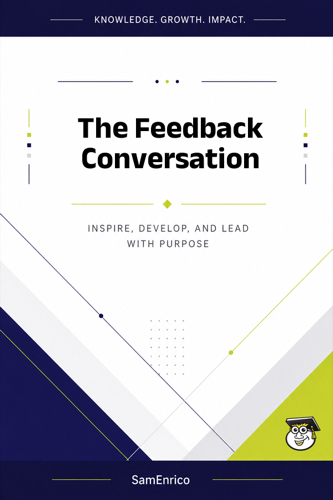
Non-FictionSelf-HelpFeedback Skills
The Feedback Conversation Audiobook
Give and receive constructive criticism without de
Give and receive constructive criticism without defensiveness or resentment.
Formats
Free sample
Chapter 1: The Neural Hijack--–- You are about to be attacked. Not by a predator in the wild, but by something that feels remarkably similar: a sentence that begins with “Can I give you some feedback?” In the space between those words leaving someone’s mouth and your brain processing their meaning, a biological ambush is already underway. Your heart rate increases. Blood rushes away from your prefrontal cortex—the seat of rational thought—and toward your limbs, preparing you to fight, flee, or freeze. Your hearing sharpens.
Your pupils dilate. Your digestive system slows down. All of this happens in less than two hundred milliseconds, which is roughly the time it takes to blink.This is not a sign of weakness, insecurity, or emotional instability. It is the legacy of five hundred million years of evolution.The human brain processes social rejection and criticism in the same neural regions—the anterior cingulate cortex and the insula—that process physical pain. In fact, brain imaging studies have shown that the experience of being criticized activates the same pain networks as being burned or cut.
Your brain literally cannot tell the difference between someone saying “Your work on that project was inadequate” and someone holding a hot iron to your skin. Both register as threats to survival. This is not a metaphor. This is neurology.For most of human history, being socially rejected meant death. Exile from the tribe meant no access to food, shelter, or protection from predators.
Your ancestors who felt the sting of criticism as a genuine threat were more likely to survive than those who shrugged it off. The result is that you are walking around with a brain exquisitely tuned to detect social danger—and to react defensively before you have even consciously registered what was said.This chapter is not about learning to stop that reaction. You cannot stop it any more than you can stop your heart from beating. Instead, this chapter is about learning to recognize the hijack as it happens, understand its three distinct forms, and install a small but powerful pause button between the trigger and your reaction. The goal is not to eliminate defensiveness—that would be like trying to eliminate your own shadow.
The goal is to catch it earlier, choose your response instead of being hijacked by it, and eventually learn to reset your brain’s threat-detection system so…
This is the end of the free sample. Get the Audiobook to keep going. Buy now
About this book
Details
- Author
- Mccray Phyliss
- Publisher
- SamEnrico
- Language
- English
- Genre
- Non-Fiction, Self-Help, Feedback Skills
- Released
- 2026-06-08
- Pages (approx.)
- 146
- Available as
- eBook, Audiobook

Listen in the VoxFlicks app
Audiobooks and audio dramas wherever you go. Sign in with your SamEnrico account and press play.
More by Mccray Phyliss
 Meeting Interruption ControlMccray Phyliss$11.99
 The Exits and Entrances GuideMccray Phyliss$11.99
 Senior Self Esteem WorkbookMccray Phyliss$11.99
 CrossFit Bodyweight WOD LibraryMccray Phyliss$11.99
 The Boy Who Went for WaterMccray Phyliss$11.99
 Point System DeterrenceMccray Phyliss$11.99
 Antwerp Heist Security LessonsMccray Phyliss$11.99
 Whispers in the Ruins: The Vanishing of the Library of AlexandriaMccray Phyliss$11.99
 Echoes of the Forgotten: The Last Days of the Berlin AirliftMccray Phyliss$11.99
 Vaccination Policy Legal Traps EmployersMccray Phyliss$12.99
 24 Hour Response WindowMccray Phyliss$12.99
 WIPO Trademark Monitoring GuideMccray Phyliss$12.99
You may also like
 Hong Kong Handover 1997Dunn Johnnie$11.99
 Zumba For Postnatal Recovery CourseNeal Christian$11.99
 Zumba for BeginnersLadner Nikia$11.99
 YouTube Comment Mining GuideHumes Pandora$12.99
 Worry Box MeditationCarlin Rudy$11.99
 Workplace Stress MeditationNguyen Lynn$11.99
 Workplace Stress and Sleep RepairHawley Ivory$11.99
 Workplace Perfectionism CureDelaney Jeffry$11.99
 Workplace Injustice Anger GuideWallen Isabelle$11.99
 Work Addiction and Burnout LinkGreenwood Ester$11.99
 Women in Yoga and WellnessBeattie Galina$11.99
 Women in Stand Up ComedyChun Evangeline$11.99