

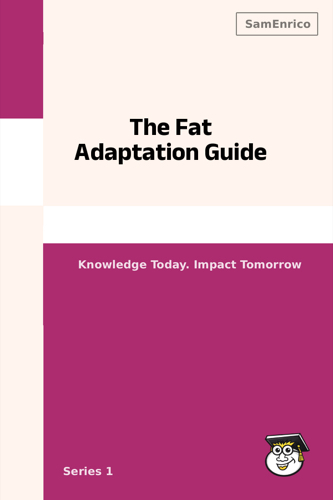
Non-FictionHealth & WellnessFat
The Fat Adaptation Guide eBook
Train your body to efficiently use fat for fuel du
by Prater Van
Train your body to efficiently use fat for fuel during weight loss.
Formats
Free sample
Chapter 1: The Glucose Trap...--–- It is 3:00 PM on a Tuesday. You ate a "healthy" lunch—perhaps a turkey sandwich on whole wheat bread, a low-fat yogurt, and an apple. Two hours later, you are staring at your computer screen unable to focus. Your eyelids feel heavy. Your stomach growls even though you ate not long ago.
The vending machine down the hall seems to be calling your name. You tell yourself you just need a little pick-me-up. One small cookie. Or a handful of pretzels. Or maybe a soda.
Just something to get you through the rest of the afternoon.This scene plays out in millions of offices, homes, and schools every single day. And almost everyone who experiences it believes the same thing about themselves: "I have no willpower." "I am weak." "I am addicted to sugar." "There is something wrong with me."But here is the truth that the diet industry does not want you to hear: You are not weak. You are not broken. You do not lack willpower. Your body has simply been trained—trained by years of eating according to standard nutritional advice—to be a sugar burner.
And until you understand why that matters, you will continue to lose the same five, ten, or twenty pounds over and over again, only to regain them when your willpower inevitably runs out.This chapter is about the single most important concept in the entire book: the glucose trap. Understanding this trap is not optional. It is the foundation upon which every other strategy in this book rests. If you skip this chapter or skim it, the rest of the book will still work—but you will not truly understand why it works. And understanding the "why" is what separates people who lose weight temporarily from people who transform their bodies permanently.The 3:00 PM Crash Is Not a Character Flaw Let us start with that 3:00 PM crash.
What is actually happening inside your body?You ate lunch. That lunch contained carbohydrates—maybe bread, maybe rice, maybe pasta, maybe fruit, maybe a combination of several of these. Carbohydrates are broken down by your digestive system into their simplest form: glucose. Glucose is a sugar molecule. It enters your bloodstream, and your blood sugar level rises.Your body does not like high blood sugar.
High blood sugar is damaging to blood vessels, nerves, and organs over time. So your pancreas releases a hormone called insulin. Insulin's primary job is to move glucose out of your bloodstream and into your cells, where it can be used for energy. This is a good thing. Without insulin, you would die.
In fact, type 1 diabetes is precisely the condition where the pancreas stops producing insulin, and without injected insulin, blood sugar rises to fatal levels.So far, so normal.But here is where the trap springs shut. Insulin does not just move glucose into cells. Insulin has a second job—a job that most diet books never mention. Insulin is the hormone that locks your fat cells shut.Think of your fat cells (adipocytes) as tiny storage lockers. When insulin is present in your bloodstream, those lockers are sealed.
Fat cannot enter them—and more importantly, fat cannot leave them. As long as insulin is high, your body is physically incapable of accessing your stored body fat for energy.This is not a matter of willpower. This is not a matter of "trying harder." This is basic biochemistry. No insulin, fat can be released. High insulin, fat is locked away.Now let us return to your 3:00 PM crash.You ate lunch.
Your blood sugar rose. Your pancreas released insulin to bring that blood sugar down. But here is the problem with the standard Western diet: it is loaded with refined carbohydrates. White bread, white rice, pasta, crackers, pretzels, chips, soda, fruit juice, pastries, cookies, cakes, and even seemingly "healthy" options like whole wheat bread and brown rice—all of these are carbohydrates that digest quickly. They spike your blood sugar rapidly.
And when blood sugar spikes rapidly, the pancreas overcorrects. It releases a surge of insulin—far more than would be necessary if you had eaten a balanced meal with protein, fat, and fiber.This massive insulin surge does its job. It pulls glucose out of your bloodstream so effectively that your blood sugar crashes below baseline. Now you are hypoglycemic—low blood sugar. And your brain, which runs exclusively on glucose (unless you are fat-adapted, which you are not yet), panics.The brain's panic response is simple and primal: EAT CARBS NOW.That is the craving you feel at 3:00 PM.
That is the desperate pull toward the vending machine. That is the voice in your head telling you that you will die if you do not eat something sweet or starchy immediately.You are not weak. You are experiencing a biological emergency signal. Your brain genuinely believes it is running out of fuel.So you eat the cookie. Or the pretzels.
Or the soda. And the cycle begins again: blood sugar spikes, insulin surges, blood sugar crashes, brain panics, eat more carbs. This is called the "hangry cycle"—hungry plus angry—and it is the primary reason most people cannot stick to a low-calorie diet for more than a few weeks.Why Low-Calorie Diets Fail (Even When You Follow Them Perfectly)Now let us address a painful reality. You have probably tried a low-calorie diet before. Maybe you ate 1,200 calories per day.
Maybe you followed a meal delivery service. Maybe you counted every single bite that entered your mouth. And maybe—just maybe—you lost some weight at first.Then the weight loss stopped.You were eating 1,200 calories. You were exercising. And the scale would not budge.
So you did what every diet book tells you to do: you cut more calories. You went from 1,200 to 1,000. Then to 800. You were hungry all the time. You thought about food constantly.
You had no energy. And still, the scale would not move.Eventually, you gave up. You ate normally for a week. And you gained back everything you had lost—plus a few extra pounds for good measure.This experience is so common that it has become a cliché. But here is the truth that no one told you: Your low-calorie diet failed because it never addressed insulin.Let us walk through this carefully.You ate 1,200 calories per day.
But what were those calories made of? If you were following standard low-calorie diet advice, your plate probably looked something like this: a small piece of lean chicken breast, a half cup of brown rice, and a cup of steamed broccoli. Low in fat. Low in calories. "Healthy," according to conventional wisdom.But look closer.
That meal is primarily carbohydrate. Brown rice is carbohydrate. Broccoli is carbohydrate (fiber, but still carbohydrate). The chicken is the only significant source of protein. Your blood sugar rose after that meal.
Insulin was released. And because you were eating small, frequent meals throughout the day (another piece of standard diet advice), your insulin never had a chance to return to baseline. It stayed elevated all day long.And as long as insulin is elevated, your fat cells remain…
This is the end of the free sample. Get the eBook to keep going. Buy now
About this book
Details
- Author
- Prater Van
- Publisher
- SamEnrico
- Language
- English
- Genre
- Non-Fiction, Health & Wellness, Fat
- Released
- 2026-06-06
- Pages (approx.)
- 142
- Available as
- eBook, Audiobook

Read better in the ZLOADR app
Your eBooks on your phone or tablet. Sign in with your SamEnrico account and start reading.
More by Prater Van
 Famous People With Bipolar GuidePrater Van$11.99
 Public Speaking for CoachesPrater Van$11.99
 Mindfulness For Parental AngerPrater Van$11.99
 Improv for ChefsPrater Van$11.99
 Gratitude for EndingsPrater Van$11.99
 The Sultan's Game: How Ottoman Football Pioneers Shaped the Premier LeaguePrater Van$11.99
 The Whispering Lanterns: The Hidden Wisdom of OiwaPrater Van$11.99
 How to Produce Concrete BroomsPrater Van$11.99
 Bonobos: Pan PaniscusPrater Van$11.99
 Implied Covenant of Good FaithPrater Van$12.99
 EU VAT Ecommerce Guide 2025Prater Van$12.99
 How to Produce Outdoor Power Equipment BASE UnitsPrater Van$11.99
You may also like
 Hong Kong Handover 1997Dunn Johnnie$11.99
 Zumba For Postnatal Recovery CourseNeal Christian$11.99
 Zumba for BeginnersLadner Nikia$11.99
 YouTube Comment Mining GuideHumes Pandora$12.99
 Worry Box MeditationCarlin Rudy$11.99
 Workplace Stress MeditationNguyen Lynn$11.99
 Workplace Stress and Sleep RepairHawley Ivory$11.99
 Workplace Perfectionism CureDelaney Jeffry$11.99
 Workplace Injustice Anger GuideWallen Isabelle$11.99
 Work Addiction and Burnout LinkGreenwood Ester$11.99
 Women in Yoga and WellnessBeattie Galina$11.99
 Women in Stand Up ComedyChun Evangeline$11.99