
Non-FictionInformativeEducational
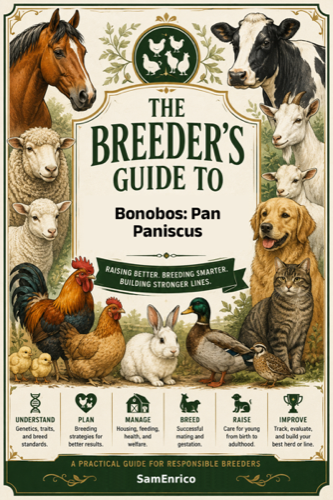
Bonobos: Pan Paniscus
This wildlife publication, published by SamEnrico,
by Prater Van
This wildlife publication, published by SamEnrico, covers Bonobos: Pan Paniscus
Formats
About this book
Free sample
Chapter 1: The Skull in the Drawer--In the dimly lit basement of the Royal Museum for Central Africa in Tervuren, Belgium, a dusty drawer slid open with a groan of old wood. Inside, nestled among fragmented bones labeled simply “Juvenile Chimpanzee – Damaged,” rested a skull that would quietly reshape our understanding of what it means to be human. The year was 1929. The man pulling open that drawer was Dr. Ernst Schwarz, a German anatomist who had traveled to Tervuren expecting to confirm what every scientist already knew: that the chimpanzees of Africa were a single, variable species, stretching from the west coast to the east, from the forests of Guinea to the shores of Lake Tanganyika.
He was wrong. And his mistake—or rather, his unwillingness to accept the obvious—would lead to one of the most consequential discoveries in twentieth-century primatology, a discovery that arrived nearly a century too late.What Schwarz held in his hands that day was not a juvenile chimpanzee at all. It was an adult. The skull was smaller than a typical chimpanzee’s, yes, but the sutures of the cranium were fully fused—the unmistakable signature of maturity. The brow ridges were less pronounced, the braincase more globular, the canine teeth remarkably small for a male ape.
This was not a young animal of a known species. This was an adult of an unknown one. Schwarz put down his cigarette, stared at the skull, and began to suspect that everything he had been taught about the great apes of Africa was incomplete.The creature in his hands would eventually receive the scientific name Pan paniscus. But in 1929, it had no name at all. It was a ghost in the museum’s collection, a specimen that had arrived decades earlier from the Belgian Congo, cataloged by a hurried clerk who assumed it was a runt, a freak, or a juvenile.
No one had bothered to look closely. For nearly a century, Pan paniscus had been hiding in plain sight—the last great ape to be recognized by Western science, and already, by the time of its discovery…
This is the end of the free sample. Get the eBook to keep going. Buy now
Contents
- Chapter 1
- Chapter 2
- Chapter 3
- Chapter 4
- Chapter 5
- Chapter 6
- Chapter 7
- Chapter 8
- Chapter 9
- Chapter 10
- Chapter 11
- Chapter 12
Details
- Author
- Prater Van
- Publisher
- SamEnrico
- Language
- English
- Genre
- Non-Fiction, Informative, Educational
- Released
- 2026-06-02
- Pages (approx.)
- 145
- Available as
- eBook, Audiobook

Read better in the ZLOADR app
Your eBooks on your phone or tablet. Sign in with your SamEnrico account and start reading.
More by Prater Van
 Famous People With Bipolar GuidePrater Van$11.99
 Public Speaking for CoachesPrater Van$11.99
 Mindfulness For Parental AngerPrater Van$11.99
 The Fat Adaptation GuidePrater Van$11.99
 Improv for ChefsPrater Van$11.99
 Gratitude for EndingsPrater Van$11.99
 The Sultan's Game: How Ottoman Football Pioneers Shaped the Premier LeaguePrater Van$11.99
 The Whispering Lanterns: The Hidden Wisdom of OiwaPrater Van$11.99
 How to Produce Concrete BroomsPrater Van$11.99
 Implied Covenant of Good FaithPrater Van$12.99
 EU VAT Ecommerce Guide 2025Prater Van$12.99
 How to Produce Outdoor Power Equipment BASE UnitsPrater Van$11.99
You may also like
 Hong Kong Handover 1997Dunn Johnnie$11.99
 Zumba For Postnatal Recovery CourseNeal Christian$11.99
 Zumba for BeginnersLadner Nikia$11.99
 YouTube Comment Mining GuideHumes Pandora$12.99
 Worry Box MeditationCarlin Rudy$11.99
 Workplace Stress MeditationNguyen Lynn$11.99
 Workplace Stress and Sleep RepairHawley Ivory$11.99
 Workplace Perfectionism CureDelaney Jeffry$11.99
 Workplace Injustice Anger GuideWallen Isabelle$11.99
 Work Addiction and Burnout LinkGreenwood Ester$11.99
 Women in Yoga and WellnessBeattie Galina$11.99
 Women in Stand Up ComedyChun Evangeline$11.99