
Non-FictionInformativeEducational
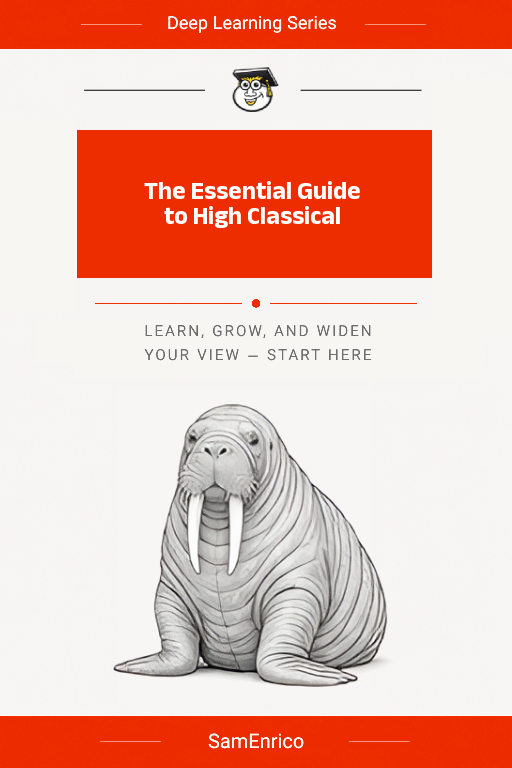
The Essential Guide to High Classical eBook
This publication, published by SamEnrico, covers T
by Milam Bula
This publication, published by SamEnrico, covers The Essential Guide to High Classical
Formats
Free sample
Chapter 1: The Serpent’s Shadow--–- The battlefield of Marathon is a flat, horseshoe-shaped plain about twenty-six miles northeast of Athens. On a clear morning in late summer, you can still feel it—the strange, hollow silence that hangs over places where too many men died too quickly. In 490 BCE, that silence was preceded by something far more terrifying: the largest invasion force the Mediterranean had ever seen.The Persian Empire, under King Darius I, stretched from modern-day Libya to Pakistan, from the Caucasus to the Arabian Sea. It was the superpower of its age, organized with bureaucratic efficiency, funded by unimaginable wealth, and defended by an army that had never lost a major campaign. When the Ionian Greek cities on the coast of Asia Minor rebelled against Persian rule in 499 BCE, Athens sent ships to help them.
Darius did not forget. His messengers traveled to every Greek city demanding the traditional tokens of submission—earth and water. Many gave in. Sparta and Athens killed the messengers instead.So the Persians came. Not with messengers this time, but with six hundred ships carrying perhaps thirty thousand soldiers, including the elite Immortals—ten thousand warriors whose numbers never diminished because every casualty was instantly replaced.
They landed at Marathon, choosing the plain because it was perfect for their cavalry. The Athenian army that marched out to meet them numbered about ten thousand hoplites—heavily armored citizen-soldiers who fought in a tight formation called the phalanx. They had no cavalry to speak of. They had no archers. They had no navy nearby to support them.
They had, however, something the Persians did not understand: the belief that free men fight differently than slaves.The battle lasted only a few hours. The Athenians, joined by a contingent of a thousand Plataeans, charged the Persian line at a run—not the usual slow, deliberate advance of hoplite warfare, but a sprint across nearly a mile of open ground. The Persians saw this and assumed madness. Their arrows, fired from composite bows, were devastating at close range, but at a sprint across uneven ground, the hoplites closed the distance faster than the archers could adjust. The bronze-clad Greek line crashed into the Persian center, and something unexpected happened: the Persians broke.
Not retreated in good order, but ran. They fled to their ships, leaving behind six thousand dead. The Athenians lost one hundred and ninety-two men.Every schoolchild knows the story of the runner Pheidippides, who allegedly ran from Marathon to Athens, gasped out “We have won,” and died. The historical truth is more complicated—Herodotus says Pheidippides ran to Sparta before the battle, not from Marathon after it—but the myth captures something real. The Greeks had done the impossible.
A small, quarreling collection of city-states had defeated the greatest empire on earth. And in that victory, something shifted in the Greek psyche. They had always believed themselves favored by the gods. Now they believed themselves capable of anything.The transformation was not immediate. Ten years later, in 480 BCE, the Persians returned under Darius’ son Xerxes with an even larger force—perhaps two hundred thousand soldiers supported by a fleet of over a thousand warships.
The Greeks this time managed a rare show of unity. Thirty-one city-states formed a defensive alliance, though many still sided with Persia. The Spartan king Leonidas led a small force to hold the narrow pass at Thermopylae, where three hundred Spartans and perhaps a thousand other Greeks held off the Persian advance for three days before being annihilated. The loss was devastating, but it bought time. The Athenian general Themistocles evacuated the entire population of Athens to the nearby island of Salamis, watching from the shore as Persian soldiers burned the Acropolis and smashed the archaic statues that had stood for generations.Then came the sea battle at Salamis.
Themistocles lured the Persian fleet into the narrow strait between Salamis and the mainland, where the Greek triremes—smaller, faster, more maneuverable—could fight on their terms. The Persian ships, designed for open water, jammed together in the confined space. The Greeks destroyed perhaps three hundred Persian vessels while losing only forty of their own. Xerxes watched from a golden throne on the shore, then retreated to Persia, leaving his general Mardonius to finish the campaign. A year later, at Plataea, the Greeks destroyed the remaining Persian army on land.The Persian Wars were over.
Greece had won. But the victory was not just military. It was psychological, philosophical, artistic. In the decade between Marathon and Salamis, the Greeks had invented a new way of seeing themselves. They were not, as the Persians assumed, barbarians on the fringe of civilization.
They were the center. They were the measure.The Art of Victory The shift is visible in the art that survives from the years immediately after the Persian Wars. Compare two sculptures. The first is the Moschophoros, or Calf-Bearer, from the Archaic period, carved around 560 BCE. He stands stiff and frontal, one foot slightly forward in the Egyptian-derived pose that dominated early Greek sculpture.
His face is frozen in the so-called “Archaic smile”—that strange, upturned expression that is not quite happiness and not quite pain, but something closer to a mask. He looks like a man trying very hard to be a statue.The second is the Kritios Boy, carved around 480 BCE, just after Marathon. Everything has changed. His weight shifts onto his left leg, causing his right hip to drop and his spine to curve into a gentle S-shape. This is contrapposto—the invention that unlocked the human body for Western art.
The Kritios Boy is not frozen. He is caught in the process of movement, of breathing, of thinking. His head turns slightly to the right, as if he has just heard someone call his name. His face is neutral, almost solemn, stripped of the archaic smile. He looks like a man who has seen something terrible and survived it.What happened between the Calf-Bearer and the Kritios Boy?
War happened. The Persian invasion forced the Greeks to confront their own mortality and their own potential. The archaic smile was the expression of a people who believed that the gods controlled everything and that human happiness was a fragile, fleeting thing. The Kritios Boy’s solemn calm is the expression of a people who have learned that they can shape their own destiny—and that this freedom carries a terrible weight.The Pottery Revolution The same transformation appears on painted pottery. In the late Archaic period, Athenian potters perfected the black-figure technique—silhouetted figures painted in black slip on the red clay of the vase, with incised lines for internal details.
The results could be exquisite, as in the works of Exekias, who painted Achilles and Ajax playing dice with a stillness and dignity that rivals any later art. But black-figure had limitations. Incised lines are thin and uniform; they cannot capture the subtle swell of a muscle or the soft curve of a cheek.Around 530 BCE, a generation before Marathon, an unknown painter invented the red-figure technique. Instead of painting figures in black, the painter reserved the red clay of the vase for the figures and…
This is the end of the free sample. Get the eBook to keep going. Buy now
About this book
Details
- Author
- Milam Bula
- Publisher
- SamEnrico
- Language
- English
- Genre
- Non-Fiction, Informative, Educational
- Released
- 2026-05-25
- Pages (approx.)
- 130
- Available as
- eBook, Audiobook

Read better in the ZLOADR app
Your eBooks on your phone or tablet. Sign in with your SamEnrico account and start reading.
More by Milam Bula
 High School Study GuideMilam Bula$11.99
 Shift Work and Digestive DisordersMilam Bula$11.99
 Fear of Failure in CreativesMilam Bula$11.99
 Exit Interview ConversationsMilam Bula$11.99
 Weight Loss Calorie CreepMilam Bula$11.99
 The Mother's Faked DeathMilam Bula$11.99
 CPR for National ParksMilam Bula$11.99
 Odysseus Unbound: The Cunning King’s Last LessonMilam Bula$11.99
 The Cosmic Visionaries of Meroë: Astronomers of the NileMilam Bula$11.99
 How to Produce Printer, Copier and Fax Machine Circuit BoardsMilam Bula$11.99
 Palm Kernel Oil: Palm Kernel NutMilam Bula$11.99
 Export Financing for Shea & CoffeeMilam Bula$12.99
You may also like
 Hong Kong Handover 1997Dunn Johnnie$11.99
 Zumba For Postnatal Recovery CourseNeal Christian$11.99
 Zumba for BeginnersLadner Nikia$11.99
 YouTube Comment Mining GuideHumes Pandora$12.99
 Worry Box MeditationCarlin Rudy$11.99
 Workplace Stress MeditationNguyen Lynn$11.99
 Workplace Stress and Sleep RepairHawley Ivory$11.99
 Workplace Perfectionism CureDelaney Jeffry$11.99
 Workplace Injustice Anger GuideWallen Isabelle$11.99
 Work Addiction and Burnout LinkGreenwood Ester$11.99
 Women in Yoga and WellnessBeattie Galina$11.99
 Women in Stand Up ComedyChun Evangeline$11.99