
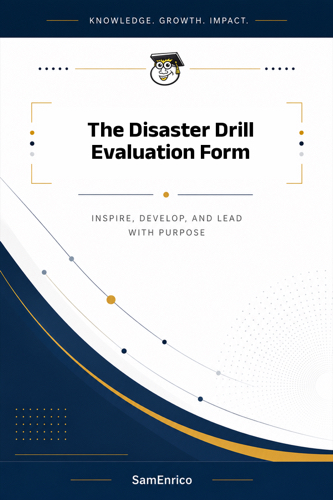
Non-FictionCrisis ManagementExercises
The Disaster Drill Evaluation Form
Teets measuring evacuation time, communication spe
Teets measuring evacuation time, communication speed, and shelter compliance.
Formats
About this book
Free sample
Chapter 1: The Participation Trophy--–- Every emergency manager knows the scene. The alarm sounds. Staff members move with purpose. Volunteers guide "evacuees" (often colleagues in street clothes pretending to be confused) toward designated exits. Within an allotted time, the building is empty.
The Incident Commander declares the drill a success. High-fives are exchanged. The clipboard is filed away. Another compliance requirement checked off.Then the real disaster comes. And the same organization freezes.This is the Participation Trophy Drill.
It feels good. It looks competent. And it kills people.The problem is not a lack of effort or goodwill. The problem is a lack of measurement. Organizations run drills to satisfy regulators, not to generate data.
They confuse activity with improvement. They mistake the absence of visible chaos for the presence of genuine preparedness. And because no one measured what actually happened, no one knows what actually failed until the fire is real, the flood is rising, or the active shooter is moving through the hallway.This book exists to fix that. It is not a general guide to emergency management. It is not a collection of inspirational stories about heroism under pressure.
It is a technical manual for the single most overlooked tool in disaster preparedness: the evaluation form. Specifically, the evaluation form that measures three things and three things only: evacuation time, communication speed, and shelter compliance.Everything else is noise.The Three Pillars of Meaningful Measurement Why these three metrics? Because after reviewing the after-action reports from every major disaster of the past twenty years, from Hurricane Katrina to the Paradise Fire to the COVID-19 pandemic surge, the same failures appear again and again. Buildings did not clear fast enough. Information did not travel fast enough.
And once people reached safety, the safe zone was not actually safe.These three failures account for the vast majority of preventable deaths in institutional disasters. Not poor leadership. Not lack of equipment. Not bad luck. Slow evacuation.
Slow communication. Unsafe shelters.Let us define each pillar precisely.Evacuation Velocity refers to the speed at which people move from a dangerous area to…
This is the end of the free sample. Get the eBook to keep going. Buy now
Contents
- Chapter 1
- Chapter 2
- Chapter 3
- Chapter 4
- Chapter 5
- Chapter 6
- Chapter 7
- Chapter 8
- Chapter 9
- Chapter 10
- Chapter 11
- Chapter 12
Details
- Author
- Frederick Lurline
- Publisher
- SamEnrico
- Language
- English
- Genre
- Non-Fiction, Crisis Management, Exercises
- Released
- 2026-06-05
- Pages (approx.)
- 138
- Available as
- eBook, Audiobook

Read better in the ZLOADR app
Your eBooks on your phone or tablet. Sign in with your SamEnrico account and start reading.
More by Frederick Lurline
 Swedish American Return To Småland GuideFrederick Lurline$11.99
 Morning Breath Ritual PrimerFrederick Lurline$11.99
 Self Compassion Metta WorkbookFrederick Lurline$11.99
 The Body Language for TSA AgentsFrederick Lurline$11.99
 The Calculus of the Cosmos: The Forgotten Mathematicians of the Swahili CoastFrederick Lurline$11.99
 Understanding Möbius Axonal Neuropathy HypogonadismFrederick Lurline$17.99
 How to Become a Nitrator OperatorFrederick Lurline$11.99
 Energy Conservation TechnicianFrederick Lurline$11.99
 UAE VAT Bad Debt AdjustmentFrederick Lurline$12.99
 Technical Blog Post Writing AIFrederick Lurline$12.99
You may also like
 Hong Kong Handover 1997Dunn Johnnie$11.99
 Zumba For Postnatal Recovery CourseNeal Christian$11.99
 Zumba for BeginnersLadner Nikia$11.99
 YouTube Comment Mining GuideHumes Pandora$12.99
 Worry Box MeditationCarlin Rudy$11.99
 Workplace Stress MeditationNguyen Lynn$11.99
 Workplace Stress and Sleep RepairHawley Ivory$11.99
 Workplace Perfectionism CureDelaney Jeffry$11.99
 Workplace Injustice Anger GuideWallen Isabelle$11.99
 Work Addiction and Burnout LinkGreenwood Ester$11.99
 Women in Yoga and WellnessBeattie Galina$11.99
 Women in Stand Up ComedyChun Evangeline$11.99