
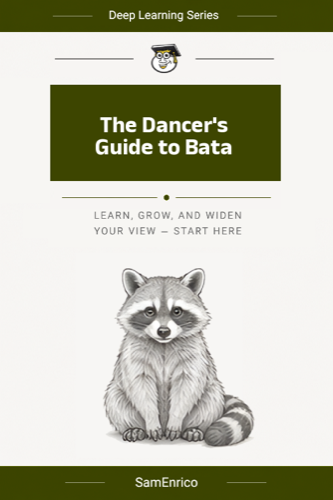
Non-FictionInformativeEducational
The Dancer's Guide to Bata eBook
This publication, published by SamEnrico, covers T
This publication, published by SamEnrico, covers The Dancer's Guide to Bata
Formats
Free sample
Chapter 1: The Living Legacy...--Before your feet ever touch the floor in a Bata step, before your hips learn to tilt or your spine learns to speak, you must understand one truth that every master drummer and elder will tell you: Bata dance is not something you do. It is something you answer.This is the fundamental distinction that separates the student from the tourist, the practitioner from the performer, the dancer from the mimic. In the Western dance tradition, you learn steps. You memorize sequences. You repeat them until muscle memory takes over, and then you perform them for applause.
Bata inverts this relationship entirely. The drum calls. The dancer responds. The drum asks a question. The body answers.
And in that call-and-response, something ancient and alive moves through both the dancer and the witness.This chapter establishes the foundational worldview necessary to authentically engage with Bata as both a dance form and a living spiritual practice. We will trace the origins of the Bata drum ensemble as sacred instruments of communication, explore the distinction between sacred and secular performance contexts, introduce the Spectrum of Intent framework that resolves the apparent contradiction between "mediator" and "performer," and close with the thesis that will guide every physical technique in this book: understanding the mythology of each rhythm fundamentally changes how you hold your body, where you place your weight, and how you use your eyes. Without this cosmology, the dancer is merely mimicking steps. With it, the dancer becomes a vessel.The Origins of Bata: More Than Music The story of Bata begins not in a dance studio or a theater but in the spiritual cosmology of the Yoruba people of Southwestern Nigeria, a civilization whose cultural influence now spans the globe through the African diaspora. The Yoruba understanding of the universe is neither linear nor hierarchical in the Western sense.
It is relational. Everything—every person, every tree, every stone, every drum, every movement—exists in dynamic relationship with everything else. The visible world and the invisible world are not separate. They interpenetrate. And the bridge between them is rhythm.The Bata drum ensemble consists of three primary drums, though variations exist across different Yoruba lineages and diaspora traditions.
The Iya Ilu—which translates literally to "Mother Drum"—is the largest and most important voice. She is the lead, the conversationalist, the improviser. Unlike Western drums that maintain a steady beat, the Iya Ilu speaks in phrases. She can mimic the tonal inflections of the Yoruba language. She can ask a question, wait for the dancer's response, and then change her question based on what she sees.
This is not metaphor. For those who have trained their ears, the Iya Ilu is as articulate as a human voice.The two smaller drums, collectively referred to as the Omele (children of the mother), provide the foundational pulse. They do not improvise. They hold the groove, the ground, the gravitational center around which the Iya Ilu dances with her patterns. Together, the three drums create what ethnomusicologists call a polyrhythmic matrix—multiple rhythmic layers moving at different speeds, intersecting at unexpected points, creating a texture so rich that the untrained ear hears only chaos.
The trained ear hears conversation.But the Bata ensemble is not complete without the Saworo Ide—brass rattles attached to the larger drum's frame. These rattles produce a sharp, metallic accent that cuts through the drums like lightning through clouds. In Yoruba cosmology, this sound is associated with Sango, the Orisha of lightning, fire, and masculine power. When the Saworo Ide speaks, the dancer must respond immediately. It is a punctuation mark.
A command. A door opening.The Orishas: Dancing with Deities To understand Bata, you must understand the Orishas. These are not "gods" in the Greco-Roman sense—distant, anthropomorphic beings sitting on thrones in the sky. The Orishas are more accurately described as concentrations of cosmic energy, archetypal forces that manifest in nature, in human personality, and in rhythm. Each Orisha has a distinct character, a distinct set of colors and foods and rituals, and most importantly for the dancer, a distinct dance vocabulary.Sango, as mentioned, is the Orisha of lightning, thunder, fire, and masculine virility.
His dance is aggressive, sharp, grounded. The dancer who channels Sango moves with explosive power, sudden stops, and a chest that seems to defy gravity. The rhythm associated with Sango is fast, militant, full of accents that hit like thunderclaps. When you dance Sango, you do not smile. You command.Ogun is the Orisha of iron, war, tools, and the road.
He is the blacksmith, the surgeon, the soldier, the one who clears the path through the wilderness. His dance is methodical, heavy, deliberate. Each step is a hammer strike. Each gesture is a tool being wielded. The Ogun rhythm is grounded, almost trudging, with a pulse that feels like a heartbeat slowed down to the pace of labor.Eshu (also known as Elegbara in some traditions) is the messenger Orisha, the guardian of crossroads, the trickster, the one who opens and closes doors of communication.
His dance is fast, sly, unpredictable. He is neither good nor evil but the principle of possibility itself. The Elegbara rhythm is sharp and quick, with sudden stops and starts that require the dancer to shift weight instantaneously.Yemoja is the Orisha of the ocean, motherhood, and the lunar cycles. Her dance is fluid, undulating, hypnotic. Where Sango's movements are sharp angles, Yemoja's are waves.
Her dancers move the spine in continuous circles, the arms like currents, the feet barely leaving the earth. The rhythm is slower, more patient, with a pulse that swells and recedes like tides.Oshun is the Orisha of rivers, love, beauty, and honey. Her dance is flirtatious, playful, sensual. She moves with a twisting waist and a fan in her hand, her face expressive, her eyes dancing with the drum. The Oshun rhythm is lighter than Yemoja's, with more syncopation, more room for individual expression.There are more than four hundred Orishas in the full Yoruba pantheon, though most communities focus on a smaller number of primary figures.
What matters for the dancer is not memorizing every name but understanding the principle: each rhythm is a personality. Each drum pattern is a conversation with a specific cosmic force. And each dance is an answer.Sacred vs. Secular: Two Modes of Practice One of the most common sources of confusion for new students—and one of the most frequent sources of cultural disrespect—is the failure to distinguish between sacred and secular contexts for Bata performance. Both are valid.
Both require training. Both can produce beauty and meaning. But they are not the same, and treating them as interchangeable is a mistake that can range from embarrassing to genuinely harmful.Sacred contexts include religious ceremonies, possession rituals, funerals, coronations, and initiations. In these settings, the Bata drums are not instruments but altars. The dancers are not performers but priests and priestesses in motion.
The goal is not to entertain but to invoke—to call an Orisha into the space, to open a door between worlds, to allow the divine to "mount" a dancer (the traditional language for possession). In sacred…
This is the end of the free sample. Get the eBook to keep going. Buy now
About this book
Details
- Author
- Sherrill Jonas
- Publisher
- SamEnrico
- Language
- English
- Genre
- Non-Fiction, Informative, Educational
- Released
- 2026-06-02
- Pages (approx.)
- 135
- Available as
- eBook, Audiobook

Read better in the ZLOADR app
Your eBooks on your phone or tablet. Sign in with your SamEnrico account and start reading.
More by Sherrill Jonas
 The Breath While WalkingSherrill Jonas$11.99
 Anger Management for Office GossipSherrill Jonas$11.99
 COVID Anxiety DBTSherrill Jonas$11.99
 Offshore Oil Rig Worker GuideSherrill Jonas$11.99
 Insurance Policy AI AbstractionSherrill Jonas$11.99
 Sunken Aircraft Carrier LogSherrill Jonas$11.99
 Family History PalaceSherrill Jonas$11.99
 Egyptian Astronomy GuideSherrill Jonas$11.99
 Rewiring ImpatienceSherrill Jonas$11.99
 The Piltdown Hoax of the Andes: How a Fake Fossil Fooled the WorldSherrill Jonas$11.99
 The Midnight Ferry: Harriet Tubman’s Secret Water RoutesSherrill Jonas$11.99
 The Rendlesham Forest Enigma: When the Military Met the UnknownSherrill Jonas$11.99
You may also like
 Hong Kong Handover 1997Dunn Johnnie$11.99
 Zumba For Postnatal Recovery CourseNeal Christian$11.99
 Zumba for BeginnersLadner Nikia$11.99
 YouTube Comment Mining GuideHumes Pandora$12.99
 Worry Box MeditationCarlin Rudy$11.99
 Workplace Stress MeditationNguyen Lynn$11.99
 Workplace Stress and Sleep RepairHawley Ivory$11.99
 Workplace Perfectionism CureDelaney Jeffry$11.99
 Workplace Injustice Anger GuideWallen Isabelle$11.99
 Work Addiction and Burnout LinkGreenwood Ester$11.99
 Women in Yoga and WellnessBeattie Galina$11.99
 Women in Stand Up ComedyChun Evangeline$11.99