

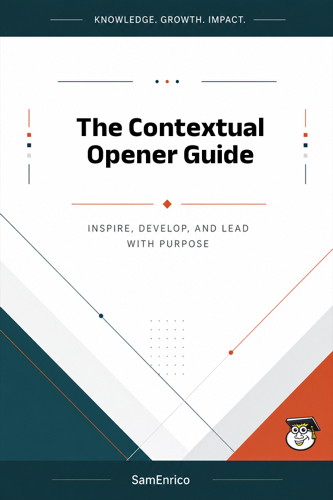
Non-FictionSelf-HelpSituational Awareness
The Contextual Opener Guide eBook
Craft natural conversation starters from your imme
Craft natural conversation starters from your immediate environment and shared situation.
Formats
Free sample
Chapter 1: The Anxiety Inventory--You are standing at the edge of a crowded room. Your drink is a prop. Your phone is a shield. Your heart is performing calisthenics. You scan for an exit, an ally, a miracle.
The person next to you looks equally lost. And in the three seconds before either of you speaks, something remarkable happens inside your body: your sympathetic nervous system activates, your cortisol levels rise, and your brain begins a frantic search through its library of pre-recorded openers. "How are you?" it offers. "Nice weather." "What do you do?" These are the emergency rations of conversation, and they are nutritionally worthless.This is not a failure of personality. It is a failure of observation.The problem with most conversation advice is that it treats the symptom—the blank mind, the awkward silence—without diagnosing the cause.
The cause is not a lack of clever lines. The cause is a lack of attention. You are not failing to remember something. You are failing to see what is already there.This chapter dismantles the single most expensive misconception in social skills literature: the belief that you need a repertoire of clever, pre-written opening lines. This misconception has been sold to you in countless books, courses, and seminars.
It has been reinforced by every well-meaning friend who told you to "just have a few go-to questions ready." It has been monetized by an entire industry built on the premise that you are missing information that can be delivered in a numbered list. You are not missing information. You are missing awareness.Dale Carnegie, whose 1936 masterpiece How to Win Friends and Influence People remains the best-selling self-help book of all time, established a single foundational insight that has been misunderstood for nearly a century. Carnegie wrote that becoming "genuinely interested in other people" is the root of likability. He did not say "become genuinely interesting to other people." He did not say "memorize a list of clever questions." He said interested.
Interest is not a script. Interest is a posture. It is the orientation of attention outward rather than inward.But somewhere between Carnegie's original text and the modern self-help industrial complex, "be interested" was translated into "ask questions." And "ask questions" was further degraded into "ask these five questions." And suddenly, millions of people were walking into rooms with pre-loaded scripts, convinced that the path to connection was through memorization. The data suggests otherwise.The Hidden Cost of Canned Openers Let us name the two most common openers for what they are: conversational poison."How are you?" is automatic, meaningless, and requires no observation whatsoever. It is the verbal equivalent of a car alarm—noise that everyone ignores.
When you ask "How are you?" to a stranger, you are not starting a conversation. You are performing a ritual that everyone has learned to complete with the single word "good" while already looking past your shoulder for someone more interesting. The question requires no answer. The answer requires no listening. The listening requires no presence.
It is a three-step dance to nowhere."What do you do?" is worse. It is interrogative, job-reducing, and implicitly hierarchical. When you ask someone what they do for work, you are asking them to summarize their identity into a job title, which they may be insecure about, embarrassed by, or actively trying to escape. You are also revealing that you have no other category for understanding them. The implicit message is: I cannot see anything about you except your economic function.
This is not a conversation starter. It is a job interview conducted by someone without authority to hire.These two openers dominate social interaction not because they work, but because they require zero effort. They are the conversational equivalent of junk food—calories without nutrition. And like junk food, they leave you hungrier than before.The irony is that the effort you save by using canned openers is exactly the effort required to connect. Real openers require work.
They require looking, listening, and noticing. They require the courage to say something specific rather than something safe. They require the vulnerability of acknowledging what you actually see rather than what you have rehearsed.The Contextual Trinity The solution to this problem is a framework I call the Contextual Trinity. It replaces memorization with awareness. It replaces scripts with observations.
It replaces anxiety with attention. Every natural opener—every single one—comes from one of three sources.The first source is the Physical Environment. This includes objects, decor, layout, lighting, temperature, and any tangible thing in the space you share. The physical environment is the most reliable source of openers because it is visible to both of you. You are not pulling information from your memory; you are pointing at reality.
A book on a table, a strange piece of art on the wall, the fact that the room is unusually cold, the peculiar layout of chairs—all of these are openers waiting to be spoken. The key is specificity. "I like this place" is dead. "I cannot figure out why they hung that painting over the exit sign" is alive.The second source is the Shared Situation. This includes waiting in line, experiencing a delay, observing the same event, navigating confusing instructions, or any circumstance that you are both undergoing simultaneously.
The shared situation is powerful because it creates what psychologists call "shared reality"—the experience of perceiving the world in the same way as another person. When you acknowledge a shared situation, you are not introducing new information. You are naming what already exists. "We have been waiting a long time" is not a clever line. It is a statement of fact.
That is why it works.The third source is the Emotional Atmosphere. This includes the room's energy level, the collective mood, the tension or relaxation in the air, and the unspoken emotional weather of the space. The emotional atmosphere is the most subtle of the three sources, and therefore the most powerful when used correctly. It requires genuine emotional intelligence—the ability to perceive what others are feeling without being told. "Everyone seems nervous" or "This room has good energy tonight" or "Is it just me, or does that table look like they're having the worst conversation of their lives?" These openers demonstrate that you are not just seeing the world; you are feeling it.The Contextual Trinity is not a checklist.
It is a lens. Once you learn to see through it, you will realize that you have never in your life been in a situation without an opener. The environment always contains something. The situation always includes both of you. The atmosphere always has a texture.
The problem is not that the material is absent. The problem is that you have been looking elsewhere.Why Memorized Scripts Backfire Let me be precise about why memorized scripts fail, because this is the core insight of the entire book.First, scripts increase anxiety. When you are trying to remember a line, you are multitasking: you are monitoring your memory while also trying to read the room. This divided attention makes you less present, not more. The person you are speaking to can feel…
This is the end of the free sample. Get the eBook to keep going. Buy now
About this book
Details
- Author
- Tolliver Lucila
- Publisher
- SamEnrico
- Language
- English
- Genre
- Non-Fiction, Self-Help, Situational Awareness
- Released
- 2026-06-07
- Pages (approx.)
- 125
- Available as
- eBook, Audiobook

Read better in the ZLOADR app
Your eBooks on your phone or tablet. Sign in with your SamEnrico account and start reading.
More by Tolliver Lucila
 Anger De escalation for First RespondersTolliver Lucila$11.99
 Second Opinion After LossTolliver Lucila$11.99
 Celebrity Child Self WorthTolliver Lucila$11.99
 Science Lab Report GuideTolliver Lucila$11.99
 Nightmare Rescripting For CouplesTolliver Lucila$11.99
 Negative Assertion GuideTolliver Lucila$11.99
 Attorney Voir Dire StrategyTolliver Lucila$11.99
 The Architect of the Golden City: Mimar Sinan and the Ottoman RenaissanceTolliver Lucila$11.99
 How to Produce Sports EyewearTolliver Lucila$11.99
 Freemium App Size OptimizationTolliver Lucila$12.99
 Prime Rate Impact on Small Business DebtTolliver Lucila$12.99
 Understanding WhiplashTolliver Lucila$11.99
You may also like
 Hong Kong Handover 1997Dunn Johnnie$11.99
 Zumba For Postnatal Recovery CourseNeal Christian$11.99
 Zumba for BeginnersLadner Nikia$11.99
 YouTube Comment Mining GuideHumes Pandora$12.99
 Worry Box MeditationCarlin Rudy$11.99
 Workplace Stress MeditationNguyen Lynn$11.99
 Workplace Stress and Sleep RepairHawley Ivory$11.99
 Workplace Perfectionism CureDelaney Jeffry$11.99
 Workplace Injustice Anger GuideWallen Isabelle$11.99
 Work Addiction and Burnout LinkGreenwood Ester$11.99
 Women in Yoga and WellnessBeattie Galina$11.99
 Women in Stand Up ComedyChun Evangeline$11.99