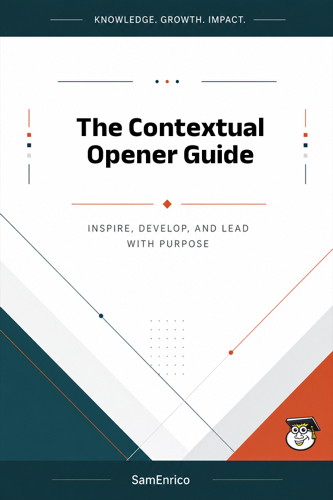
The Contextual Opener Guide
Craft natural conversation starters from your imme
Craft natural conversation starters from your immediate environment and shared situation.
Formats
About this book
Free sample
Chapter 1: The Anxiety Inventory--You are standing at the edge of a crowded room. Your drink is a prop. Your phone is a shield. Your heart is performing calisthenics. You scan for an exit, an ally, a miracle.
The person next to you looks equally lost. And in the three seconds before either of you speaks, something remarkable happens inside your body: your sympathetic nervous system activates, your cortisol levels rise, and your brain begins a frantic search through its library of pre-recorded openers. "How are you?" it offers. "Nice weather." "What do you do?" These are the emergency rations of conversation, and they are nutritionally worthless.This is not a failure of personality. It is a failure of observation.The problem with most conversation advice is that it treats the symptom—the blank mind, the awkward silence—without diagnosing the cause.
The cause is not a lack of clever lines. The cause is a lack of attention. You are not failing to remember something. You are failing to see what is already there.This chapter dismantles the single most expensive misconception in social skills literature: the belief that you need a repertoire of clever, pre-written opening lines. This misconception has been sold to you in countless books, courses, and seminars.
It has been reinforced by every well-meaning friend who told you to "just have a few go-to questions ready." It has been monetized by an entire industry built on the premise that you are missing information that can be delivered in a numbered list. You are not missing information. You are missing awareness.Dale Carnegie, whose 1936 masterpiece How to Win Friends and Influence People remains the best-selling self-help book of all time, established a single foundational insight that has been misunderstood for nearly a century. Carnegie wrote that becoming "genuinely interested in other people" is the root of likability. He did not say "become genuinely interesting to other people." He did not say "memorize a list of clever questions." He said interested.
Interest is not a script. Interest is a posture. It is the orientation of attention outward rather than inward.But somewhere…
This is the end of the free sample. Get the eBook to keep going. Buy now
Contents
- Chapter 1
- Chapter 2
- Chapter 3
- Chapter 4
- Chapter 5
- Chapter 6
- Chapter 7
- Chapter 8
- Chapter 9
- Chapter 10
- Chapter 11
- Chapter 12
Details
- Author
- Tolliver Lucila
- Publisher
- SamEnrico
- Language
- English
- Genre
- Non-Fiction, Self-Help, Situational Awareness
- Released
- 2026-06-07
- Pages (approx.)
- 125
- Available as
- eBook, Audiobook

Read better in the ZLOADR app
Your eBooks on your phone or tablet. Sign in with your SamEnrico account and start reading.
More by Tolliver Lucila
 Anger De escalation for First RespondersTolliver Lucila$11.99
 Second Opinion After LossTolliver Lucila$11.99
 Celebrity Child Self WorthTolliver Lucila$11.99
 Science Lab Report GuideTolliver Lucila$11.99
 Nightmare Rescripting For CouplesTolliver Lucila$11.99
 Negative Assertion GuideTolliver Lucila$11.99
 Attorney Voir Dire StrategyTolliver Lucila$11.99
 The Architect of the Golden City: Mimar Sinan and the Ottoman RenaissanceTolliver Lucila$11.99
 How to Produce Sports EyewearTolliver Lucila$11.99
 Freemium App Size OptimizationTolliver Lucila$12.99
 Prime Rate Impact on Small Business DebtTolliver Lucila$12.99
 Understanding WhiplashTolliver Lucila$11.99