
Non-FictionSelf-HelpNeurodivergent
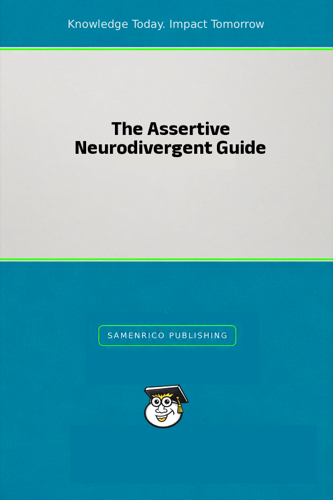
The Assertive Neurodivergent Guide eBook
Adapt assertive communication for ADHD, autism, an
Adapt assertive communication for ADHD, autism, and other neurotypes.
Formats
Free sample
Chapter 1: The 48-Hour Lie--–- The first time I was taught to be assertive, I ended up crying in my car two days later with no idea why. I had followed the instructions perfectly. Steady voice. Eye contact. “I feel X when you do Y.” I had practiced in the mirror.
I had lowered my tone. I had suppressed the urge to look away, to stim, to laugh nervously, to say “never mind” and retreat into safety. I had been good. And then, forty-eight hours after that successful conversation, I woke up unable to move. Not physically paralyzed, but close.
Every task required ten times the usual effort. A text message felt like a calculus exam. The thought of speaking made my throat close. I had no idea that the polite, well-received assertiveness I performed on Tuesday had borrowed energy from Thursday—and Thursday had come to collect.For years, I believed I was simply bad at assertiveness. I would read books, take workshops, and practice scripts, only to find myself either people-pleasing my way into exhaustion or snapping with a bluntness that shocked even me.
The standard advice worked for everyone else, I assumed. The problem must be me.It was not.Traditional assertiveness training was designed for neurotypical nervous systems—brains that process language in real time, tolerate eye contact without sensory cost, regulate emotions under social pressure, and follow linear, turn-taking conversation without internal chaos. For the rest of us—ADHD, autistic, Au DHD, and otherwise neurodivergent—these techniques do not simply fail. They actively harm. They increase masking.
They trigger shame. And they produce a very specific, very predictable pattern: successful performance, followed by delayed collapse.This book exists because that pattern is not your fault. And it is not inevitable.The Performance You Didn’t Know You Were Giving Let me describe what happens when a neurodivergent person tries to follow standard assertiveness advice. Imagine you are running a high-endurance application on a computer—a video game, a rendering program, a massive data analysis. That application consumes most of your processing power.
Now imagine that the assertiveness training tells you to open another high-endurance application at the same time. Your computer slows. It overheats. Eventually, it crashes.That is masking. And standard assertiveness is masking disguised as self-improvement.When you are told to “make eye contact to show confidence,” your brain does not simply make eye contact.
It also:Suppresses the instinct to look away (which is a natural regulation behavior)Monitors the duration and intensity of the gaze (too long becomes staring, too short becomes shifty)Continues to process the content of the conversation (which is now harder because eye contact consumes cognitive resources)Manages any sensory discomfort (for many autistic people, eye contact is physically unpleasant)Performs the facial expressions expected during eye contact (nodding, smiling, serious faces)That is not one task. That is five tasks running simultaneously. And standard assertiveness training treats these five tasks as a single, simple instruction: “Make eye contact.”Now multiply that by every component of “good” assertiveness. Maintain a calm tone (while your nervous system is screaming). Use “I” statements (while translating your direct thoughts into indirect language).
Speak at a measured pace (while your working memory is leaking information by the second). Do not interrupt (while your ADHD brain knows that if you do not say it now, it will be gone forever).This is the hidden curriculum of neurotypical assertiveness. And it is exhausting.The Sensory Cup: A Better Metaphor Throughout this book, we will use a simple metaphor to understand your capacity for assertiveness: the sensory cup.Imagine you have a cup. Every sensory input and social demand pours water into that cup. The flickering fluorescent light in your office?
A few drops. The small talk with a coworker before a meeting? More drops. The background music in the coffee shop? Drops.
The effort of translating your thoughts into neurotypical-friendly language? A steady stream. The suppressed urge to stim? Another stream.By the time you sit down for a conversation that requires assertiveness, your cup is often already half full—or more. Standard assertiveness training assumes your cup is empty.
It tells you to pour even more into the cup (eye contact, calm tone, measured pace) while also asking you to hold the conversation. The cup overflows. That overflow is not a personal failure. It is physics.The solution is not to get a bigger cup. The solution is to understand what fills your cup, to empty it proactively, and to stop apologizing for having a cup that works differently than the one the training manuals imagined.The 48-Hour Burnout Lag One of the most insidious features of neurodivergent burnout is its delay.
You can have a “successful” assertive conversation on Tuesday—calm, clear, well-received—and feel fine on Wednesday. Then Thursday arrives, and you cannot function. The simplest task feels monumental. You may experience brain fog, physical exhaustion, irritability, or a complete loss of motivation. You may have a meltdown or a shutdown.
And because the cause is not immediately obvious, you blame yourself. You think you are lazy, unreliable, or weak.You are none of those things. You are experiencing the 48-Hour Burnout Lag.Here is what happened. During Tuesday’s conversation, your nervous system borrowed energy from future you. It suppressed your sensory needs, overrode your fatigue signals, and performed neurotypical fluency at a high metabolic cost.
That cost did not disappear. It was deferred. And on Thursday, the bill arrived.This pattern is so common among neurodivergent people that it has become a diagnostic clue for clinicians who know what to look for. A client reports that they “handle stress well” in the moment but fall apart two days later. They have learned to perform resilience.
But the performance has a price.The first step toward genuine assertiveness is recognizing this pattern in your own life. The Post-Interaction Inventory at the end of this chapter will help you track it. For now, simply notice: if you have ever been told you are “good under pressure” but regularly crash afterward, you are not broken. You are running a different operating system.The Two Traps: Fawning and Fighting The 20,000 negative messages statistic appears often in neurodiversity literature, and for good reason. By age ten, the average neurodivergent child has heard approximately twenty thousand more corrective, critical, or shaming messages than their neurotypical peers.
“Sit still.” “Look at me.” “Stop interrupting.” “Why can’t you be normal?” “Try harder.” “You’re being too much.” “You’re not trying hard enough.”Twenty thousand messages is not a number. It is a nervous system rewrite.That rewrite produces two common, opposite, and equally damaging patterns in adulthood. I call them the Two Traps.The Fawning Trap (People-Pleasing). You learned early that safety came from being small, helpful, and invisible. If you anticipate everyone’s needs, no one will be angry at you.
If you say “sorry” before anyone can accuse you, you control the narrative. If you agree quickly and comply fully, the criticism stops. The problem is that fawning feels like assertiveness when it is actually the absence of self. You are not…
This is the end of the free sample. Get the eBook to keep going. Buy now
About this book
Details
- Author
- Skinner Mayola
- Publisher
- SamEnrico
- Language
- English
- Genre
- Non-Fiction, Self-Help, Neurodivergent
- Released
- 2026-06-07
- Pages (approx.)
- 134
- Available as
- eBook, Audiobook

Read better in the ZLOADR app
Your eBooks on your phone or tablet. Sign in with your SamEnrico account and start reading.
More by Skinner Mayola
 Childhood Trauma Dream DecoderSkinner Mayola$11.99
 Denmark Norway Napoleonic Wars GuideSkinner Mayola$11.99
 The Roman Room Technique GuideSkinner Mayola$11.99
 DBT For WorthlessnessSkinner Mayola$11.99
 The Blood and Gold of Cajamarca: Pizarro’s Gambit (1532)Skinner Mayola$11.99
 Gameroom AttendantSkinner Mayola$11.99
 Grant Writing as EvidenceSkinner Mayola$12.99
 Chinese Negotiation TacticsSkinner Mayola$12.99
 Understanding Syndrome of Inappropraite Antidiuretic HormoneSkinner Mayola$17.99
 How to Start a Muslin Dressing Business (Beginners Guide)Skinner Mayola$11.99
You may also like
 Hong Kong Handover 1997Dunn Johnnie$11.99
 Zumba For Postnatal Recovery CourseNeal Christian$11.99
 Zumba for BeginnersLadner Nikia$11.99
 YouTube Comment Mining GuideHumes Pandora$12.99
 Worry Box MeditationCarlin Rudy$11.99
 Workplace Stress MeditationNguyen Lynn$11.99
 Workplace Stress and Sleep RepairHawley Ivory$11.99
 Workplace Perfectionism CureDelaney Jeffry$11.99
 Workplace Injustice Anger GuideWallen Isabelle$11.99
 Work Addiction and Burnout LinkGreenwood Ester$11.99
 Women in Yoga and WellnessBeattie Galina$11.99
 Women in Stand Up ComedyChun Evangeline$11.99