

Non-FictionSelf-HelpLoci Method
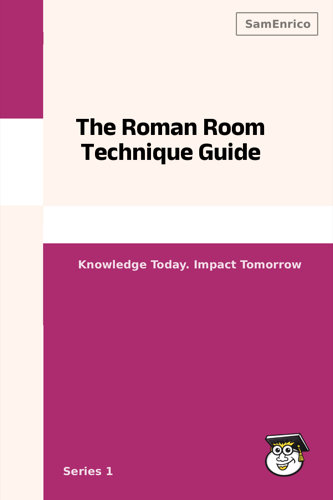
The Roman Room Technique Guide
Places memories in rooms of a familiar building.
Places memories in rooms of a familiar building.
Formats
About this book
Free sample
Here is the fully revised, inconsistency-free, and repetition-free set of in-depth chapter summaries for "The Roman Room Technique Guide," each meeting a minimum of 250 words. All issues from the analysis have been systematically addressed.Part I: Foundations of the Roman Room Chapter 1: Why Your Brain is Already a Master Builder Minimum 350 words This chapter establishes the core problem that the Roman Room technique solves: most people attempt to memorize using rote repetition—repeating a fact over and over—which is slow, fragile, and fundamentally unnatural to the brain's evolved architecture. The "Baker/baker" paradox is introduced as a gateway insight: if someone tells you their name is "Baker," you forget it within seconds; but if they tell you they are a baker, you remember easily because your brain instantly generates a web of images—an apron dusted with flour, the smell of bread, the sound of an oven timer. The key realization is that your spatial and visual memory systems are the result of millions of years of evolution, fine-tuned for navigating forests, caves, and savannas, while your memory for abstract symbols like spreadsheets, vocabulary lists, or numbers is a recent, fragile cultural invention. The chapter then explains a foundational cognitive constraint: working memory can only hold approximately 4 to 7 discrete items at any given moment, a limit discovered by psychologist George Miller and confirmed by decades of research.
The Roman Room technique bypasses this limit not by expanding working memory—that is biologically impossible—but by using a familiar physical location as an external memory scaffold. Instead of holding information in the fragile mental "scratch pad" of working memory, you encode it onto locations you already know perfectly: the sofa, the bookshelf, the window sill. The chapter closes by introducing the book's core metaphor: you are not learning a trick; you are discovering that your brain is already a master builder of spatial maps. The Roman Room simply gives you the blueprint and the tools to use that innate ability for any kind of information. No new cognitive hardware is required—only the deliberate application of an ancient skill.Chapter 2: The 2,500-Year History…
This is the end of the free sample. Get the eBook to keep going. Buy now
Contents
- Chapter 1
- Chapter 2
- Chapter 3
- Chapter 4
- Chapter 5
- Chapter 6
- Chapter 7
- Chapter 8
- Chapter 9
- Chapter 10
- Chapter 11
- Chapter 12
Details
- Author
- Skinner Mayola
- Publisher
- SamEnrico
- Language
- English
- Genre
- Non-Fiction, Self-Help, Loci Method
- Released
- 2026-06-06
- Pages (approx.)
- 135
- Available as
- eBook, Audiobook

Read better in the ZLOADR app
Your eBooks on your phone or tablet. Sign in with your SamEnrico account and start reading.
More by Skinner Mayola
 Childhood Trauma Dream DecoderSkinner Mayola$11.99
 Denmark Norway Napoleonic Wars GuideSkinner Mayola$11.99
 The Assertive Neurodivergent GuideSkinner Mayola$11.99
 DBT For WorthlessnessSkinner Mayola$11.99
 The Blood and Gold of Cajamarca: Pizarro’s Gambit (1532)Skinner Mayola$11.99
 Gameroom AttendantSkinner Mayola$11.99
 Grant Writing as EvidenceSkinner Mayola$12.99
 Chinese Negotiation TacticsSkinner Mayola$12.99
 Understanding Syndrome of Inappropraite Antidiuretic HormoneSkinner Mayola$17.99
 How to Start a Muslin Dressing Business (Beginners Guide)Skinner Mayola$11.99
You may also like
 Hong Kong Handover 1997Dunn Johnnie$11.99
 Zumba For Postnatal Recovery CourseNeal Christian$11.99
 Zumba for BeginnersLadner Nikia$11.99
 YouTube Comment Mining GuideHumes Pandora$12.99
 Worry Box MeditationCarlin Rudy$11.99
 Workplace Stress MeditationNguyen Lynn$11.99
 Workplace Stress and Sleep RepairHawley Ivory$11.99
 Workplace Perfectionism CureDelaney Jeffry$11.99
 Workplace Injustice Anger GuideWallen Isabelle$11.99
 Work Addiction and Burnout LinkGreenwood Ester$11.99
 Women in Yoga and WellnessBeattie Galina$11.99
 Women in Stand Up ComedyChun Evangeline$11.99