
Non-FictionSelf-HelpCommunication Skills
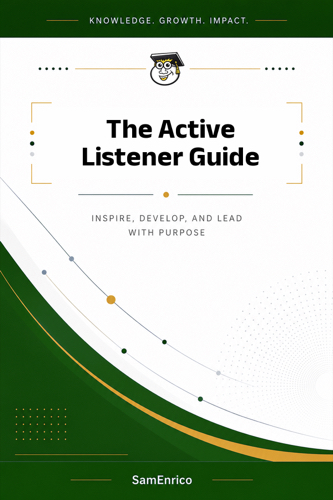
The Active Listener Guide eBook
Teaches core techniques like paraphrasing, reflect
Teaches core techniques like paraphrasing, reflecting, and questioning to improve workplace communication and reduce misunderstandings.
Formats
Free sample
Chapter 1: The Silence Beneath the Words--–- Every morning, Sarah, a seasoned marketing director, walks into her team’s weekly stand-up meeting. She asks for updates, notes the timelines, and assigns next steps. By all appearances, communication is happening. But underneath the surface, a quieter, more expensive problem is festering. Her junior designer, Marcus, has stopped sharing his creative concerns after being interrupted three meetings in a row.
Her analytics lead, Priya, feels that her detailed risk assessments are met with impatient nods before the group moves on. And Sarah herself is exhausted from repeating instructions that somehow still go wrong. Nobody in that room would say they aren’t listening. Yet the evidence—missed deadlines, duplicated work, quiet quitting—suggests otherwise.This is not a failure of hearing. It is a failure of active listening.
And it is the single most under-addressed driver of workplace dysfunction today.The Core Problem: The Illusion of Understanding Most professionals believe they are good listeners. Ask any manager, and they will rate themselves above average. Ask their direct reports, and a very different picture emerges. According to research cited by Heather R. Younger in The Art of Active Listening, during the Great Resignation, “workers began leaving their jobs, in part because they hadn’t felt heard for a long time.” Not underpaid.
Not overworked. Not heard.Let that sink in. People leave organizations not because of strategy or compensation alone, but because the daily experience of speaking into a void—of offering ideas, raising concerns, or simply explaining a problem, only to be met with distraction, interruption, or premature solutions—erodes their sense of value. When listening fails, trust fails. When trust fails, engagement fails.
And when engagement fails, the organization bleeds talent, time, and money.The pandemic and the shift to remote and hybrid work did not create this problem, but they brutally exposed it. In a physical office, we could rely on incidental nonverbal cues—a nod, eye contact, a leaned-in posture—to simulate listening. On Zoom or Slack, those crutches disappeared. Suddenly, the gap between talking and being understood became impossible to ignore. Meetings stretched longer.
Emails multiplied. Misunderstandings that would have taken thirty seconds to resolve in person became three-day email threads.This book, The Active Listener Guide, is built on a simple premise: listening is not a passive virtue. It is an active discipline. It can be diagnosed, practiced, measured, and improved. And when it is, the return on investment is staggering—lower turnover, faster decisions, less rework, and a culture where people actually feel safe enough to tell the truth before a small problem becomes a crisis.In this chapter, we will diagnose why listening fails at work, identify the personal and organizational barriers that keep us stuck in reactive mode, and introduce the foundational framework that will guide you through the rest of this book: the Active Listening Cycle.
By the end of this chapter, you will have a clear baseline of your current listening habits and a concrete commitment to begin changing them.The High Cost of Not Listening Before we can fix listening, we have to believe the problem is worth fixing. The data is sobering.A study by the International Listening Association found that people remember only 25 to 50 percent of what they hear. In a workplace context, that means half of every conversation—half of every instruction, half of every client request, half of every safety warning—is lost or distorted. Extrapolate that across a fifty-person organization, and the cost in wasted time alone runs into hundreds of thousands of dollars annually.But the costs go far beyond inefficiency. Consider these patterns:Rework and error rates.
When a manager says, “I need this by Friday,” and the employee hears, “I need this by Friday unless something else comes up,” the resulting delay is not a failure of effort. It is a failure of confirming understanding. Paraphrasing—which we will cover in depth in Chapter 3—would have caught the ambiguity in seconds. Without it, teams spend hours fixing what should have been clear.Turnover and disengagement. Younger’s research, cited in the opening of this book, found that feeling unheard is a primary driver of voluntary turnover.
Employees who believe their manager does not listen to them are 63 percent more likely to be actively looking for another job. The cost of replacing a single mid-level employee is typically one-half to two times their annual salary. For a manager with ten direct reports, improving listening skills could save the organization hundreds of thousands of dollars in avoided turnover alone.Innovation loss. The most dangerous cost is invisible: the ideas that never get spoken. In teams with low listening scores, employees learn to self-censor.
They stop offering process improvements, stop flagging risks, stop challenging bad strategies. The organization doesn’t fail because people make the wrong decisions. It fails because the right information never reaches decision-makers. Every interrupted sentence, every dismissed concern, every meeting dominated by the loudest voice is a small death of innovation.Conflict escalation. Most workplace conflicts are not about irreconcilable differences.
They are about misunderstandings that hardened into assumptions. One person says something ambiguous; the other infers intent; neither checks their interpretation; resentment builds; and six months later, HR is mediating a dispute that a single reflective statement (“It sounds like you felt dismissed in that meeting”) could have defused on day one.These costs are not theoretical. They are line items on every organization’s profit-and-loss statement, hidden under categories like “rework,” “employee relations,” and “project delays.” The organizations that learn to listen actively will systematically outperform those that don’t. This is not a soft skill. It is a competitive advantage.Why We Think We’re Listening When We’re Not If listening is so valuable and so rare, why do most people believe they are already good at it?
The answer lies in three cognitive traps that distort our self-perception.Trap 1: The Hearing-Listening Confusion Hearing is physiological. Sound waves enter your ear, your eardrum vibrates, and signals travel to your brain. You have almost no control over hearing. If someone speaks at a normal volume in a quiet room, you will hear them whether you want to or not.Listening is different. Listening is the intentional act of attending to, interpreting, and remembering what you heard.
You can hear every word someone says and still not listen to their meaning. Think of the last time you nodded along to a colleague while mentally drafting an email. You heard them. You did not listen.The confusion between hearing and listening is the most common self-assessment error. People point to their intact auditory system and conclude they are good listeners.
But listening is not a sense. It is a skill. And like any skill, it requires deliberate practice.Trap 2: Reactive Listening (Waiting to Speak)The second trap is the human tendency to listen for openings rather than understanding. Neuroscientists call this “reactive listening.” While the other person is speaking, your brain is doing two things simultaneously: processing their words and preparing your response. In most people, the response-preparation circuit overrides the comprehension circuit.
You are not listening to understand. You are listening to reply.You can spot reactive listening easily. It shows up as…
This is the end of the free sample. Get the eBook to keep going. Buy now
About this book
Details
- Author
- Mckenna Charlesetta
- Publisher
- SamEnrico
- Language
- English
- Genre
- Non-Fiction, Self-Help, Communication Skills
- Released
- 2026-06-07
- Pages (approx.)
- 156
- Available as
- eBook, Audiobook

Read better in the ZLOADR app
Your eBooks on your phone or tablet. Sign in with your SamEnrico account and start reading.
More by Mckenna Charlesetta
 The Online Dating Stalker GuideMckenna Charlesetta$11.99
 DBT For Foster Youth TransitionMckenna Charlesetta$11.99
 Principal Leadership StressMckenna Charlesetta$11.99
 The Autistic Student GuideMckenna Charlesetta$11.99
 The Great Gale of 1898: When the Sky Split OpenMckenna Charlesetta$11.99
 Managing PartnerMckenna Charlesetta$11.99
 Latin America Eco-Credits ManualMckenna Charlesetta$12.99
 How to Become a Congressional-district AideMckenna Charlesetta$11.99
 Pop Up Case Study NYCMckenna Charlesetta$12.99
You may also like
 Hong Kong Handover 1997Dunn Johnnie$11.99
 Zumba For Postnatal Recovery CourseNeal Christian$11.99
 Zumba for BeginnersLadner Nikia$11.99
 YouTube Comment Mining GuideHumes Pandora$12.99
 Worry Box MeditationCarlin Rudy$11.99
 Workplace Stress MeditationNguyen Lynn$11.99
 Workplace Stress and Sleep RepairHawley Ivory$11.99
 Workplace Perfectionism CureDelaney Jeffry$11.99
 Workplace Injustice Anger GuideWallen Isabelle$11.99
 Work Addiction and Burnout LinkGreenwood Ester$11.99
 Women in Yoga and WellnessBeattie Galina$11.99
 Women in Stand Up ComedyChun Evangeline$11.99