
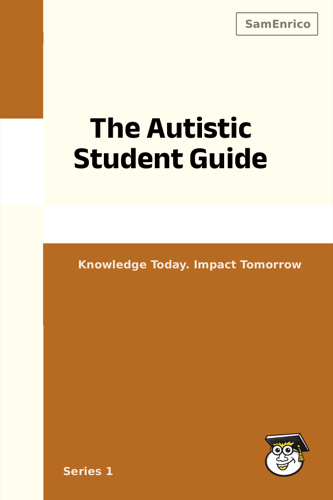
The Autistic Student Guide
Manage sensory overload and social demands in acad
Manage sensory overload and social demands in academic settings.
Formats
About this book
Free sample
Chapter 1: The Acoustic Minefield--–- The first time the cafeteria tray clattered to the floor, you felt it in your teeth. Not metaphorically. Your molars ached. Your jaw clenched. Your eyes squeezed shut before you could stop them.
And when you opened them again, every other student in the room was still eating, laughing, walking—completely unbothered. That was the moment you realized your nervous system was processing the world on a different frequency than everyone else's.Welcome to the acoustic reality of higher education. If you are autistic, your auditory system is not broken. It is working exactly as designed—for a different environment than the one you have just entered. College campuses are not built for autistic ears.
They are built for neurotypical ones: designed to be stimulating, energetic, and collaborative. For a significant subset of autistic students, those same design choices produce a continuous, low-grade stress response that never fully turns off. This chapter is about turning it off—or at least turning it down to a manageable volume.The Hidden Curriculum of Sound Before we discuss solutions, we need to understand the problem. Most neurotypical students experience sound as background. Their brains automatically filter out the hum of the HVAC system, the distant conversation two tables over, the rhythmic tapping of a pen in the row behind them.
This is called sensory gating—the neurological ability to separate relevant signals from irrelevant noise. Research consistently shows that autistic individuals have reduced sensory gating. Your brain processes the pen-tapping and the HVAC hum and the distant conversation with the same urgency as the professor's voice. This is not a attention deficit. It is a neural filtering difference.
Your brain is working harder, processing more data, with every passing second of a lecture.This constant over-processing has a cumulative cost. After twenty minutes in a standard classroom, your cognitive load—the amount of mental effort your working memory can sustain—may be depleted by fifty percent or more compared to a neurotypical peer sitting next to you. You are not less intelligent. You are not less capable. You are spending half…
This is the end of the free sample. Get the eBook to keep going. Buy now
Contents
- Chapter 1
- Chapter 2
- Chapter 3
- Chapter 4
- Chapter 5
- Chapter 6
- Chapter 7
- Chapter 8
- Chapter 9
- Chapter 10
- Chapter 11
- Chapter 12
Details
- Author
- Mckenna Charlesetta
- Publisher
- SamEnrico
- Language
- English
- Genre
- Non-Fiction, Self-Help, Autism
- Released
- 2026-06-06
- Pages (approx.)
- 154
- Available as
- eBook, Audiobook

Read better in the ZLOADR app
Your eBooks on your phone or tablet. Sign in with your SamEnrico account and start reading.
More by Mckenna Charlesetta
 The Online Dating Stalker GuideMckenna Charlesetta$11.99
 DBT For Foster Youth TransitionMckenna Charlesetta$11.99
 Principal Leadership StressMckenna Charlesetta$11.99
 The Active Listener GuideMckenna Charlesetta$11.99
 The Great Gale of 1898: When the Sky Split OpenMckenna Charlesetta$11.99
 Managing PartnerMckenna Charlesetta$11.99
 Latin America Eco-Credits ManualMckenna Charlesetta$12.99
 How to Become a Congressional-district AideMckenna Charlesetta$11.99
 Pop Up Case Study NYCMckenna Charlesetta$12.99
You may also like
 Hong Kong Handover 1997Dunn Johnnie$11.99
 Zumba For Postnatal Recovery CourseNeal Christian$11.99
 Zumba for BeginnersLadner Nikia$11.99
 YouTube Comment Mining GuideHumes Pandora$12.99
 Worry Box MeditationCarlin Rudy$11.99
 Workplace Stress MeditationNguyen Lynn$11.99
 Workplace Stress and Sleep RepairHawley Ivory$11.99
 Workplace Perfectionism CureDelaney Jeffry$11.99
 Workplace Injustice Anger GuideWallen Isabelle$11.99
 Work Addiction and Burnout LinkGreenwood Ester$11.99
 Women in Yoga and WellnessBeattie Galina$11.99
 Women in Stand Up ComedyChun Evangeline$11.99