
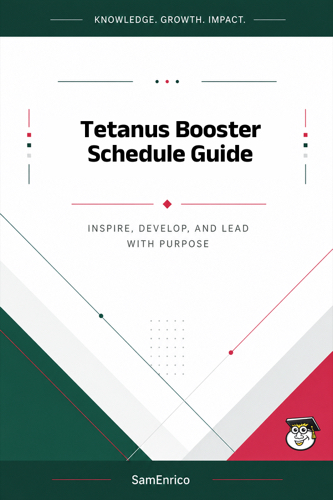
Non-FictionHealth & WellnessEmergency Medicine
Tetanus Booster Schedule Guide Audiobook
Wound management and 10-year update protocols.
by Autry Shayla
Wound management and 10-year update protocols.
Formats
Free sample
Chapter 1: The Unnecessary Epidemic...--–- The first thing Mary remembers after waking from the coma was her jaw. It wouldn't open. The nurses called it "lockjaw." Mary called it torture. She had stepped on a rusted nail in her own garden—a garden she had tended for thirty years without incident. Her last tetanus shot was eleven years ago, and she had declined the booster at her physical because, as she told her doctor, "I'm healthy.
I don't need any more shots." Eleven days later, she was intubated in the intensive care unit, her body arched backward in a spasm so violent that it fractured two vertebrae. Mary survived. Forty-seven days in the hospital, twenty-three of them on a ventilator. Three hundred thousand dollars in medical bills. And a permanent tremor in her left hand from hypoxic brain injury suffered during a prolonged spasm that compromised her breathing.
All from a nail. All from a disease that is nearly 100 percent preventable.Mary's story is not rare. It is not exceptional. It is, tragically, typical.Tetanus is often described as a "forgotten disease" because it has become uncommon in wealthy nations with robust vaccination programs. But forgetting a disease is not the same as eradicating it.
Tetanus spores are everywhere—in soil, in dust, in manure, and even in the dust of your own living room floor. The bacterium that causes tetanus, Clostridium tetani, is one of the most resilient organisms on the planet. Its spores can survive for decades in the environment, waiting for the right opportunity to enter a human body. That opportunity can be a deep puncture wound from a nail, but it can also be a superficial scratch from a rose thorn, a burn from a kitchen accident, a surgical incision, an injection site, a dental extraction, or even a paper cut. If the wound contains devitalized tissue or foreign material, creating an anaerobic environment, the spores germinate.
And once they germinate, the clock starts ticking toward one of the most painful and terrifying illnesses known to medicine.The Bacterium That Refuses to Die Clostridium tetani is a gram-positive, spore-forming, anaerobic bacillus. In plain English: it is a bacterium that forms highly resistant spores and thrives in environments without oxygen. The spores are everywhere. Studies have found C. tetani spores in soil samples from every continent, including Antarctica.
They are present in agricultural soil, garden soil, forest soil, desert sand, and even indoor dust. They are routinely found…
This is the end of the free sample. Get the Audiobook to keep going. Buy now
About this book
Details
- Author
- Autry Shayla
- Publisher
- SamEnrico
- Language
- English
- Genre
- Non-Fiction, Health & Wellness, Emergency Medicine
- Released
- 2026-06-05
- Pages (approx.)
- 159
- Available as
- eBook, Audiobook

Listen in the VoxFlicks app
Audiobooks and audio dramas wherever you go. Sign in with your SamEnrico account and press play.
More by Autry Shayla
 Transcendental Meditation for IBSAutry Shayla$11.99
 Pineapple EvidenceAutry Shayla$11.99
 Personal Branding Without EgoAutry Shayla$11.99
 Self Hypnosis for Fear of InjuryAutry Shayla$11.99
 James Madison Father ConstitutionAutry Shayla$11.99
 Hearing Protection GuideAutry Shayla$11.99
 Divorce and Children GuideAutry Shayla$11.99
 The Silk Road's African Gold: The Rise of the Swahili Merchant PrincesAutry Shayla$11.99
 The Hidden Wisdom of the Troll GrandmotherAutry Shayla$11.99
 Yorkshire Terrier: Tiny & FeistyAutry Shayla$11.99
 How to Start a Aerospace Equipment Business (Beginners Guide)Autry Shayla$11.99
 A Collector's Handbook to the Berkeley FoursomeAutry Shayla$11.99
You may also like
 Hong Kong Handover 1997Dunn Johnnie$11.99
 Zumba For Postnatal Recovery CourseNeal Christian$11.99
 Zumba for BeginnersLadner Nikia$11.99
 YouTube Comment Mining GuideHumes Pandora$12.99
 Worry Box MeditationCarlin Rudy$11.99
 Workplace Stress MeditationNguyen Lynn$11.99
 Workplace Stress and Sleep RepairHawley Ivory$11.99
 Workplace Perfectionism CureDelaney Jeffry$11.99
 Workplace Injustice Anger GuideWallen Isabelle$11.99
 Work Addiction and Burnout LinkGreenwood Ester$11.99
 Women in Yoga and WellnessBeattie Galina$11.99
 Women in Stand Up ComedyChun Evangeline$11.99