
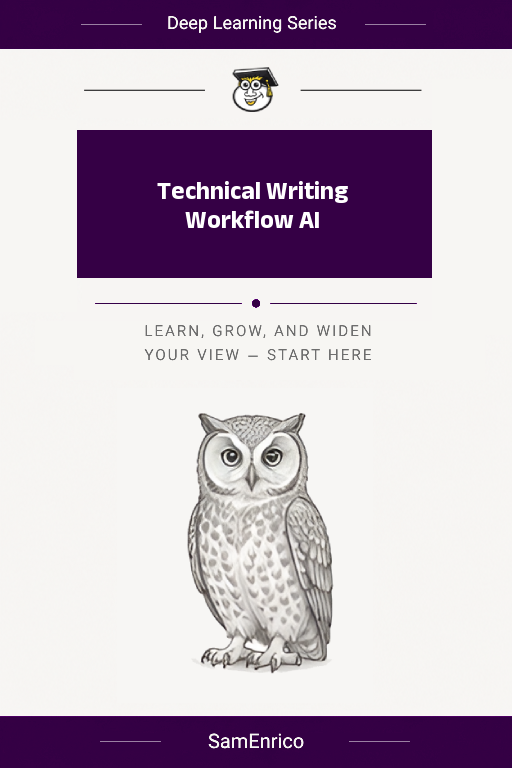
Non-FictionAI OperatorWorkflow
Technical Writing Workflow AI eBook
Build end-to-end AI-assisted workflows for technic
Build end-to-end AI-assisted workflows for technical writing from research to publication.
Formats
Free sample
Chapter 1: The Compiler Mindset--–- Sarah had just spent eighteen hours manually verifying a 200-page API migration guide. Three different engineers had given her three conflicting sets of instructions. The product launched anyway. Users complained for six months. When she finally discovered the contradiction—a single changed endpoint buried on page 147—she wanted to throw her laptop into the Pacific Ocean.
That was 2023. She swore she would never do that again.She didn't. By 2025, Sarah had become the first Content Engineer at her company. She didn't write more documentation; she wrote less. But every piece she published was accurate, consistent, and arrived the same day the code shipped.
Her secret wasn't a magical AI tool. It was a mindset shift so fundamental that once you adopt it, you will never look at technical writing the same way again.This is the Compiler Mindset.The Great Misunderstanding For decades, technical writing has been taught as a craft of prose. You learn about active voice, numbered lists, consistent terminology, and the gentle art of guiding a confused user from error to resolution. These are valuable skills. But they treat documentation as a literary artifact—something to be read and appreciated for its clarity.AI changes this equation completely.
When you can generate grammatically perfect paragraphs in seconds, the bottleneck is no longer the act of writing. The bottleneck is verification. Did the AI invent that command-line flag? Does that procedure actually work with the latest software version? Is the diagram consistent with the text on page 42?Most technical writers approach AI as a faster keyboard.
They ask Chat GPT to "write a procedure for installing the database" and then copy-paste the result into their CMS. This is like giving a calculator to someone who doesn't understand multiplication—faster errors, not faster solutions.The Compiler Mindset flips this on its head.What the Compiler Mindset Actually Means In software engineering, a compiler takes human-readable source code and transforms it into machine-executable instructions. If your code has a syntax error, the compiler refuses to run. If you reference a variable that doesn't exist, the compiler throws an error. If your logic contradicts itself—declaring a constant as both true and false—the compiler catches it immediately.Technical writing has no compiler.
Our "code" (prose) can be internally contradictory, factually wrong, or completely untestable, and it will still "compile" to a PDF or a help center page. The reader discovers the error. The reader suffers.The Compiler Mindset means treating AI as your compiler. You design a workflow where AI cannot proceed unless certain conditions are met. You structure your prompts so that the AI must verify claims against source material.
You build automated checks that flag contradictions across a thousand-page documentation set before a human ever sees them.This is not about trusting AI less. It is about engineering a system where trust is earned through verification.The Three-Phase Architecture (Plan → Execute → Verify)Every successful AI-assisted documentation workflow follows the same abstract pattern. I call this the Plan-Execute-Verify architecture, and it will appear in every chapter of this book.Phase 1: Plan Before any words are written, you use AI to digest source material, identify gaps, and create a structured outline. The AI acts as a research assistant—not an oracle. It tells you what it thinks it knows, but more importantly, it tells you what it doesn't know.In this phase, you are the architect.
The AI is your surveyor.Phase 2: Execute With a verified plan in hand, you generate content. This might be first drafts, code-close documentation, or visual diagrams. The AI writes quickly and at scale. But crucially, it writes within constraints that you have already defined—style guides, terminology boundaries, and structural templates.In this phase, the AI is the laborer. You are the foreman.Phase 3: Verify This is the most important phase, and the one most writers skip.
You run the generated content through a series of automated and human checks. Does it match the source material? Is it internally consistent? Does it follow the style guide? Does the code actually run?Only after passing verification does content move to publication.
In this phase, you are the compiler. The AI is the code being compiled.Here is the critical insight that separates amateurs from professionals: Verification is not a single step at the end. It is a continuous loop that runs throughout the entire process. You verify the plan before executing. You verify intermediate drafts before proceeding.
You verify the final output before publishing.Case Study: How Slack Automated API Documentation Updates In early 2024, Slack's documentation team faced an impossible problem. Their API reference contained over 1,200 endpoints, and the engineering team was shipping changes every day. Human writers could not keep up. Documentation lagged by weeks. Developers complained.
Support tickets multiplied.Slack's solution was not to hire more writers. It was to build an AI-assisted workflow based on the Plan-Execute-Verify architecture.Phase 1 (Plan): Every night, a script pulled the latest Open API specification from Slack's codebase. An AI model (Claude, due to its large context window) ingested the spec and compared it to the previous day's version. The AI generated a structured report: endpoints that had changed, new parameters added, deprecated fields removed. This was the "plan" for the next day's documentation updates.Phase 2 (Execute): A second AI model took the change report and generated draft updates for each affected documentation page.
For new endpoints, it wrote complete reference pages including parameter descriptions, example requests, and response schemas. For changed endpoints, it produced redline diffs showing exactly what needed to be updated.Phase 3 (Verify): Before any draft was published, a verification pipeline ran three checks. First, a citation check confirmed that every parameter description could be traced back to the Open API spec. Second, a consistency check ensured that the same terminology was used across all updated pages. Third, a human reviewer spent 15 minutes spot-checking the AI's work—not reading everything, just verifying the verification.The result?
Documentation updates went from a two-week lag to same-day shipping. The human team spent less time writing and more time on the 30% that matters: edge cases, error messages, and the narrative glue that helps developers understand why an API works a certain way.Slack did not replace writers. They replaced drudgery.Case Study: AWS and AI-Assisted Migration Guides AWS faced a different problem. Their customers were migrating from legacy on-premises systems to the cloud, and every migration was unique. Writing a custom migration guide for each customer would take months.
But generic guides left customers confused and error-prone.AWS's solution used the same Plan-Execute-Verify architecture, but applied it to personalized content.Phase 1 (Plan): A customer filled out a questionnaire about their existing infrastructure: database type, server count, storage requirements, compliance needs. An AI model analyzed these answers and produced a migration "blueprint"—a structured list of tasks, dependencies, and risk areas.Phase 2 (Execute): A second AI model took the blueprint and generated a draft migration guide by assembling pre-written modules from a content library. The AI didn't write from scratch; it selected and customized existing content based on the customer's specific answers.Phase 3 (Verify): The draft guide was run through an automated checker that validated…
This is the end of the free sample. Get the eBook to keep going. Buy now
About this book
Details
- Author
- Heckman Karissa
- Publisher
- SamEnrico
- Language
- English
- Genre
- Non-Fiction, AI Operator, Workflow
- Released
- 2026-05-29
- Pages (approx.)
- 148
- Available as
- eBook, Audiobook

Read better in the ZLOADR app
Your eBooks on your phone or tablet. Sign in with your SamEnrico account and start reading.
More by Heckman Karissa
 Loving Kindness for BreakupsHeckman Karissa$11.99
 High Net Worth Wellness HabitsHeckman Karissa$11.99
 Overcoming Self Doubt in Creative FieldsHeckman Karissa$11.99
 Cameroon Union des PopulationsHeckman Karissa$11.99
 The Equifax Breach ExposedHeckman Karissa$11.99
 The Symphony of the Stars: How Apollo 8’s Christmas Broadcast United the WorldHeckman Karissa$11.99
 Procter Gamble GuideHeckman Karissa$12.99
 Understanding Moore–Smith–weaver SyndromeHeckman Karissa$17.99
 How to Become a Cloth-printing InspectorHeckman Karissa$11.99
 HR RecruiterHeckman Karissa$11.99
You may also like
 Hong Kong Handover 1997Dunn Johnnie$11.99
 Zumba For Postnatal Recovery CourseNeal Christian$11.99
 Zumba for BeginnersLadner Nikia$11.99
 YouTube Comment Mining GuideHumes Pandora$12.99
 Worry Box MeditationCarlin Rudy$11.99
 Workplace Stress MeditationNguyen Lynn$11.99
 Workplace Stress and Sleep RepairHawley Ivory$11.99
 Workplace Perfectionism CureDelaney Jeffry$11.99
 Workplace Injustice Anger GuideWallen Isabelle$11.99
 Work Addiction and Burnout LinkGreenwood Ester$11.99
 Women in Yoga and WellnessBeattie Galina$11.99
 Women in Stand Up ComedyChun Evangeline$11.99