
Non-FictionSelf-HelpTeams Skills
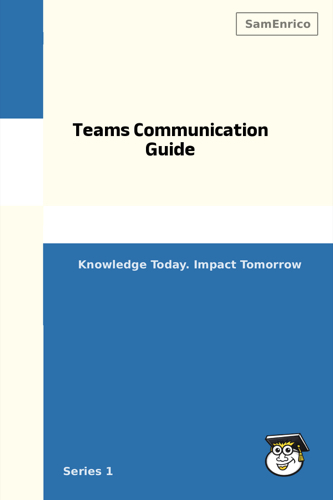
Teams Communication Guide eBook
Navigate Microsoft Teams effectively for remote co
Navigate Microsoft Teams effectively for remote collaboration using this handbook.
Formats
Free sample
Chapter 1: The Notification Cadaver--The average knowledge worker now checks Microsoft Teams every six minutes. That is not a productivity metric. That is a diagnostic criterion for addiction.Before we go any further, I want you to do something uncomfortable. Open your Teams activity feed right now. Look at the last seven days.
Count how many notifications you received. Not just @mentions—every ping, every banner, every email-forwarded-to-chat, every @channel broadcast, every reaction to a message you sent three days ago. Write that number down.Now multiply it by twenty-three.That is how many minutes of deep focus you lost this week. Twenty-three minutes is the average time cognitive neuroscientists have found it takes to return to a state of deep concentration after a single interruption. Not to recover your full cognitive capacity—just to get back to where you were before the ping.
And you were interrupted hundreds of times.Welcome to the "Always On" trap. You are not the problem. Your willpower is not the problem. The default configuration of Microsoft Teams—and every other collaboration tool built on the same reactive, synchronous, urgency-faking architecture—is the problem.This chapter will not ask you to meditate more or try harder. It will show you exactly how Teams was designed to keep you reactive, why that design is quietly destroying your ability to do knowledge work, and—most importantly—how to reconfigure both the software and your team's norms to escape the trap.
By the end, you will have a personal "interruption autopsy" and the first concrete tools to reclaim your attention. Let us begin with the corpse of your last productive day.The Twenty-Three Minute Graveyard In 2014, researchers at the University of California, Irvine, conducted a landmark study that should have ended the era of constant digital interruption. They followed knowledge workers in their natural environment—not a lab—and tracked every time someone switched tasks. The finding was devastating: after any interruption, it took an average of twenty-three minutes and fifteen seconds to return to the original task with the same level of focus.Let me translate that into human terms. You are writing a proposal.
A Teams chat appears: "Quick question?" You answer. That exchange takes forty-five seconds. You then spend the next twenty-two and a half minutes trying to remember where you were in the proposal, what your argument was, what data you had pulled, and what sentence you were about to write. By the time you regain flow, you have lost nearly half an hour. And that was one interruption.Now multiply that by the average number of Teams notifications per day.
In a 2024 study by the productivity analytics firm Rescue Time, the average Microsoft Teams user received 147 notifications daily across chat, channels, meetings, and activity feed alerts. If every one of those cost twenty-three minutes of recovery—which they do not, because some are batched and some you ignore—you would need fifty-six hours just to recover from interruptions each day. The math is absurd because the premise is absurd. But the underlying truth is not: we have normalized a level of interruption that would have been considered workplace sabotage a generation ago.The most insidious part is that most of these interruptions are not urgent. In fact, when researchers at MIT's Sloan School analyzed 1.2 million Teams messages across fifty companies, they found that only 7 percent required a response within one hour.
Ninety-three percent of what pings you could wait four hours or more. But the software does not know that. It treats every message—whether it is "The server is on fire" or "Nice job on that report"—exactly the same: a red badge, a banner, a vibration, a cognitive hijack.This is not a bug. It is a business model. Microsoft, like every other collaboration software company, makes money when you use their product more, not when you work better.
The default settings—notifications on for everything, @channel available to anyone, chat alerts popping over your work, activity feed showing every reaction—are designed to keep you inside the app. They are designed to manufacture urgency. And they are designed to make you feel guilty for not responding instantly. Your exhaustion is not a personal failing. It is a design feature of the Reactivity Machine.The Async-First Declaration There is an alternative.
It is called async-first communication, and it is the single most important shift you can make to survive the Teams apocalypse.Async-first means treating the vast majority of workplace communication like email used to work before smartphones: deliberate, batched, thoughtful, and respectful of the recipient's attention. You write a message. You do not expect an immediate reply. The recipient reads it when they finish their current block of deep work. The default is delay, not speed.
The assumption is that the other person is busy, not that they are waiting for you.This is not Luddism. This is not "turn off all notifications and hide in a cave." Async-first acknowledges that some communication truly is urgent—the server is on fire, the client is on the line, the regulatory filing is due in an hour. For those situations, we have synchronous tools: voice calls, video calls, and the dreaded "IM me ASAP." But those situations represent, in most knowledge work environments, somewhere between 5 and 15 percent of all communication. The other 85 to 95 percent can and should be async.Here is the async-first manifesto, which you should print and tape to your monitor:Most messages do not need an answer within an hour. They need an answer within a day.If you would not interrupt a colleague at their desk to say it, do not send a chat ping.The sender is responsible for urgency, not the receiver.
If you need an answer now, say so clearly—and expect to be told "no" unless it is a true emergency.Deep work blocks are sacred. No notifications during focus time. Period.Your availability is not your obligation. Your output is.This manifesto directly contradicts everything the Reactivity Machine teaches you. The Reactivity Machine says: green dot means available.
The async-first philosophy says: green dot means I am signed in, not that I am at your service. The Reactivity Machine says: reply within minutes or seem rude. The async-first philosophy says: reply within four hours for non-urgent messages, and communicate your expected response times clearly in your Team Communications Charter (which we will draft in Chapter 2).The transition from reactive to async-first is not easy. It requires retraining your own dopamine response to notifications. It requires convincing your team that you are not ignoring them.
It requires a written agreement, which we will build together in the next chapter. But it is the only path out of the twenty-three-minute graveyard.The Interruption Autopsy Before you can fix your relationship with Teams, you need to know how broken it is. This is the Interruption Autopsy—a personal audit that will take you about twenty minutes and will horrify you in the most productive way possible.Step One: Track Your Pings For two consecutive workdays, keep a log. Every time Teams interrupts you—a chat message, a channel post, an @mention, a meeting reminder, a reaction, a call—write down the…
This is the end of the free sample. Get the eBook to keep going. Buy now
About this book
Details
- Author
- Ricker Helaine
- Publisher
- SamEnrico
- Language
- English
- Genre
- Non-Fiction, Self-Help, Teams Skills
- Released
- 2026-06-06
- Pages (approx.)
- 143
- Available as
- eBook, Audiobook

Read better in the ZLOADR app
Your eBooks on your phone or tablet. Sign in with your SamEnrico account and start reading.
More by Ricker Helaine
 The Liking Persuasion TechniqueRicker Helaine$11.99
 Self Hypnosis for Psoriatic ArthritisRicker Helaine$11.99
 Body Scan for PTSD HyperarousalRicker Helaine$11.99
 Professional Confidence PrimerRicker Helaine$11.99
 Tony Award SpeechesRicker Helaine$11.99
 Prostate Cancer Risk FactorsRicker Helaine$11.99
 Building Creative HabitsRicker Helaine$11.99
 The Snowtown Murders: Australia's Darkest Trial of the CenturyRicker Helaine$11.99
 The Prague Embassy Siege: The Spy Who Stole the Cold WarRicker Helaine$11.99
 How to Produce Ostomy SuppliesRicker Helaine$11.99
 A Collector's Handbook to the Studebaker President (1938-39)Ricker Helaine$11.99
 How to Produce CollectiblesRicker Helaine$11.99
You may also like
 Hong Kong Handover 1997Dunn Johnnie$11.99
 Zumba For Postnatal Recovery CourseNeal Christian$11.99
 Zumba for BeginnersLadner Nikia$11.99
 YouTube Comment Mining GuideHumes Pandora$12.99
 Worry Box MeditationCarlin Rudy$11.99
 Workplace Stress MeditationNguyen Lynn$11.99
 Workplace Stress and Sleep RepairHawley Ivory$11.99
 Workplace Perfectionism CureDelaney Jeffry$11.99
 Workplace Injustice Anger GuideWallen Isabelle$11.99
 Work Addiction and Burnout LinkGreenwood Ester$11.99
 Women in Yoga and WellnessBeattie Galina$11.99
 Women in Stand Up ComedyChun Evangeline$11.99