
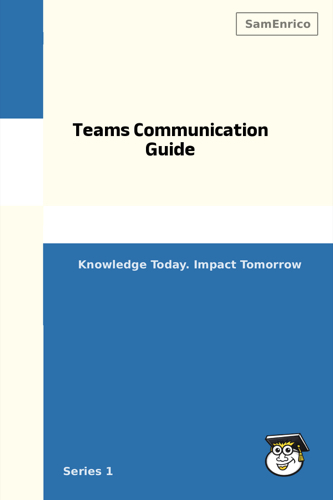
Teams Communication Guide
Navigate Microsoft Teams effectively for remote co
Navigate Microsoft Teams effectively for remote collaboration using this handbook.
Formats
About this book
Free sample
Chapter 1: The Notification Cadaver--The average knowledge worker now checks Microsoft Teams every six minutes. That is not a productivity metric. That is a diagnostic criterion for addiction.Before we go any further, I want you to do something uncomfortable. Open your Teams activity feed right now. Look at the last seven days.
Count how many notifications you received. Not just @mentions—every ping, every banner, every email-forwarded-to-chat, every @channel broadcast, every reaction to a message you sent three days ago. Write that number down.Now multiply it by twenty-three.That is how many minutes of deep focus you lost this week. Twenty-three minutes is the average time cognitive neuroscientists have found it takes to return to a state of deep concentration after a single interruption. Not to recover your full cognitive capacity—just to get back to where you were before the ping.
And you were interrupted hundreds of times.Welcome to the "Always On" trap. You are not the problem. Your willpower is not the problem. The default configuration of Microsoft Teams—and every other collaboration tool built on the same reactive, synchronous, urgency-faking architecture—is the problem.This chapter will not ask you to meditate more or try harder. It will show you exactly how Teams was designed to keep you reactive, why that design is quietly destroying your ability to do knowledge work, and—most importantly—how to reconfigure both the software and your team's norms to escape the trap.
By the end, you will have a personal "interruption autopsy" and the first concrete tools to reclaim your attention. Let us begin with the corpse of your last productive day.The Twenty-Three Minute Graveyard In 2014, researchers at the University of California, Irvine, conducted a landmark study that should have ended the era of constant digital interruption. They followed knowledge workers in their natural environment—not a lab—and tracked every time someone switched tasks. The finding was devastating: after any interruption, it took an average of twenty-three minutes and fifteen seconds to return to the original task with the same level of focus.Let me translate that into human terms.…
This is the end of the free sample. Get the eBook to keep going. Buy now
Contents
- Chapter 1
- Chapter 2
- Chapter 3
- Chapter 4
- Chapter 5
- Chapter 6
- Chapter 7
- Chapter 8
- Chapter 9
- Chapter 10
- Chapter 11
- Chapter 12
Details
- Author
- Ricker Helaine
- Publisher
- SamEnrico
- Language
- English
- Genre
- Non-Fiction, Self-Help, Teams Skills
- Released
- 2026-06-06
- Pages (approx.)
- 143
- Available as
- eBook, Audiobook

Read better in the ZLOADR app
Your eBooks on your phone or tablet. Sign in with your SamEnrico account and start reading.
More by Ricker Helaine
 The Liking Persuasion TechniqueRicker Helaine$11.99
 Self Hypnosis for Psoriatic ArthritisRicker Helaine$11.99
 Body Scan for PTSD HyperarousalRicker Helaine$11.99
 Professional Confidence PrimerRicker Helaine$11.99
 Tony Award SpeechesRicker Helaine$11.99
 Prostate Cancer Risk FactorsRicker Helaine$11.99
 Building Creative HabitsRicker Helaine$11.99
 The Snowtown Murders: Australia's Darkest Trial of the CenturyRicker Helaine$11.99
 The Prague Embassy Siege: The Spy Who Stole the Cold WarRicker Helaine$11.99
 How to Produce Ostomy SuppliesRicker Helaine$11.99
 A Collector's Handbook to the Studebaker President (1938-39)Ricker Helaine$11.99
 How to Produce CollectiblesRicker Helaine$11.99