
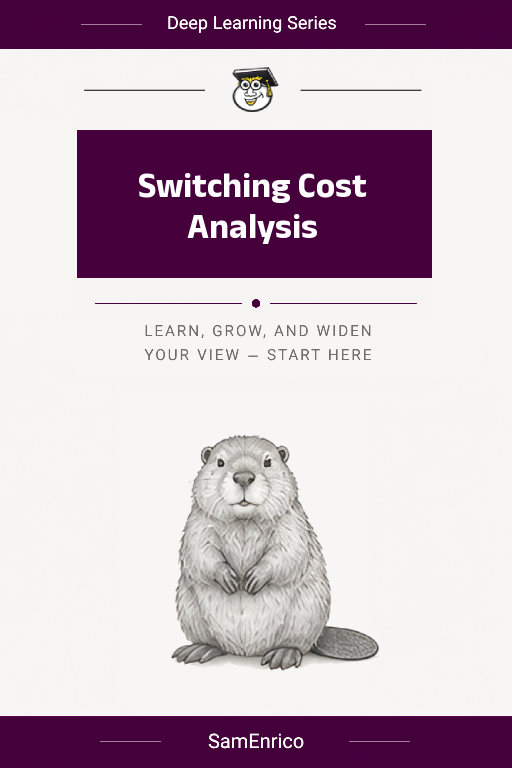
Switching Cost Analysis Audiobook
Identify customer switching costs to build moats a
Identify customer switching costs to build moats and reduce churn on a single strategic page.
Formats
Free sample
Chapter 1: The Taxonomy of Pain--–- Every morning, Sarah, a veteran CFO at a mid-sized logistics company, opens three different software dashboards before she can see her company’s real-time cash position. One dashboard is from her ERP system, implemented a decade ago at a cost of nearly two million dollars. The second is from her bank’s commercial portal, a clunky interface that crashes every Tuesday without fail. The third is a custom-built spreadsheet maintained by an analyst who has threatened to retire three times in the past year. Sarah hates every single one of these systems.
She has told her CEO, her board, and even the vendor account managers directly: “Your software is slow, your support is worse, and I would fire you all tomorrow if I could.”And yet, tomorrow comes, and Sarah does not switch. She does not even start a formal vendor review process.Why?If you ask Sarah, she will give you a list that sounds like complaints: “We’d lose all our historical forecasting models.” “The bank’s API is embedded in our treasury workflow.” “My team would need weeks of retraining.” “We’d have to renegotiate our line of credit.” “I don’t have the headcount to manage a migration.” What Sarah is describing, without using the academic term, is a thicket of switching costs. She is not staying because she loves her vendors. She is staying because leaving would trigger a cascade of pain—financial, procedural, and relational—that she cannot justify to her board, her team, or even to herself.This chapter introduces the foundational framework of the entire book: the three distinct categories of switching costs that keep customers locked in, often against their rational self-interest. You will learn to distinguish between Financial costs (hard dollars lost), Procedural costs (hassle and friction), and Relational costs (emotional and psychological).
You will understand which category is the most durable, which is the most fragile, and how successful companies like Salesforce layer multiple categories to build moats that competitors cannot cross. By the end of this chapter, you will never again look at a customer who “should have left” and wonder why they stayed.The Three Pillars of Customer Pain Switching costs are not a single, monolithic force. They are a portfolio of frictions, each with different characteristics, different durations, and different strategic implications. Think of them as three distinct types of handcuffs…
This is the end of the free sample. Get the Audiobook to keep going. Buy now
About this book
Details
- Author
- Vanover Enoch
- Publisher
- SamEnrico
- Language
- English
- Genre
- Non-Fiction, Business Brief, Customer Economics
- Released
- 2026-06-01
- Pages (approx.)
- 154
- Available as
- eBook, Audiobook

Listen in the VoxFlicks app
Audiobooks and audio dramas wherever you go. Sign in with your SamEnrico account and press play.
More by Vanover Enoch
 Treehouse Rest GuideVanover Enoch$11.99
 The Academic Deep WorkVanover Enoch$11.99
 Affirmations for Financial AbundanceVanover Enoch$11.99
 Flow in Public SpeakingVanover Enoch$11.99
 Alpine Lake ReflectionVanover Enoch$11.99
 Chronic Stress Cortisol GuideVanover Enoch$11.99
 Remote Executive CommunicationVanover Enoch$11.99
 MMA Fighter's HypnosisVanover Enoch$11.99
 The Neon Oracle of ShanghaiVanover Enoch$11.99
 Shadows of the Immortal: The Lost Tomb of Darius the GreatVanover Enoch$11.99
 Walruses: Tusked PinnipedVanover Enoch$11.99
 How to Produce Diaper Rash TreatmentsVanover Enoch$11.99