
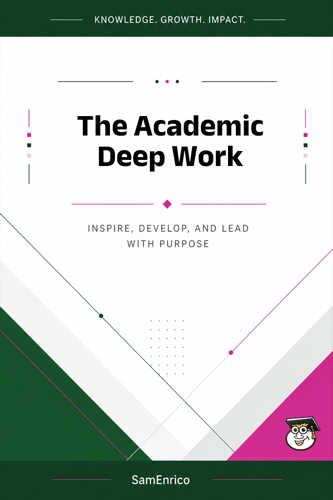
The Academic Deep Work
Conduct research and write papers without distract
Conduct research and write papers without distraction.
Formats
About this book
Free sample
Chapter 1: The Distraction Epidemic--If you are reading this book, you have likely experienced the following scene more times than you care to admit. You sit down at your desk, coffee in hand, with a clear intention: write the introduction, analyze the data, or finally finish that literature review. You open your laptop. You stare at the blinking cursor. And then, without conscious decision, your fingers carry you elsewhere.
You check email. Then the news. Then Twitter. Then email again. You remember a citation you need to find, so you open a browser tab, but somehow you are now reading about a celebrity breakup.
Forty-five minutes later, you close the laptop, feeling a familiar cocktail of guilt, exhaustion, and self-loathing. You tell yourself that tomorrow will be different. Tomorrow, you will focus.Tomorrow comes. The same thing happens.This pattern is not a personal failing. It is not a weakness of character or a sign that you lack the discipline for academic life.
It is, rather, a predictable response to an environment that has become systematically hostile to deep thinking. Over the past two decades, the academic workplace has been transformed by forces that few scholars fully understand and even fewer know how to resist. The rise of constant connectivity, the normalization of email as a primary work tool, the pressure to be responsive at all hours, the fragmentation of the workday into ever-smaller chunks – these are not incidental features of modern academic life. They are the very mechanisms that prevent you from doing your best work.The Quiet Catastrophe of Distracted Scholarship Let us begin with a simple question that most academics never stop to ask: what is the actual cognitive cost of distraction? Not the vague sense of inefficiency, but the measurable, replicable, documented cost of switching your attention away from a difficult intellectual task.The answer comes from research conducted by Sophie Leroy, an organizational psychologist who studied what happens when people switch between tasks.
Leroy coined the term attention residue to describe a phenomenon that every academic knows but few have named. When you are working on…
This is the end of the free sample. Get the eBook to keep going. Buy now
Contents
- Chapter 1
- Chapter 2
- Chapter 3
- Chapter 4
- Chapter 5
- Chapter 6
- Chapter 7
- Chapter 8
- Chapter 9
- Chapter 10
- Chapter 11
- Chapter 12
Details
- Author
- Vanover Enoch
- Publisher
- SamEnrico
- Language
- English
- Genre
- Non-Fiction, Business Brief, Academic
- Released
- 2026-06-09
- Pages (approx.)
- 144
- Available as
- eBook, Audiobook

Read better in the ZLOADR app
Your eBooks on your phone or tablet. Sign in with your SamEnrico account and start reading.
More by Vanover Enoch
 Treehouse Rest GuideVanover Enoch$11.99
 Affirmations for Financial AbundanceVanover Enoch$11.99
 Flow in Public SpeakingVanover Enoch$11.99
 Alpine Lake ReflectionVanover Enoch$11.99
 Chronic Stress Cortisol GuideVanover Enoch$11.99
 Remote Executive CommunicationVanover Enoch$11.99
 MMA Fighter's HypnosisVanover Enoch$11.99
 The Neon Oracle of ShanghaiVanover Enoch$11.99
 Shadows of the Immortal: The Lost Tomb of Darius the GreatVanover Enoch$11.99
 Walruses: Tusked PinnipedVanover Enoch$11.99
 How to Produce Diaper Rash TreatmentsVanover Enoch$11.99
 Switching Cost AnalysisVanover Enoch$12.99