
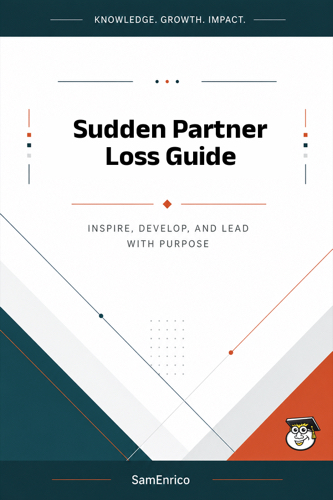
Non-FictionSelf-HelpSudden Death
Sudden Partner Loss Guide eBook
Cope with unexpected death from accident, heart at
by Ebert Emery
Cope with unexpected death from accident, heart attack, or violence.
Formats
Free sample
Chapter 1: The Phone Call...--The phone rings at 2:14 PM on a Tuesday. You recognize the number but cannot place it. The voice on the other end asks if you are sitting down. You lie and say yes. You are not sitting down.
You are standing in your kitchen, barefoot on the cold tile, holding a spatula, halfway through making a grilled cheese sandwich that you will never finish. The voice says there has been an accident. Or a heart attack. Or a shooting. The words tumble out in a specific order designed by hospital administrators and police departments to deliver maximum information with minimum liability.
Your partner has been taken to the hospital. You need to come now. Please come now.You hang up. The spatula is still in your hand. The grilled cheese is burning.
You will not remember any of this later. You will not remember the drive to the hospital, or the red light you ran, or the way the parking garage smelled like stale coffee and exhaust. You will remember only fragments: the automatic doors that opened too slowly, the fluorescent lights that buzzed, the face of the doctor who met you in the hallway, and then the words. The words that split your life into before and after. The words that made you a widow or a widower in a single sentence.This chapter is for the person standing in that hallway.
For the person who just heard those words. For the person who is reading this in the middle of the night, unable to sleep, because the silence in the bedroom is a sound you can feel in your teeth. This chapter is for the first seventy-two hours. Nothing more. Nothing less.The First Thing You Need to Know You are not going crazy.
I need to say that first, before anything else, because the feeling of craziness is going to be overwhelming. You are going to feel like you have stepped into a dream. The world will look wrong. Colors will seem too bright or too dull. Time will stretch and compress.
You will forget what you were saying in the middle of a sentence. You will walk into a room and have no idea why. You will reach for your phone to text your partner and then remember. You will remember over and over again, each time a fresh wound.This is not madness. This is neurology.
When the human brain receives news of a sudden, unexpected death, it does not process that information like other information. It processes it like a physical threat. The amygdala, that small almond-shaped cluster deep in your temporal lobe, hijacks the entire system. It pumps cortisol and adrenaline into your bloodstream. It shuts down the prefrontal cortex, the part of your brain responsible for rational thought, planning, and impulse control.
It redirects blood flow away from your frontal lobes and toward your brainstem, the most primitive part of your nervous system.You are not losing your mind. Your mind has been temporarily taken offline by a survival mechanism that evolved millions of years ago to help you run from predators. The problem is that there is no predator. There is no running. There is only the knowledge, and your brain does not know what to do with it.So it keeps you in a state of high alert.
Your heart races. Your palms sweat. You feel like you cannot breathe. You may shake uncontrollably, even in a warm room. You may vomit.
You may feel like you are watching yourself from outside your body. This is called dissociation, and it is a protective mechanism. Your brain is distancing you from the full impact of the loss because the full impact would be too much to bear all at once.You are not crazy. You are having a normal response to an abnormal event. Repeat that to yourself as many times as you need to.
Write it on your hand if you have to. You are not crazy. You are not crazy. You are not crazy.The Three Things You Must Do In the first seventy-two hours, you have exactly three jobs. Everything else is optional.
Everything else can wait. Everything else can be done by someone else or not done at all. Your only task is to keep your body alive and to protect what little cognitive capacity you have left.Job One: Hydrate Your body is in a state of profound physiological stress. Your heart rate is elevated. Your blood pressure is unstable.
Your cortisol levels are through the roof. In this state, dehydration is not just uncomfortable. It is dangerous. Dehydration will amplify every difficult symptom you are experiencing: confusion, dizziness, nausea, the feeling that you might faint.You need to drink water. Not coffee, which will spike your anxiety.
Not alcohol, which will depress your nervous system and interfere with sleep. Not soda, which will give you a sugar crash. Water. If you cannot tolerate plain water, try electrolyte drinks, coconut water, or watered-down juice.Here is the rule: one small sip every fifteen minutes. Set a timer.
Ask someone to hand you a cup every quarter hour. Do not try to remember. You will not remember. Your memory is not working right now. If you cannot keep water down, if you vomit more than twice in twenty-four hours, or if you go more than twelve hours without urinating, go to an emergency room.
Dehydration after traumatic loss is treatable, but only if you get help.Job Two: Eat Simple Carbohydrates You are not going to feel hungry. The gut-brain axis, the communication system between your digestive tract and your nervous system, shuts down after trauma. Food will seem abstract. The idea of chewing and swallowing may feel disgusting or impossible. You do not need to eat a full meal.
You do not need to cook. You need simple carbohydrates: crackers, bread, rice, bananas, applesauce, plain toast. These foods break down quickly into glucose, which your brain desperately needs.Do not worry about nutrition. Do not worry about calories. Do not worry about eating like an adult.
If all you can eat is four saltines a day, eat four saltines. If you need someone to put the cracker directly into your hand and tell you to chew, ask them to do that. Do not eat dairy or heavy fats in the first forty-eight hours. Your slowed digestive system will not handle them well.Job Three: Appoint a Single Point Person You cannot make phone calls. You cannot answer questions.
You cannot coordinate travel for relatives or order food or call the funeral home. These tasks require working memory and emotional regulation. You have neither right now. That is not a character flaw. That is neurology.Choose one person to be your communications director.
This person should be someone who is not in active shock themselves, who is organized, who is not afraid to tell other people no. This person will make the calls, field the questions, run interference. Your only job is to point at that person when someone asks you something you cannot answer.If you do not have such a person in…
This is the end of the free sample. Get the eBook to keep going. Buy now
About this book
Details
- Author
- Ebert Emery
- Publisher
- SamEnrico
- Language
- English
- Genre
- Non-Fiction, Self-Help, Sudden Death
- Released
- 2026-06-09
- Pages (approx.)
- 126
- Available as
- eBook, Audiobook

Read better in the ZLOADR app
Your eBooks on your phone or tablet. Sign in with your SamEnrico account and start reading.
More by Ebert Emery
 The Scarcity ToolkitEbert Emery$11.99
 Worry Stone PracticeEbert Emery$11.99
 GRE Issue Essay PromptsEbert Emery$11.99
 The Sleep Talking Memory ClueEbert Emery$11.99
 The Forgotten Storm: The Battle of the Coral Sea's Naval RevolutionEbert Emery$11.99
 How to Start a Check Trader Business (Beginners Guide)Ebert Emery$11.99
 Associate R&D ScientistEbert Emery$11.99
 Understanding Pityriasis Lichenoides Et Varioliformis AcutaEbert Emery$17.99
 Medtech Acquisition TargetsEbert Emery$12.99
 QuickBooks Mobile App GuideEbert Emery$12.99
You may also like
 Hong Kong Handover 1997Dunn Johnnie$11.99
 Zumba For Postnatal Recovery CourseNeal Christian$11.99
 Zumba for BeginnersLadner Nikia$11.99
 YouTube Comment Mining GuideHumes Pandora$12.99
 Worry Box MeditationCarlin Rudy$11.99
 Workplace Stress MeditationNguyen Lynn$11.99
 Workplace Stress and Sleep RepairHawley Ivory$11.99
 Workplace Perfectionism CureDelaney Jeffry$11.99
 Workplace Injustice Anger GuideWallen Isabelle$11.99
 Work Addiction and Burnout LinkGreenwood Ester$11.99
 Women in Yoga and WellnessBeattie Galina$11.99
 Women in Stand Up ComedyChun Evangeline$11.99