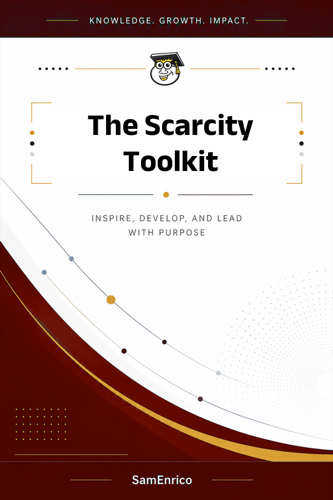
The Scarcity Toolkit
Practical tools and templates for generating ideas
by Ebert Emery
Practical tools and templates for generating ideas under constraints.
Formats
About this book
Free sample
Chapter 1: The Abundance Trap...--–- In 1975, a team of engineers at Eastman Kodak did something remarkable. They invented the first digital camera. It was a clumsy thing—eight pounds, black and white, with a resolution of 0.01 megapixels—but it worked. When Steven Sasson, the lead engineer, showed his invention to Kodak's executives, they asked him a single question: "When will this be ready for the market?"Sasson said five to seven years.The executives looked at each other. They looked at the bulky prototype.
They looked at their own thriving film business, which was printing money like a counterfeiting operation. Kodak controlled 90% of the film market. They had more patents than any company in their sector. They had a research budget that rivaled small countries. They had time, talent, money, and a brand that was synonymous with capturing memories.And they had one more thing: the abundance trap.The digital camera sat on a shelf for twenty years.
Not because Kodak couldn't develop it. Not because they lacked the resources. But because they had so much of everything that they couldn't see what was right in front of them. By the time Kodak realized that digital was the future, it was 2005. The company filed for bankruptcy in 2012.
The digital camera they invented? It killed them.This is not a story about technology. It is a story about the most dangerous myth in business and creativity: the belief that more resources lead to better results.The Great Lie of More We have been trained from childhood to believe that scarcity is a problem to be solved and abundance is a goal to be achieved. Want to write a better book? Give yourself more time.
Want to build a better product? Hire more engineers. Want to solve a difficult problem? Get more budget, more data, more meetings, more feedback, more iterations.This sounds so obvious that we never question it.But here is the truth that Kodak learned too late: having unlimited resources does not lead to better ideas. It leads to waste, endless revision, feature creep, analysis paralysis, and solutions that are…
This is the end of the free sample. Get the eBook to keep going. Buy now
Contents
- Chapter 1
- Chapter 2
- Chapter 3
- Chapter 4
- Chapter 5
- Chapter 6
- Chapter 7
- Chapter 8
- Chapter 9
- Chapter 10
- Chapter 11
- Chapter 12
Details
- Author
- Ebert Emery
- Publisher
- SamEnrico
- Language
- English
- Genre
- Non-Fiction, Self-Help, Toolkit
- Released
- 2026-06-08
- Pages (approx.)
- 135
- Available as
- eBook, Audiobook

Read better in the ZLOADR app
Your eBooks on your phone or tablet. Sign in with your SamEnrico account and start reading.
More by Ebert Emery
 Sudden Partner Loss GuideEbert Emery$11.99
 Worry Stone PracticeEbert Emery$11.99
 GRE Issue Essay PromptsEbert Emery$11.99
 The Sleep Talking Memory ClueEbert Emery$11.99
 The Forgotten Storm: The Battle of the Coral Sea's Naval RevolutionEbert Emery$11.99
 How to Start a Check Trader Business (Beginners Guide)Ebert Emery$11.99
 Associate R&D ScientistEbert Emery$11.99
 Understanding Pityriasis Lichenoides Et Varioliformis AcutaEbert Emery$17.99
 Medtech Acquisition TargetsEbert Emery$12.99
 QuickBooks Mobile App GuideEbert Emery$12.99