
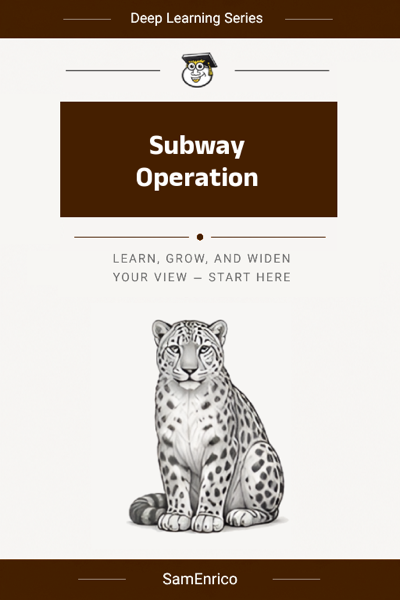
Subway Operation eBook
A Coursebook on Subway Operation
A Coursebook on Subway Operation
Formats
Free sample
Chapter 1: The Buried Century...---- At 8:47 on a Tuesday morning, 1,200 people trapped in a dark tunnel do not know that a decision made in 1863 is about to determine who breathes and who suffocates. The train has stopped between stations. The lights flicker. The public address system is dead. And somewhere in the darkness ahead, a wisp of smoke curls upward.
In thirty seconds, someone will pull the emergency handle. In ninety seconds, panic will begin. In six minutes, the tunnel will fill with something far more dangerous than fire. None of these passengers know that the solution to their predicament was written into the first subway law ever passed—a law that has not been meaningfully updated in 160 years. They are riding a machine whose oldest parts predate electricity, whose safety assumptions were made when horses ruled the streets, and whose fundamental operating logic has not changed since a Victorian engineer named John Fowler drew the first underground railway on a napkin.This is the hidden reality of every subway system on Earth.
The train you board each morning is not a modern marvel. It is a palimpsest—layer upon layer of engineering decisions, political compromises, and emergency patches, each one added on top of the last without ever removing what came before. The tunnel was dug in 1920. The signals were upgraded in 1985 but still speak to a computer from 2012. The train itself was built in 2018 but runs on track laid in 1955.
To understand how a subway operates, you must first understand that you are not riding a single machine. You are riding a century of accumulated history, and every piece of that history is still doing its job—or failing to.The First Breath Underground The story begins not with a train but with a problem. London, 1850. The city had become the largest metropolis in human history, and its streets were dying. Not metaphorically—literally.
Every day, 200,000 people crossed London Bridge alone. Horse-drawn omnibuses, cabs, and private carriages packed the roads so densely that the average speed across the city had fallen to six miles per hour, slower than a walking pace. The Thames was an open sewer. Cholera outbreaks killed thousands. And the solution proposed by the city's best minds was, by modern standards, insane: tear down entire neighborhoods to widen the streets.Into this chaos stepped Charles Pearson, a solicitor with a radical idea.
What if, instead of building more roads on the surface, London built railways underground? The idea was met with laughter, then horror. Tunnels collapsed. Steam engines could not run in enclosed spaces—the smoke would suffocate passengers. And even if it worked, no one would voluntarily descend into a dark, smoky hole beneath the earth.Pearson was undeterred.
He spent fourteen years lobbying Parliament, raising money, and fighting lawsuits. In 1854, he finally won approval for the Metropolitan Railway, a three-and-three-quarter-mile line from Paddington to Farringdon, built using a method called "cut-and-cover." Workers tore open the streets, dug a trench forty feet wide and thirty feet deep, bricked over the sides and roof, then repaved the surface. It was not tunneling so much as burying a railway. The disruption was immense—shopkeepers went bankrupt, residents fled the noise, and newspapers called it "the great bore." But on January 10, 1863, the Metropolitan Railway opened to the public, and 38,000 people rode it on the first day.They emerged from the stations covered in soot, eyes watering from sulfur, clothes smelling of coal smoke. And they loved it.
The trains ran every fifteen minutes. The fares were affordable. And for the first time in history, a commuter living in the suburbs could reach the city center in less than an hour. The Victorian novelist Charles Dickens rode the new line and called it "a glimpse of the infernal regions." But he rode it again the next week, and the week after that. The subway was born, and it was filthy, dangerous by modern standards, and absolutely essential to the functioning of the city.That first subway train was powered by steam.
The locomotives burned coke—a cleaner-burning form of coal—but "cleaner" was relative. The tunnels filled with smoke so thick that conductors wore wet handkerchiefs over their mouths. Ventilation shafts were cut every few hundred yards, but they only moved the problem to the surface, where clouds of black smoke poured onto city streets. In 1864, just one year after opening, a train crashed into the rear of another in the tunnel—the first subway collision. The inquiry determined that the driver could not see the signal through the smoke.Yet the line expanded.
By 1884, the Metropolitan had grown into a loop around central London. Other companies built competing lines, each with its own incompatible technology, its own station designs, its own signaling systems. The modern condition of fragmented, patchworked infrastructure was established within the first two decades.The Network Effect: How a Hole in the Ground Changes a City Here is something that every subway planner knows but almost no passenger considers: a new station does not just serve a neighborhood. It transforms it. And the transformation follows a predictable, mathematically describable pattern that has held true for 160 years across every continent.The mechanism is called the network effect, and it works like this.
Before a subway line is built, land values at any given location are determined by local factors: schools, crime rates, proximity to shops. After a station opens, every property within a 500-meter radius—the distance most people will comfortably walk—increases in value. The increase is not uniform. Properties directly above the station entrance see the highest jump, sometimes 200 to 300 percent. At 500 meters, the increase might be only 10 percent.
Somewhere in between, there is a line where the increase drops to zero, and beyond that, the station has no effect at all.This effect has been measured in London, where the Jubilee Line Extension of the 1990s added 40 billion pounds in land value. It has been measured in Hong Kong, where the Mass Transit Railway is one of the world's most profitable real estate developers. It has been measured in New York, where the first phase of the Second Avenue Subway added more than 5 billion dollars in property value before a single train ran.The network effect does not stop at land values. When a station opens, zoning laws change. Cities reclassify the surrounding area for higher-density development.
Parking requirements are waived. Tax incentives are offered. Within a decade, the empty lot next to the station becomes a twenty-story apartment building, and the single-family homes further out become duplexes, and the duplexes become six-unit walkups. This process is called transit-oriented development, and it is the single most powerful tool cities have for shaping their own growth.But the network effect has a dark side. Because property values rise so dramatically around stations, the people who lived there before the subway arrived are often priced out.
The same subway that connects a poor neighborhood to downtown jobs also makes that neighborhood attractive to wealthier residents. Rent increases. Property taxes rise. Longtime residents leave. By the time the line is fully operational, the neighborhood that justified its construction may no longer exist.
This is called transit-induced gentrification, and it is one of the most bitterly contested issues in urban planning.The data on…
This is the end of the free sample. Get the eBook to keep going. Buy now
About this book
Details
- Author
- Mattos Romelia
- Publisher
- SamEnrico
- Language
- English
- Genre
- Non-Fiction, Informative, Educational
- Released
- 2026-05-11
- Pages (approx.)
- 150
- Available as
- eBook, Audiobook

Read better in the ZLOADR app
Your eBooks on your phone or tablet. Sign in with your SamEnrico account and start reading.
More by Mattos Romelia
 Burnout In Helping Professions WorkbookMattos Romelia$11.99
 Toe and Foot Body Image GuideMattos Romelia$11.99
 Navigating Conflict With Your Boss GuideMattos Romelia$11.99
 Gerwig Indie Lady BirdMattos Romelia$11.99
 Autism Sleep Challenges GuideMattos Romelia$11.99
 The Coffeehouse Revolution: How Enlightenment Thinkers Built the Modern MindMattos Romelia$11.99
 How to Become a NematologistMattos Romelia$11.99
 Understanding Mental Retardation, X Linked, NonspecificMattos Romelia$17.99
 Global Minimum Tax GuideMattos Romelia$12.99
 Prototype Description via PromptingMattos Romelia$12.99