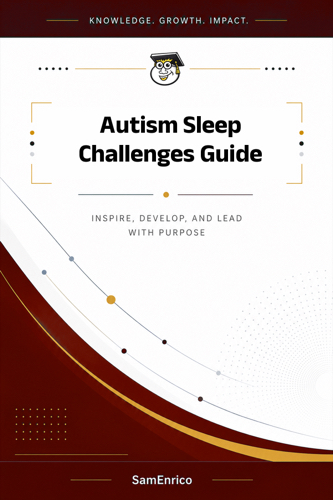
Autism Sleep Challenges Guide
Address sensory and routine based sleep issues in
Address sensory and routine based sleep issues in autistic children using this handbook.
Formats
About this book
Free sample
Chapter 1: The Midnight Gene--–- It is 10:47 PM. Your child is not asleep. They are not yawning, not rubbing their eyes, not slowing down. Instead, they are building an elaborate Lego tower, reciting dialogue from a movie they watched six months ago, or perhaps spinning in a circle with the focused intensity of a planet orbiting the sun. You have tried everything the parenting books recommend: the warm bath, the dimmed lights, the soft lullabies, the firm boundary.
Nothing works. And somewhere beneath your exhaustion, a quieter feeling takes root: Is this defiance? Is my child choosing to stay awake just to push my limits?If you have asked yourself that question—and most parents of autistic children have, usually sometime between the third and fourth hour of a bedtime battle—this chapter exists to give you an answer. It is not defiance. It is not stubbornness.
It is not poor parenting. It is biology. Specifically, it is a tiny but powerful genetic variation in something called the MTNR1A gene, and it may be the single most important piece of the puzzle you have been missing.This chapter dismantles the myth of willful bedtime resistance and replaces it with something far more useful: a clear, actionable understanding of how the autistic sleep-wake cycle actually works. You will learn why your child may be genuinely, physiologically awake at 10 PM while their neurotypical sibling is already dreaming. You will learn how to distinguish behavioral resistance (which responds to the routines in Chapters 7 through 9) from biological sleep-onset insomnia (which requires a completely different approach).
And you will be given a precise, cautious protocol for the most common intervention parents reach for: melatonin. By the end of this chapter, you will stop blaming yourself and start working with your child's neurology instead of against it.The 80 Percent Problem: Why This Isn't Your Fault Let us begin with a statistic that should be printed on every pediatrician's prescription pad: between 50 and 80 percent of autistic children experience significant sleep disturbances. Among neurotypical children, that number hovers below 25 percent. This is not a…
This is the end of the free sample. Get the eBook to keep going. Buy now
Contents
- Chapter 1
- Chapter 2
- Chapter 3
- Chapter 4
- Chapter 5
- Chapter 6
- Chapter 7
- Chapter 8
- Chapter 9
- Chapter 10
- Chapter 11
- Chapter 12
Details
- Author
- Mattos Romelia
- Publisher
- SamEnrico
- Language
- English
- Genre
- Non-Fiction, Health & Wellness, Autism
- Released
- 2026-06-06
- Pages (approx.)
- 147
- Available as
- eBook, Audiobook

Read better in the ZLOADR app
Your eBooks on your phone or tablet. Sign in with your SamEnrico account and start reading.
More by Mattos Romelia
 Burnout In Helping Professions WorkbookMattos Romelia$11.99
 Toe and Foot Body Image GuideMattos Romelia$11.99
 Navigating Conflict With Your Boss GuideMattos Romelia$11.99
 Gerwig Indie Lady BirdMattos Romelia$11.99
 The Coffeehouse Revolution: How Enlightenment Thinkers Built the Modern MindMattos Romelia$11.99
 How to Become a NematologistMattos Romelia$11.99
 Understanding Mental Retardation, X Linked, NonspecificMattos Romelia$17.99
 Global Minimum Tax GuideMattos Romelia$12.99
 Prototype Description via PromptingMattos Romelia$12.99
 Subway OperationMattos Romelia$11.99