
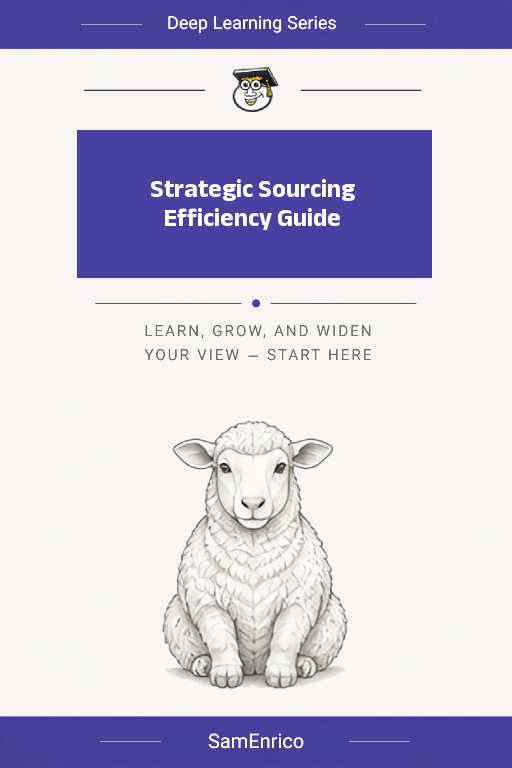
Non-FictionOperational Efficiency ManualSupply Chain
Strategic Sourcing Efficiency Guide eBook
Accelerates supplier selection, negotiation, and c
Accelerates supplier selection, negotiation, and contract management processes while maintaining quality and compliance standards.
Formats
Free sample
Chapter 1: The Billion-Dollar Pause--–- In 2018, a senior procurement manager at a global automaker named Sarah found herself standing in a silent conference room at 11:47 PM, staring at a spreadsheet that had just cost her company $47 million. The spreadsheet itself was unremarkable—rows of supplier names, part numbers, unit prices, and delivery dates. What made it remarkable was what it represented: a sourcing decision that had taken fourteen weeks too long. The supplier she had recommended in week three—a mid-tier electronics firm with excellent quality ratings and competitive pricing—had been rejected by the compliance committee because one of its sub-suppliers appeared on an outdated sanctions list. By the time the legal team finished its investigation, that supplier had signed an exclusive agreement with a competitor.
The automaker paid 18% more for a lower-quality alternative. And Sarah, despite doing everything right, was placed on a performance improvement plan.–- This story is not unique. It happens every day in companies around the world. Procurement teams delay decisions to avoid risk, and in doing so, create a different kind of risk altogether: the risk of delay. The cost of waiting is almost always higher than the cost of deciding.
Yet the structural incentives inside most organizations reward the opposite behavior. No one gets fired for saying "let's get another quote." No one gets called into the CEO's office for requesting "one more round of due diligence." But people do get fired for launching a product late. Companies do go bankrupt when raw material prices spike while they are still negotiating. And supply chains do collapse when a sourcing cycle that should have taken three months takes nine.–- This chapter introduces the central paradox of modern strategic sourcing: the belief that rigor requires slowness is not only false—it is dangerous. When properly structured, accelerated processes actually reduce risk by shortening exposure windows to market changes, limiting the time during which a supplier's financial health can deteriorate, and forcing decisions before outdated data becomes irrelevant.
The chapter provides a framework for redefining efficiency not as cost reduction alone, but as time-to-value, risk mitigation velocity, and total cost of ownership compression. It establishes the taxonomy of parallelism that will guide the entire book. And it closes with a case study that demonstrates, with real numbers, how one automotive buyer saved twelve months of sourcing time and secured better pricing by abandoning sequential workflows.The False Trade-Off That Is Destroying Value–- For decades, procurement professionals have been taught that speed and rigor are enemies. The conventional wisdom holds that thorough supplier vetting requires time, that negotiation leverage requires patience, and that compliance review cannot be rushed. Like many conventional wisdoms, this one contains a kernel of truth wrapped in a mountain of false assumption.
Yes, skipping due diligence to save time is reckless. Yes, rushing a negotiation without understanding BATNA is foolish. But the assumption that thorough and fast are mutually exclusive is based on a model of work that predates digital tools, real-time data, and automated workflows.–- The Speed-Rigor Paradox, as this book defines it, states that accelerated sourcing processes, when properly structured with parallel workflows, automated checks, and standardized decision criteria, actually produce higher quality outcomes than slow, sequential processes. The reason is counterintuitive but empirically demonstrable: long sourcing cycles introduce more opportunities for error, more time for market conditions to change, and more space for internal politics to corrupt objective decision-making. A supplier's financial health score that is excellent on day one of a six-month sourcing cycle may be distressed on day one hundred and eighty.
A commodity price that is stable in January may have doubled by June. A compliance requirement that was clear at the beginning of a project may have been superseded by new regulations by the time the contract is signed.–- Consider the following data points, drawn from research across manufacturing, technology, and services industries. Companies with sourcing cycles shorter than ninety days are 40% less likely to experience supply disruptions than companies with cycles longer than six months. Organizations that use automated due diligence tools complete compliance checks in an average of forty-eight hours, compared to three weeks for manual processes, with no difference in error rates. And perhaps most surprisingly, faster sourcing cycles correlate with better pricing, not worse—because buyers who move quickly can lock in rates before anticipated price increases, and because suppliers value predictability and speed enough to offer discounts.–- The key insight is that rigor is not measured by time spent.
Rigor is measured by the completeness and accuracy of information used to make a decision, and by the quality of the decision framework applied to that information. A decision made in two weeks using complete, verified data and an objective scoring model is more rigorous than a decision made in six months using incomplete data and political negotiation. The procurement function that understands this distinction has a competitive advantage that its slower competitors cannot easily replicate.Redefining Efficiency: Three Dimensions That Matter–- Before any organization can improve sourcing efficiency, it must define what efficiency means. Too many procurement teams measure efficiency by a single metric: cost reduction. While cost is important, it is a lagging indicator that tells you nothing about process health.
A team can achieve low costs while taking forever to award contracts, missing market opportunities, and exposing the company to hidden risks. This book defines efficiency across three dimensions, each of which will be explored in depth throughout subsequent chapters.–- Dimension one is time-to-contract. This measures the elapsed days from initial spend identification to signed agreement. Time-to-contract is the most direct measure of sourcing velocity, and it correlates strongly with business outcomes. A six-month time-to-contract on a critical component means that the business has committed to a six-month lead time before it can even begin production planning.
A sixty-day time-to-contract means the business can respond to market changes four times faster. Throughout this book, we will provide specific methodologies for compressing time-to-contract without sacrificing quality or compliance. Chapter 6 will show how negotiation playbooks can reduce time-to-contract by eliminating escalation delays. Chapter 12 will provide a framework for setting organizational targets.–- Dimension two is risk mitigation velocity. This measures how quickly an organization can identify, assess, and respond to supplier risks.
Traditional risk management is static—a due diligence check at onboarding, an annual review, and little in between. Risk mitigation velocity is dynamic. It asks: if a key supplier's financial health deteriorates, how quickly will you know? If a new sanctions list is published, how fast can you check your supplier base? If a quality issue emerges, how rapidly can you implement corrective action?
Chapters 4 and 9 will provide the tools for measuring and improving this dimension, including automated due diligence portals and real-time quality dashboards.–- Dimension three is total cost of ownership compression. This moves beyond purchase price to consider all costs associated with a supplier relationship: transportation, inventory holding, quality failures, compliance violations, and transition costs. TCO compression means reducing these costs through better supplier selection, contract design, and performance management. Importantly, TCO compression often accelerates timelines rather than extending them. A well-designed contract with agile pricing models…
This is the end of the free sample. Get the eBook to keep going. Buy now
About this book
Details
- Author
- Littleton Randell
- Publisher
- SamEnrico
- Language
- English
- Genre
- Non-Fiction, Operational Efficiency Manual, Supply Chain
- Released
- 2026-05-29
- Pages (approx.)
- 160
- Available as
- eBook, Audiobook

Read better in the ZLOADR app
Your eBooks on your phone or tablet. Sign in with your SamEnrico account and start reading.
More by Littleton Randell
 Disability Body Self Esteem GuideLittleton Randell$11.99
 The Anger Intelligence WorkbookLittleton Randell$11.99
 Assertiveness During Performance ReviewsLittleton Randell$11.99
 Personal Property DepreciationLittleton Randell$11.99
 EQ for Workplace Leadership PrimerLittleton Randell$11.99
 The Light of Byzantium: The Science of the Eastern Roman EmpireLittleton Randell$11.99
 Data Presentation Glossary TermsLittleton Randell$12.99
 Understanding Macular Degeneration, PolymorphicLittleton Randell$17.99
 Loader OperativeLittleton Randell$11.99
 A Beginners Guide to Dragon boat racing (Volume 1)Littleton Randell$11.99
You may also like
 Hong Kong Handover 1997Dunn Johnnie$11.99
 Zumba For Postnatal Recovery CourseNeal Christian$11.99
 Zumba for BeginnersLadner Nikia$11.99
 YouTube Comment Mining GuideHumes Pandora$12.99
 Worry Box MeditationCarlin Rudy$11.99
 Workplace Stress MeditationNguyen Lynn$11.99
 Workplace Stress and Sleep RepairHawley Ivory$11.99
 Workplace Perfectionism CureDelaney Jeffry$11.99
 Workplace Injustice Anger GuideWallen Isabelle$11.99
 Work Addiction and Burnout LinkGreenwood Ester$11.99
 Women in Yoga and WellnessBeattie Galina$11.99
 Women in Stand Up ComedyChun Evangeline$11.99